News and Announcements
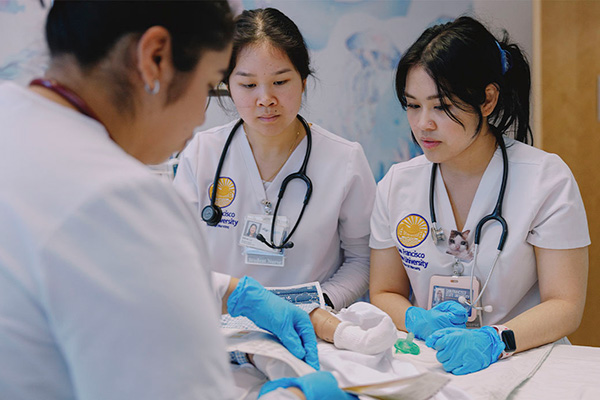
Sutter’s CPMC, part of Sutter Health, and San Francisco State University (SFSU) today announced a milestone in their partnership to advance pediatric nursing education through a $200,000 Sutter Health investment. The funding supports a new, fully equipped pediatric simulation room on the SFSU campus designed to strengthen hands-on training for future nurses in the San Francisco Bay Area. Through the collaboration, graduates are well-positioned to enter pediatric units better prepared, potentially reducing onboarding time and improving early-career readiness for employers like Sutter and others across the region.
The new initiative builds on a successful academic-clinical collaboration between Sutter’s CPMC and SFSU that began in 2024 to expand clinical placements for nursing students, an effort which allowed the University to increase enrollment in its Accelerated Bachelor of Science in Nursing Program by 25%.
“We are grateful to Sutter Health for their investment in our pediatric simulation lab. This partnership strengthens how we prepare our nursing students by giving them access to realistic pediatric training environments earlier in their education,” said SFSU President Lynn Mahoney. “It expands what is possible within nursing education and ensures our graduates are ready to serve the needs of patients and families as they transition from learning into practice.”
Pediatric workforce needs in the Bay Area
Hospitals and health systems across California continue to need more well-trained nurses across all nursing specialties, with pediatric care among the most specialized and difficult areas to staff. At the same time, limited clinical placement opportunities, also called clinical rotations, have constrained nursing program growth, even as demand for care continues to rise.
“As a profession, nursing continues to face significant workforce shortages,” said Elaine Musselman, Ph.D., RN, director and associate professor of pediatrics at SFSU. “Pediatric care is one of the most specialized and high-acuity areas where that gap is especially visible, due in part to fewer opportunities to train on complex cases and competition among nursing programs for clinical placements. Simulation-based learning helps bridge that gap by allowing students to practice critical skills in a safe environment before they reach the bedside. By providing a space for deliberate practice and error, we’re ensuring more consistent competency for our students, something employers look for in future nurse candidates.”
Preparing practice-ready pediatric nurses
The pediatric simulation room began pilot use in March 2026 and will be fully integrated into SFSU’s nursing curriculum in fall 2026. Once fully implemented, the space will support approximately 120 pre-licensure students each year— 80 students in the fall and 40 students in the spring.
The simulation environment, complete with a wireless infant manikin and hospital-ready equipment, is designed to replicate pediatric hospital workflows, including those used across Sutter facilities like Sutter’s CPMC. Inside the room, students get practice recognizing early signs of patient deterioration, administering IV therapy with syringe pumps, responding to pediatric emergencies and managing care across multiple patients. Their training also emphasizes communication with families and interdisciplinary care teams, including physicians and respiratory therapists, reflecting the realities of pediatric hospital settings.
Each simulation begins with a structured pre-briefing that establishes expectations and psychological safety. Students then participate in realistic clinical scenarios using a wireless manikin, followed by a guided debrief focused on clinical reasoning, communication and decision-making.
This hands-on approach to learning is designed to strengthen clinical judgment in pediatric care, where patients require distinct physiological assessment and communication strategies compared to adult populations. It also provides consistent exposure to high-risk, low-frequency pediatric emergencies that students may not regularly encounter during their clinical rotations.
“As nursing students transition into real-world care, Sutter Health aims to give them every advantage through training that aligned with the clinically excellent standards of our hospital units,” said Hollie Seeley, CEO of Sutter’s CPMC. “We are pleased to see the deepening of our partnership with SFSU and the ability for both our organizations to invest in the future of nursing through innovative, workforce-focused education.”
“It’s exciting to see a simulation space like this come to life and be put into practice,” said Lauren O’Neill, chief nurse executive at Sutter’s CPMC. “Exposure to complex pediatric scenarios is critical for nurses who want to work in these settings — even in a simulated environment. This type of immersive training at SFSU, made possible by Sutter Health, will also help address local and regional workforce needs by strengthening the pipeline of nurses who are confident in their pediatric care skills. We are grateful to the faculty and leadership at SFSU who saw this need and worked with us to make it a reality for this next generation of nurse caregivers.”
Photo by Corinne Allen
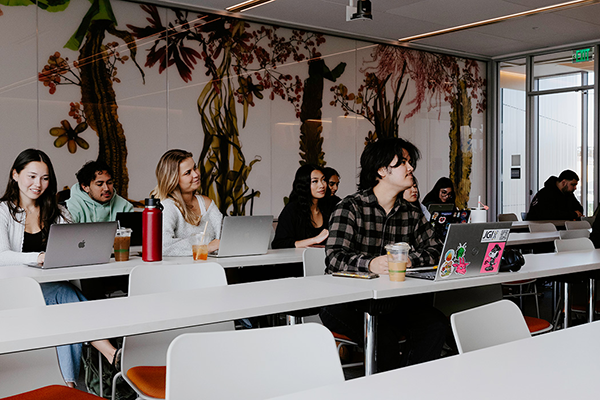
After hearing the positive things colleagues had to say about SFSU’s Promoting Inclusivity in Computing (PINC) program, Genentech scientist Will Thrift reached out to PINC Director Anagha Kulkarni with a proposal: collaborate on a course focused on protein artificial intelligence (AI). The result is “CSC 511: Protein Modeling with Deep Learning,” now giving SFSU undergraduates the opportunity to learn from a working Genentech scientist.
Taught by Thrift, the class launched in the spring of 2026. Undergraduates learn the fundamentals of deep machine learning (an AI approach that trains computer models to recognize patterns in complex data) as it applies to protein systems, protein property predictions, protein folding, generative and discriminative models, and more. Since many diseases originate from proteins misbehaving, AI can help predict how a protein may malfunction and support drug discovery.
“Protein modeling with deep learning is as cutting edge as it gets. And we get to have an industry practitioner — someone who knows the theory and practices the science — craft and lead the development of the course,” said Kulkarni. As a Computer Science professor and associate chair, she’s an expert in machine learning. But protein AI isn’t her area of expertise.
“My reaction to CSC 511 was excitement,” said Psychology senior Akemi Smart. “I felt proud that I was taking it. The school wanted me to succeed, and that’s a theme I felt throughout the PINC program.”
CSC 511 completes the sequence of classes required for the PINC minor and Data Science and Machine Learning for Biotechnology certificate. The PINC umbrella — programs and classes designed to make coding accessible for life science undergraduates — also includes a summer program, a scholarship, professional development opportunities, peer mentors in every PINC class and a comparable data certificate for professionals.
Although CSC 511 students can add skills like PyTorch (a popular platform for building AI models) and protein modeling to their resume, Thrift wanted students to walk away with more.
“Students are learning a mindset rather than a particular set of skills in the class. Especially in deep learning, things are moving so quickly that the specific things you learn in class are probably not what you’ll do day to day,” Thrift explained. “My goal with the class is to give students the mindset to not be fearful of topics and to really engage with them.”
CSC 511 just launched but it has already had a ripple effect on the PINC program. Although machine learning has been a part of PINC since the beginning, Kulkarni says CSC 511 underscores how the evolution of machine learning and AI can outpace standard university curriculum development.
“The role us educators play now is slightly different. We must give our students skills that are immediately usable,” Kulkarni said, explaining that PINC faculty will update other classes to better match CSC 511. “These kinds of partnerships really help us make that transition. I feel this needs to happen more and more.”
Over the years, SFSU’s partnership with Genentech has helped PINC do just this. Company scientists have visited and taught PINC classes and seminars, participated in professional development training, networked with students, provided Genentech tours and more. PINC graduates have found new career paths, enrolled in graduate programs and gone on to academic and industry internships and jobs — including some at Genentech.
“I want to go into the biotech or health care industry, which I never thought about before. It’s because of the passion of each Genentech employee we’ve spoken to,” Smart said. After graduation, she’ll start a master’s program in Communication Data Science at the University of Southern California. She plans to return to the Bay Area to start her career.
“It’s a big advantage to have the PINC program in San Francisco considering how big of a biotech hub is here, how innovative it is and how many startups there are. We’re an amazing city to start your career, to get your education. There are so many opportunities,” Smart added. “Programs like PINC are possible because of our location.”
PINC Managing Director Michael Savvides encourages students to join PINC as early as freshman year. “There is a large segment of the student body that thinks coding is too hard [and] impossible to learn. But we have successfully proven through several cohorts that you can enter this program and learn even if you have zero foundation in coding,” he said.
Photo by Alexander Villagomez-Miranda
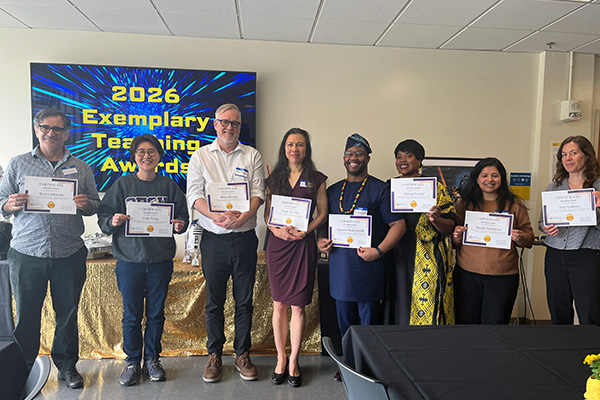
The Center for Equity and Excellence in Teaching and Learning (CEETL) is delighted to announce the winners of the 2026 Exemplary Teaching Awards, which recognize outstanding faculty who have made a significant impact on their students’ learning and development. Awardees were honored on May 4, 2 – 4 p.m., at the CEETL awards reception.
Awardees:
- Amy Latham, Lam Family College of Business
- Barbara Abadia-Rexach, College of Ethnic Studies
- Bo Ferns, Lam Family College of Business
- Brian Strang, College of Liberal & Creative Arts
- Bryce Johnson, College of Science & Engineering
- Hsiao Yun Chu, College of Liberal & Creative Arts
- Lena Yang, Lam Family College of Business
- Lionnell “Badu” Smith, College of Liberal & Creative Arts
- Shubhi Sachdeva, College of Health & Social Sciences
- Tiffany Caesar, College of Ethnic Studies
- Zia Davidian, J. Paul Leonard Library
Photo courtesy of CEETL
Dean Eugene Sivadas has announced that he will conclude his service as dean of the Lam Family College of Business on Thursday, Dec. 31, as he prepares to return to the faculty. Beginning Friday, Jan. 1, Dean Sivadas will rejoin the college as professor of Marketing.
Until the end of his deanship, he will continue to be fully engaged in leading the college, advancing its strategic priorities, supporting faculty and student success and strengthening key external partnerships.
“The University extends its deepest appreciation to Dean Sivadas for his distinguished leadership since joining SFSU in July 2020. Over the past several years, he has provided steady and visionary guidance, strengthening the college’s mission across teaching, research and engagement,” said Amy Sueyoshi, provost and vice president of Academic Affairs. “His leadership helped transform a $25-million philanthropic gift into seven strategic initiatives that expanded student engagement and enriched academic programming. The University is grateful for Dean Sivadas’ many contributions and lasting impact on the Lam Family College of Business and looks forward to his continued contributions as a valued member of the faculty.”
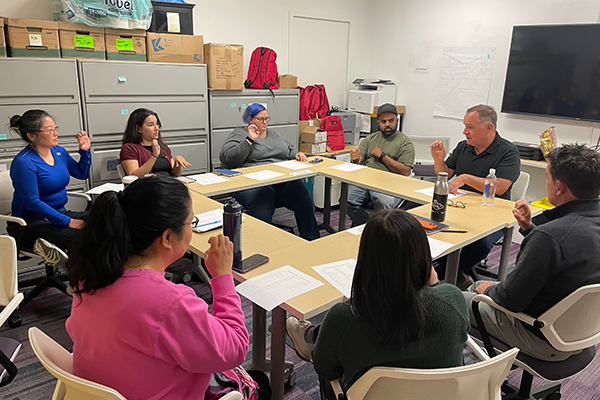
SFSU’s Office of Emergency Services recently teamed with lecturer Special Education Lecturer Faculty Peter deHaas for an American Sign Language (ASL) and Deaf Culture workshop focused on improving communication during emergency situations.
The session covered key emergency signs in American Sign Language along with practical strategies for interacting with deaf individuals in high-stress environments. Emphasis was placed on slowing down, avoiding assumptions and understanding how to access appropriate communication support when needed.
The workshop also reflects growing engagement across campus, with Office of Emergency Services Director Hope Kaye enrolled in ASL I this semester.
This work highlights ongoing efforts to strengthen accessibility and preparedness through collaboration and shared learning.
Environment, Health and Safety (EHS) is pleased to announce the appointment of Matthew A. Trujillo as director of (EHS) at SFSU.
Trujillo brings over 15 years of progressively responsible experience in environmental, health and safety leadership across California. His background includes senior management roles overseeing regulatory compliance, occupational safety, hazardous materials management and emergency response programs, along with extensive collaboration with agencies such as the California Division of Occupational Safety and Health and the California Environmental Protection Agency.
In his new role, Trujillo will oversee the planning, implementation and continuous improvement of programs designed to ensure regulatory compliance and minimize risk across campus operations. He will also serve as a key adviser to campus leadership on safety strategy and compliance obligations.
His experience directing multidisciplinary teams, responding to regulatory inspections and incidents, and developing effective training and compliance programs aligns strongly with the University’s commitment to maintaining a safe and healthy campus environment. He is noted for his collaborative leadership style and demonstrated ability to manage complex and sensitive matters.
You can reach out to Trujillo via email at matthew.trujillo@sfsu.edu.
On April 24 and April 25, M.A. students in Cinema and Media Studies hosted the 27th annual Graduate Cinema Conference, “Chronically Online: Fandom Across Media,” centering on fandom culture as a whole, participatory culture, queer fandom, and global fandom practices.
The conference featured keynote speaker David Church (M.A., Cinema, ’08), as well as graduate student presenters from SFSU and other institutions.
Tarae Mcqueen, Drew Persing, Levina Umali, Carson Burton and Sebastian Bustamante Ceja conceived, organized and ran the conference.
Students, staff and faculty are invited to meet with Provost Amy Sueyoshi in the summer and fall 2026 semesters during her open office hours. Meetings will take place 8 – 9 a.m. on a Thursday each month depending on her availability.
All meetings will be in the Provost’s Office (Administration 455). Breakfast refreshments will be provided.
Please reserve your time via Qualtrics to discuss any topics.
President Lynn Mahoney and Provost Amy Sueyoshi celebrated this year’s emeriti faculty at the Rites of Passage Luncheon held on Thursday, May 7, in the Vista Room. The gathering honored the faculty members’ years of dedicated service, scholarship, mentorship and lasting contributions to our students and University community.
CampusMemo will go on hiatus following the Tuesday, May 26, issue. Summer issues will be published on Monday, June 15, and Monday, July 13. Weekly publication will resume with the Monday, Aug. 17, issue.
The deadline for submissions is 5 p.m. the Tuesday preceding publication.
Submit your events to to the University Calendar.
For questions, please email the Office of Strategic Marketing and Communications at marcomm@sfsu.edu.
As SFSU employees, for a limited time you can receive 1% off your qualifying San Francisco Federal Credit Union HomeSolutions Loan rate. With low fixed rates and terms up to 180 months, check that project off your to-do list.
Use promo code HAPPYHOME. Terms and conditions apply. This offer ends Sunday, May 31. For more information, please visit the San Francisco Federal Credit Union website or email the home lending team at homelending@sanfranciscofcu.com.
After nearly 40 years of service as a professor of Public Health and associate dean of the College of Health & Social Sciences at SFSU, John Elia will retire on Wednesday, Aug. 19.
While Elia will retire as a college associate dean, he will join the Faculty Early Retirement Program and continue to teach Public Health and Sexuality Studies courses in fall semesters. He looks forward to continuing his long association with SFSU.
He earned bachelor’s degrees with honors in Physical Education (now Kinesiology) and History, and a master’s degree in History, from SFSU. He went on to earn a Ph.D. in education, with a specialization in the history and philosophy of American education, at the University of California, Davis. In recent years, he completed advanced study in the history of health sciences at the University of California, San Francisco.
Elia discovered his love of university teaching while an undergraduate as the chief teaching assistant for the storied “Variations in Human Sexuality” class at SFSU under the direction of Professor John Paul De Cecco. He became a lecturer in 1987 as a yearlong sabbatical replacement for De Cecco and taught the “Variations” class in McKenna Theatre to 800 students with the aid of 20 teaching assistants each semester. That year’s “temporary” teaching stint led to 13 additional years of being a full-time lecturer in Sexuality Studies, Psychology and Health Education (now Public Health).
In 2001, he began a tenure-track professorship at SFSU and was promoted to full professor of Health Education in 2009. He served as associate chair of the department from 2003 to 2014 under the long-term chair, Mary Beth Love.
A testament to his love of teaching, Elia earned the Sarlo Excellence Award in Teaching in 2010. He taught a diverse selection of 21 courses at the undergraduate and graduate levels during his tenure at SFSU.
In 2014, he was appointed associate dean of the College of Health & Social Sciences, serving under Dean Alvin Alvarez, and more recently, under Dean Andreana Clay. Elia’s achievements as associate dean have included founding the CHSS Teaching Academy; the CHSS Task Forces on Teaching, Scholarship and Service; the CHSS Lecture Series; and the CHSS Faculty and Staff Excellence Awards programs.
Additionally, he served as the principal investigator for two five-year cycles of a $1.3-million TRIO/SSS grant through the U.S. Department of Education. It funds the college’s Student Outreach and Academic Retention program, which is devoted to serving low-income and first-generation college students. Elia extends his gratitude to David Woo for drafting the grant application and to JC Gonzalez for his exemplary directorship of the program.
Elia’s scholarly contributions have included several edited books, peer-reviewed scholarly journal articles, book chapters and encyclopedia entries, which have focused on historical and philosophical aspects of sexuality education, LGBTQIA+ studies and the history of public health.
For nearly two decades, he has been the editor-in-chief of the Journal of Homosexuality, a landmark international peer-reviewed scholarly journal, which was among the very first in gay and lesbian studies and sexuality studies in general. Currently, he and his colleague, Mickey Eliason, have a contract with Rutgers University Press to publish a book on the sociopolitical and historical factors that led SFSU to create the first undergraduate program in Sexuality Studies in the nation.
The SFSU Academic Senate met on Tuesday, May 5, via Zoom.
The Senate:
- Presented the following informational items:
- Bachelor of Arts in Classics: suspension
- Passed the following items:
- Policy of restructuring academic units, No. S25-290
- Department Chair and Equivalent Unit Director Policy, No. F25-145
- Policy on Student College Advisory Committee
- Resolution Condemning Attacks of Civilian Infrastructure and Affirming Commitment to International Humanitarian Law
- Heard in first reading:
- Policy on Abrasive Behavior/Bullying
- Grade Appeal Practices and Procedures, F24-230
- RSCA Accountability Resolution
The SFSU Academic Senate will meet on Tuesday, May 12, 2 – 5 p.m., at Seven Hills Conference Center for its 15th meeting of the academic year.
- 2025 – 2026 Senate, Final Plenary (time approximate: 2 – 2:45 p.m.)
- Recommendation from Executive Committee:
- Resolution Commending and Thanking Senators Completing Terms of Service on the Executive Committee: consent item
- Certificates of Recognition
- Presentation by the Distinguished Faculty and Staff Awards Committee: “Awarding Recipients of Distinguished Faculty and Staff Awards” (time approximate: 2:30 p.m.)
- Recommendation from Executive Committee:
- 2026 – 2027 Senate, Opening Plenary (time approximate: 2:45 – 3:45 p.m.)
- Welcome from Senate chair
- Election of chair, vice chair, secretary, at-large positions and standing committee chairs
This spring, the Library’s Wellness Weeks programming expands throughout the building.
All the end-of-semester support usually packed into Events Room 121 will instead be spread throughout the Library starting the week before finals:
- Study break stations on multiple floors — look for the signs!
- Free snacks for students near the Book Checkout and Pickup Desk
- Crafternoon-style crafting pop-ups
- Information hubs with research tips and campus support resources on the first and second floors
- Visiting therapy dogs on Tuesday, May 12, in partnership with Gator Health and Well-being
The Library will also be open extended hours to support students during the final crunch, Wednesday, May 10 – Friday, 22:
- Monday – Thursday, 7 a.m. – midnight
- Friday, 7 a.m. – 7 p.m.
- Saturday and Sunday, noon – 9 p.m.
The Digital Media Studio and MakerSpace hosts a “Podcasting 101” event on Tuesday, May 12, noon – 1 p.m., in Library 260. It is open to all SFSU students, faculty and staff. Learn the basics of podcasting, including recording, editing and publishing.
An RSVP is required. Please RSVP for “Podcasting 101” via the Academic Technology website.
The Environment, Health and Safety department is proud to announce that the annual electronic waste disposal Event will take place Wednesday, May 12 – Thursday, May 13, 11 a.m.– noon., on the Creative Arts quad.
For questions, please email Dipak Janda at dipakjanda@sfsu.edu.
Human Resources will host the last Staff Forum of the semester on Wednesday, May 13, 11 a.m. – noon, via Zoom. All SFSU staff, except management personnel plan employees and faculty, are encouraged to attend to keep up on SFSU happenings.
This Staff Forum includes remarks from President Lynn Mahoney and updates about the San Francisco Bay Regional Network, AdobeSign, 25Live and Human Resources.
The University Budget Committee (UBC) invites employees to its last meeting of the spring semester on Thursday, May 14, 10 a.m. – noon, via Zoom.
Agenda items include fall 2026 enrollment, Voluntary Separation Incentive Program savings and updates from UBC work groups.
UBC members host a drop-in office hour on Friday, May 15, 11 a.m. – noon., via Zoom, for faculty and staff for conversations about budget-related concerns.
UBC meetings will resume in the fall.
To RSVP for the UBC meeting, please email UBC at ubc@sfsu.edu.
Following the search committee’s final review process for the dean of the University Library position, Interim Dean Christy Stevens has been selected to advance as the finalist for the position. The campus community is invited to attend her public presentation and interview on Wednesday, May 13, at 2 p.m. in Library 244. A Q&A session and light reception will follow.
Each spring semester the Health Equity Institute (HEI) pairs graduate students with faculty mentors to collaborate on health equity research projects. This semester six HEI student scholars will present their contributions in a research poster that highlights key insights from their experience and findings. The showcase will take place Thursday, May 14, 3:45 – 5 p.m., in Burk Hall 410. Refreshments will be provided.
Please RSVP via Google Forms for the Health Equity Student Scholar Research Showcase.
The Digital Media Studio and MakerSpace hosts the “iOS Appathon Competition” showcase on Thursday, May 14, 3:30 – 5 p.m., in Library 260. It is open to all SFSU students, faculty and staff.
Student teams will demonstrate their iOS apps solving real-world problems and showcase creativity, design and technical skills in a fast-paced, judged competition. They will compete for prizes and recognition.
An RSVP is required. Please RSVP for “iOS Appathon Competition” via the Academic Technology website.
The Digital Media Studio and MakerSpace hosts a “Cricut Mug Deco” workshop on Friday, May 15, noon – 2 p.m., in Library 260. It is open to all SFSU students, faculty and staff.
Join us and you’ll design and decorate your own mug using the Cricut cutting machine. Bring your own mug to personalize or use one of our limited mugs, provided on a first-come, first-served basis.
An RSVP is required. Please RSVP for “Cricut Mug Deco” via the Academic Technology website.

Students from the Apparel Design and Merchandising program present their semester-long research project in an exhibit titled “Uggs, Vans and Doc Martens.” The exhibition is in the J. Paul Leonard Library on the first floor by the circulation desk. It opened April 21 and will run through Monday, May 18.
Environment, Health and Safety will host a certification and recertification training in first aid, Cardiopulmonary Resuscitation (CPR) and Automated External Defibrillator (AED) on Tuesday, May 19, 8 a.m. – 4 p.m., in Library 121. The training courses will be split into two four-hour sessions.
SFSU Spotlight
Why does qualitative research still have to prove its legitimacy? Qualitative research in implementation science reveals how healthcare functions through individuals’ experiences, specific challenges, and the complex realities of practice. However, qualitative research is frequently assessed using criteria designed for quantitative studies, which overlooks its unique contributions.
A recent article in Implementation Science by Communication Studies Professor Christopher Koenig, Andrea L. Nevedal, Christine P. Kowalski, Erin P. Finley, Gemmae M. Fix and Alison B. Hamilton addresses this issue directly. It is titled “Optimizing qualitative methods in implementation research: a resource for editors, reviewers, authors, and researchers to dispel ten common misperceptions about qualitative research methods.”
Collaborating with experienced qualitative researchers, they identify 10 misconceptions that influence how qualitative research is evaluated by journal editors and peer reviewers. Some misconceptions stem from applying inappropriate quantitative standards, such as expecting representative sample sizes or statistical analysis. Others arise from inflexible assumptions about qualitative methodology.
This article moves beyond merely identifying these issues. For each misconception, the authors provide practical strategies to address critiques and promote fairer evaluation. When qualitative research is assessed according to its own principles, studies are strengthened, and overcoming implementation barriers can lead to improved processes and better healthcare outcomes.
A new publication highlights collaborative work across Scherr Nutrition Science Consulting and the Family, Interiors, Nutrition and Apparel Department. Nutrients recently published “Building Food Literacy in Adolescence: A Pilot Study of the Teens CAN Curriculum” by Emily Sklar, Tonya Xie, Professor Gretchen L. George, graduate student Rebecca Crosby, Marcela D. Radtke, Sheri Zidenberg-Cherr and Lecturer Faculty Rachel Scherr.
The pilot study explores the Teens CAN curriculum as a promising strategy to build food literacy among adolescents and support healthier, informed decision-making.