News and Announcements
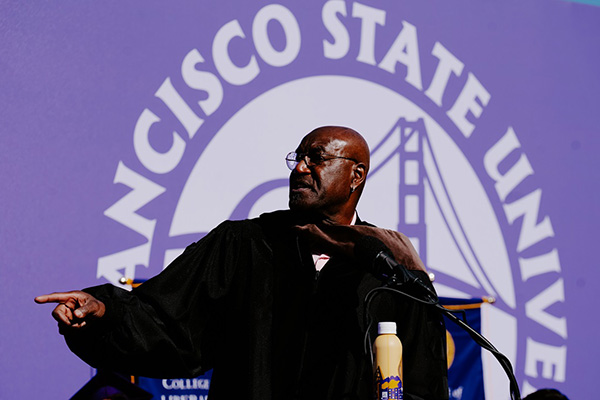
Oscar-nominated actor Delroy Lindo (B.A., ’04) urged the Class of 2026 to create opportunities for themselves and others at SFSU’s 125th Commencement ceremony, held May 21, at Oracle Park, home of the San Francisco Giants.
Extending the celebration beyond the ballpark, Salesforce Tower lit up the San Francisco skyline with student-created artwork honoring this year’s graduating Gators.
Speaking to a crowd of more than 30,000 graduates, family members and supporters at Oracle Park, Lindo encouraged students to embrace ambition, resilience and the values they developed at SFSU.
“Set goals for yourselves, you guys, as clearly and specifically as you’re able, as I did,” said Lindo, a 2026 Academy Award nominee in the Best Supporting Actor category for his performance in “Sinners.” “And know this — your definition of success is the only definition that matters.”
An SFSU alumnus and member of the SFSU Foundation Board of Directors, Lindo described speaking at Commencement as “a homecoming of sorts” and praised the University’s longstanding commitment to expanding access and opportunity.
“What I’ve always appreciated about State is that it’s an institution priding itself on creating opportunity where opportunity has not previously existed,” Lindo said.
He also encouraged graduates to take pride in what they had already overcome to earn their degrees.
“Don’t forget who you are, where you came from, what you come from, and embrace that,” he said. “Be bold, be proud. Because you all deserve it.”
The ceremony celebrated 7,269 graduates, many of whom balanced work, family responsibilities and other challenges while earning their degrees. SFSU President Lynn Mahoney praised the class for its commitment and tenacity, noting that many students began their academic journeys during the COVID-19 pandemic.
“You learned to navigate a virtual world and became part of the generation that helped us move beyond the challenges of the pandemic and reconnect in innovative ways,” Mahoney said. “You are exemplars of resilience and success.”
Mahoney also emphasized the University’s mission of educational equity, highlighting the many first-generation college graduates in the Class of 2026 and recognizing the 210 student veterans earning degrees this year.
In addition to delivering the keynote address, Lindo received an honorary Doctor of Fine Arts degree. He was recognized alongside muralist and educator Juana Alicia and broadcast journalist Wendy Tokuda, who also received honorary doctorates during the ceremony.
Student speakers reflected on the personal and academic journeys that brought them to Commencement.
Graduate student speaker Tanya Aghazadeh shared how perseverance carried her through the demands of working full time while pursuing her degree. “Today is not only a celebration of a degree — it’s a celebration of everything we overcame to get here,” she said.
Undergraduate speaker Orlando Mayen-Castañeda described overcoming housing instability and self-doubt to pursue his passion for astronomy. He credited mentors and community at SFSU for helping him stay on track, encouraging his fellow graduates to support others in turn.
“Be the reason somebody keeps going,” he said. “Because your story matters. Your voice matters. And the world needs what only you can offer.”
At the close of the ceremony, graduates marked the milestone by moving their tassels from right to left — officially becoming members of SFSU’s global alumni community of more than 300,000.
“You have and will make us proud,” Mahoney said.
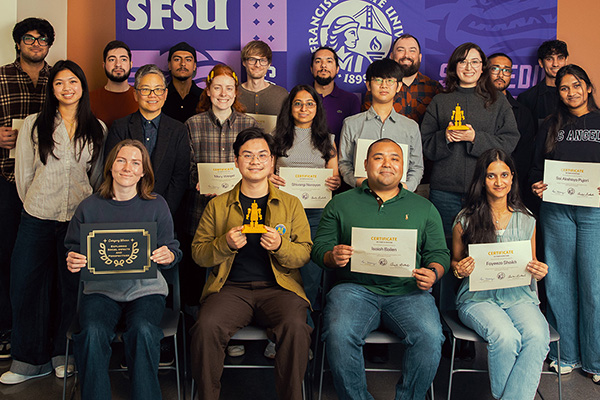
SFSU recently recognized the winners and participants of its first Student AI Awards, which showcased student projects that explored the possibilities and implications of artificial intelligence across disciplines.
The awards, presented May 5, celebrate original student work that engages AI through innovation, critical analysis and real-world problem solving. This year’s winning projects reflect a range of approaches, from examining bias in AI systems to building tools that improve workflows and support workers.
Among the winners is Claudia Wormley, a Software Engineering student, whose project, “Encoding Inequality: How Social Prejudice is Passed into AI,” earned recognition in the Exploring Societal Impacts and Perspectives category. Her work examines how artificial intelligence systems can reinforce inequities.
“My project explores how artificial intelligence systems inherit and amplify the systemic biases that exist in society,” Wormley said. “AI models are trained on historical data that reflects patterns of prejudice, discrimination and exclusion.”
Wormley said her research highlights the urgency of addressing bias as AI becomes more embedded in everyday systems. “Through my paper, I wanted to highlight the urgency of this harmful design and emphasize the need for policy and regulation to reduce the harmful impacts of AI bias,” she said.
She traced her inspiration to investigative reporting on algorithmic bias in the criminal justice system. “It was incredibly impactful seeing the blatant racial bias the audit revealed,” Wormley said. “This was the first of many cases I discovered in which biased AI was being implemented in critical spaces reinforcing existing inequalities against already vulnerable groups.”
Wormley said her academic experiences shaped her perspective on responsible technology. “I feel a responsibility to understand and critically examine the role AI plays in society,” she said. “As I prepare to enter the professional world, I want to prioritize responsible development and advocate for technology that serves the public interest.”
She encourages other students to approach AI thoughtfully. “AI can be an incredibly powerful tool, but it should enhance your abilities, not replace them,” Wormley said. “I also encourage students to focus on developing the kinds of skills AI can’t easily replace, like critical thinking, creativity and empathy.”
Student recognized for innovation
Within the Student AI Awards’ Innovation category, the winning project, "Shipyard,” highlights how AI can support innovation and entrepreneurship. Developed by Kareem Amin, the platform streamlines hackathon management, improving submissions, judging and event operations.
Since its launch, Shipyard has supported more than 1,000 users and nine hackathons, including SFSU’s annual SFHacks. Amin said his experience attending hackathons inspired him to build a more consistent system. “I kept seeing the same problem over and over again, which was that hackathons were just really inconsistent with each other,” he said. “So eventually I was like, ‘OK, I’m going to fix this.’”
Amin said AI became a key part of both building and growing the platform. “There is a lot of baggage with AI, and it can be good or bad, but I think a lot of it comes down to experimentation, preferably in low-stakes environments,” Amin said. For Amin, the value of AI lies in how it supports outcomes rather than replaces human judgment.
‘AI that enhances human capabilities’
The third winning project, in the awards’ Problem Solving with AI category, “BlueCore AI” focuses on improving working conditions in high-pressure environments. The project was developed by Kataliya Sungkamee, Giovanna Gomez, John Tatlonghari and Arman Daghbashyan.
“BlueCore AI is a human-centered AI prototype designed to support maritime workers by reducing administrative burden and improving operational well-being,” Gomez said. “We approached AI as a support system that enhances human capability rather than replacing people.”
The project emerged through SFSU’s participation in the SUGAR Network, which connects students with industry challenges. “We were introduced to challenges within the maritime industry, particularly fatigue, workforce decline and operational strain,” Gomez said. “That pushed us to explore how AI could reduce invisible administrative stress while still keeping human needs, safety and decision making at the center of the solution.”
Gomez said her studies in Information Systems shaped the team’s approach. “My coursework has taught me that technology is not just about systems or automation, it is also about people, processes, ethics and implementation,” she said. “That perspective shaped how we designed BlueCore AI.”
Teammate Kataliya Sungkamee said the project also influenced her academic and career direction. “This project genuinely shifted everything for me,” Sungkamee said. “That full ownership showed me exactly what I love to do: design thinking.” She added that working with AI accelerated both the project and her own growth. “It pushed me to find and learn tools I’d never touched before and to immediately show up as a self-starter,” she said.
Sungkamee encouraged students to engage with AI intentionally. “The goal isn’t to work alongside AI like it’s a coworker doing half the tasks,” she said. “It’s to use AI as a way to push your own growth forward faster than you could on your own.”
Gomez also emphasized the importance of understanding AI’s broader capabilities. “People hear the word ‘AI’ and often reduce it to chatbots or automation, but AI has the ability to process massive amounts of information, recognize patterns humans might miss and help uncover insights,” Gomez said.
For students hesitant to engage with AI, Gomez offered a direct message. “AI is not going anywhere,” she said. “In many ways, it acts like a tool for amplifying human understanding.”
Reflecting on the technology’s role, she added, “AI should be viewed as a tool for augmenting human capability and decision making, not simply as a replacement for human work.”
For Andrew Roderick, assistant vice president of Academic Technology, the program’s first year underscored the range of student thinking on AI.
“The awards showed us that SFSU students bring a lot to the table and do not think monolithically about AI. The breadth of submissions was amazing, and we know there is more great student thinking centered on ethics, innovation and human impact that we want to surface for next year’s awards. It really underscores the incredible talent SFSU is sending into our communities and workforce.”
All the projects submitted to the first annual SFSU Student AI Awards are available on the SFSU’s AI website. You can also view the entire AI Awards Ceremony on YouTube.
Photo by Christian Alvarado
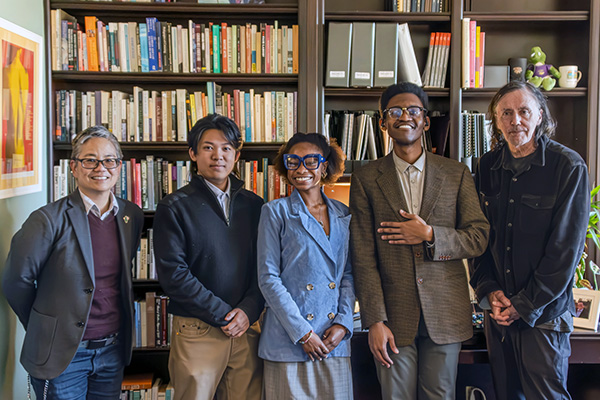
Earlier this month, Provost Amy Sueyoshi presented three Labor and Employment Studies students — Jordan Isaiah Edmonds, Leila Walton and Nico Wang — with the Yetta K. Zetoony Labor Studies Scholarship.
“I discovered Labor and Employment Studies as the best way to fulfill my desire to collaborate with others from similar backgrounds and create change,” Edmonds, who will graduate in spring 2027, wrote in his scholarship application. “Now, I have clear goals thanks to my academic journey, and my future no longer feels bleak.”
Walton, who transferred to SFSU from a historically Black college in the South, is a homecare worker in Contra Costa County. She will soon start internships with the Urban League and the mayor of Vallejo, where she lives and commutes by ferry to SFSU. She has also been offered a paid internship through the nationally competitive UC Berkeley Labor Studies program.
Wang just finished an internship with the Boys and Girls Club of San Francisco and will graduate in spring 2027.
Photo by Kyle Dong
The primary election is coming up on Tuesday, June 2. SFSU will host a polling place at Annex 1, open 7 a.m. – 8 p.m. on Election Day. Whether you’re a student, faculty, staff member or community resident assigned to this polling location, you can cast your ballot conveniently on campus.
Beforehand, please be sure to:
- Check and update your voter registration.
- Select a language preference for election materials.
- Consider serving as a poll worker to assist voters at local polling places.
- Share election information with your networks.
CampusMemo will go on hiatus after today’s issue. Summer issues will be published on Monday, June 15, and Monday, July 13. Weekly publication will resume with the Monday, Aug. 17, issue.
The deadline for submissions is 5 p.m. the Tuesday preceding publication.
Submit your events to to the University Calendar.
For questions, please email the Office of Strategic Marketing and Communications at marcomm@sfsu.edu.
The Digital Media Studio and MakerSpace will be open during the summer. Starting Tuesday, May 26, it is open Mondays – Fridays, 10 a.m. – 5 p.m. Semester hours (Mondays – Thursdays, 10 a.m. – 7 p.m.; Fridays, 10 a.m. – 5 p.m.) will resume on Monday, Aug. 24.
The AI Literacy Education Program equips the SFSU community with essential knowledge and skills to effectively and responsibly engage with generative artificial intelligence (AI). The summer 2026 intensive course schedule is now available! Earn your badge in one day or catch up on course offerings in early summer.
Two intensive days of programming are being offered: Friday, June 5, and Wednesday, June 10.
Please visit the SFSU AI website to register for the AI Literacy Education Program.
SFSU Spotlight
Marc Stein, the Jamie and Phyllis Pasker Professor of History, received a review for his latest book, “Bicentennial: A Revolutionary History of the 1970s” (University of Chicago Press), in The New Republic on May 15.
“‘Bicentennial’ dares readers to believe that American independence is worth commemorating, in the face of countless existential threats to the country and to the world,” reviewer Rebecca Brenner Graham wrote.
Ellen Christensen, assistant professor of Visual Communication Design, contributed “Seen and Unseen: Mediated Cultural Landscapes of the Everyday on Zoom,” the concluding chapter in “Visual Ecologies of Placemaking” (Bloomsbury Visual Arts), edited by Leslie Atzmon and Pamela Stewart. Contributing to a growing discourse in spatial humanities, the collection of essays provides a unique, critical insight into how place is shaped through visual and sensory practices.
Recreation, Parks and Tourism Professor Erik Peper attended the 56th meeting of the Association of Applied Psychophysiology and Biofeedback, held May 13 – 16 in Baltimore.
He presented “What we can learn from healers, yogis and Sufis” as part of the symposium “Emotion as expectations as medicine: How beliefs about pain change the brain.” He coauthored the poster “Enhancing self-regulation in fire service personnel: Two case studies in biofeedback and stress management training.”
The Archives of American Art (AAA) recently announced that the Rodger Birt Papers are now available for researchers. Birt is a professor emeritus of Humanities and American Studies.
His collection at the AAA consists of his research files on the history of photography, especially the celebrated Black photographer of Harlem, James VanDerZee, the subject of Birt’s co-authored monograph, “VanDerZee: Photographer, 1886 – 1983,” published by the National Portrait Gallery in 1993.
The Rodger Birt Papers at the AAA also include Birt’s own photographic work.
The AAA, a branch of the Smithsonian Institution, is among the most prominent U.S. archival repository for the arts.