News and Announcements
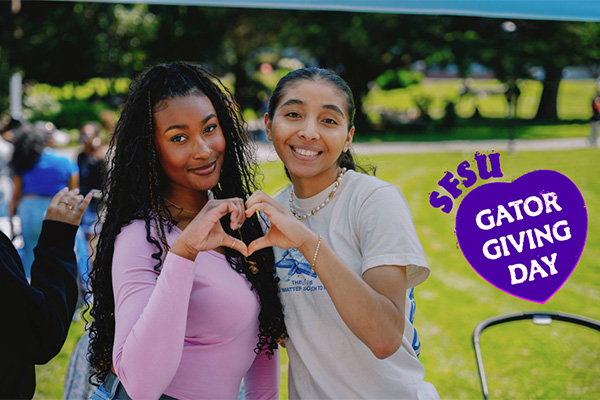
SFSU hosts its second annual Gator Giving Day on Wednesday, March 18, in celebration of the University’s founding in March of 1899. The 24-hour online event begins at midnight and runs through 11:59 p.m. More than 100 campus groups — including colleges, schools, departments, student organizations and clubs — will participate. Find a cause you love and support it by visiting the Gator Giving Day page.
Want to help spread the word? Sign up as a Gator Giving Day advocate to receive a personalized sharing link and helpful tips.

SFSU has been named a Gilman Program 25th Anniversary Top Producing Institution, earning national recognition for its long-standing commitment to expanding access to study abroad opportunities.
This week, the U.S. Department of State recognized SFSU for having a high number of students receive the Benjamin A. Gilman International Scholarship over the program’s 25-year history. The University was also noted for its success in making international education accessible to diverse and high-need students.
In 2025 alone, 22 SFSU students studied abroad with support from the Gilman Scholarship. Altogether, students received $41,000 in awards, with individual scholarships ranging from $3,000 to $8,000.
For Jason Reyes, who studied at the University of Amsterdam in the Netherlands for a semester, the Gilman Scholarship was transformative.
“Receiving the Gilman scholarship has oriented my academic and professional goals toward a more globally integrated path,” Reyes said. “I am much more well-rounded in my field now that I have experienced it in very different settings. I have gained skills and knowledge and had access to learning materials that I would not have otherwise been able to access. Ultimately, I graduated much faster by studying abroad and created many strong relationships with my professors, both at home and abroad.”
Angelique Shara Persails, who studied in Madrid, Spain said that receiving the Gilman scholarship was a main factor in her ability to study abroad last year.
“With the help of Gilman and the campus Study Abroad office, I was able to turn my dreams of traveling into reality. This opportunity has taught me a global perspective and supported my work as a journalist through lived experiences and cross-cultural exploration. Thanks to the Gilman Scholarship offered here at SF State, my work is more well-rounded, and I have gained the confidence and adaptability required to enter my field after graduation.”
“When you step beyond your borders, you don’t just discover the world; you discover yourself in it,” said Janelle Waldrep, who advises students applying for the scholarship alongside colleague Mark Belocura. “San Francisco State University has a long, proud history of supporting diversity of participants in education abroad, including but not limited to the minoritized, first-generation college students and transfer students. We feel that the Benjamin A. Gilman International Scholarship is a fundamental piece in that support. We enjoy a shared goal with Gilman in increasing diversity in education abroad.”
Belocura added that personalized advising and application coaching help students see studying abroad as achievable. “For many students, cost is the biggest barrier,” he said. “We work closely with them to navigate the application process and tell their stories in a compelling way.”
According to the Institute of International Education, one of the most common regrets among college graduates is not studying abroad. Yet for many SFSU students, it can feel financially out of reach. The Gilman Scholarship, which is open to U.S. citizen undergraduates who receive Pell Grants, helps bridge that gap.
SFSU offers study abroad programs in 36 countries, with options available for students in all majors. Through the University’s exchange model, students pay the same SFSU tuition while abroad, continue receiving financial aid and earn resident credit that keeps them on track for graduation.
Megan Chow, who spent a semester at Chung-Ang University in South Korea, documented her experience in a blog, offering practical tips on planning and financing a study abroad journey.
Students interested in exploring international opportunities can browse programs in the SF State Abroad Database, which includes options across six continents.
With national recognition from the U.S. Department of State and continued support for high-need students, SFSU’s message is clear: studying abroad is not just possible, it’s within reach.

Studies have shown that one must practice for 10,000 hours to master their craft. Zach Pereyra completed a lofty number of his hours at San Francisco State University before earning his first Grammy Award nomination this year.
Pereyra’s Grammy nomination came in the Album of the Year category as the mastering engineer for “Let God Sort Em Out,” performed by the Clipse with production by Pharrell Williams.
Pereyra (B.A., ’17) credits SFSU’s Broadcast and Electronic Communication Arts (BECA) Department for helping him discover his career path. He found a home in the campus music recording studio that was helmed by Professor John Barsotti beginning in 1973. Barsotti, a respected audio engineer, became a mentor to Pereyra.
“He had all these old two-track, four-track, eight-track tapes,” Pereyra said. “One semester, I did an independent study program with him. I would refurbish some of the tapes a little bit, and then I would transfer his old recordings from the 1970s and 1980s, to archive them digitally.
“I didn’t know it then, but the reel-to-reel tape machine that we had is one of the gold standards when it comes to mastering music,” he added. “There have been times within the last couple years when I’ve had to use that type of tape machine.”
When Pereyra wasn’t in the studio, he could often be found at the student-run radio station, KSFS. He and his friends had a show where they improvised to make beats live on air. Pereyra also broadened his horizons by taking electives in areas such as Music and Cinema. While taking a Journalism class, he met his future wife, Mackenzie Guthrie (B.A., ’17), now a marketing and communications specialist.
As a mastering engineer, Pereyra begins his work after the music is recorded and mixed. He makes final adjustments to all sonic components, including enhancing tracks to taste and the sequencing of albums.
“I’m the last set of ears to come in and be an objective listener,” he said. “It is my goal to ensure that the emotion of a record is achieving what the intention is supposed to be. It’s inherently musical and sometimes technical, but also, I find sometimes there’s some psychology to it. We’re so close to the finish line, and it’s my job to make everybody feel like we’re done and ready to go.”
Pereyra grew up in the Los Angeles area and entered SFSU as a Gators baseball recruit. His first-ever trip to 19th and Holloway came, however, when he was 9 or 10 years old, to visit an older sister living in an SFSU residence hall. “I knew that if I could make it work, I would go there,” he said.
Pereyra now works out of the storied Larrabee Studios in North Hollywood, founded by Carole King and Gerry Goffin. He was relentless about getting his foot in the door at Larrabee once he and Guthrie moved to Southern California three years after SFSU.
“I kept calling until I got an interview to be a studio runner, taking food orders, taking out the trash, cleaning the bathrooms and stuff,” he said.
It’s safe to say Pereyra has far exceeded his 10,000 hours of training. He has mastered more than 1,000 songs, garnering 45 billion streams worldwide. His upcoming projects include albums from Charlie Puth and Lizzo.
Pereyra and Guthrie reflect upon their SFSU years often.
“Oh, man, I loved it. It was the coolest,” he said. “I remember vividly experiences in the Creative Arts building, working on projects, hearing music and then walking outside and there’s a demonstration or protest. Passion and creativity all over.”
Learn more about the Broadcast and Electronic Communication Arts Department.
Photo by Casey Orozco
Climate HQ congratulates faculty members and collaborators for their 2025 – 2026 Climate Justice Mini Grants.
- Miguel Abad, assistant professor of Child and Adolescent Development, and Alondra Aragon, youth organizer with PODER. Their project, “Solidarity in Motion: Youth Leadership and Climate Justice in Yelam,” focuses on creating youth participatory action research opportunities that strengthen youth voice in water and land management planning and decision making in Yelamu (San Francisco). The work will advance two youth led climate and environmental justice projects: a public education bike tour on local climate justice and a youth participatory action research inquiry utilizing photovoice methodology.
- Kai Burrus, professor of Biology; Carina Anttilla-Suarez, professor at Skyline College; Bibi Traut, professor at City College of San Francisco; Karen Hurst, professor at San Jose City College; Peter Roberts, professor at Contra Costa College; and Jeff Watanabe, professor at Ohlone College. Their project, “The Invisible Workforce of Climate Resilience: Microbial Indicators for Oyster Reef Restoration in San Francisco Bay,” focuses on reef microbial communities — the vast, unseen collection of bacteria and other microorganisms living in oyster habitat — and their patterns across the broader Bay Area. The work centers on establishing the first comprehensive Bay-wide microbial baseline by expanding monitoring to six community college partner sites.
- Fernando Carvalho, associate professor of Industrial Design; Katharyn Boyer, professor of Biology; and Josie Iselin, designer and author at Above-Below. Their project, “Living Seawalls of the Bay,” builds on previous successes of the now three-year-old Biodesign Challenge program in the School of Design, combined with the Estuarine and Ocean Science Center’s commitment to bring in artists and designers into interdisciplinary projects that recognizes the power of creative thinking and storytelling to the advancement and spread of transformative scientific knowledge. This grant will support the project team and its 2026 Biodesign Challenge class student group to represent SFSU in the Biodesign Challenge, an international competition that, for the past decade, has taken place over the summer in New York City at Parsons New School of Design and the Museum of Modern Art, involving more than 50 educational institutions around the world.
- Nancy Carmona, assistant professor of Public Health; Aritree Samanta, associate professor in the School of the Environment; and Jonathon Stillman, professor of Biology. Their project, “Advancing Reproductive Justice through Community-Engaged Climate Research,” focuses on the relationship between climate change’s impact on extreme heat events and social vulnerability. The work centers climate justice by examining how extreme heat events contribute to maternal health disparities and explores lived experiences of frontline community-serving organizations and community members.
SFSU’s 125th Commencement ceremony will take place Thursday, May 21, at Oracle Park, home of the San Francisco Giants. Staff and faculty are invited to serve as Commencement ambassadors and help support our graduates and their families during this historic milestone. Your participation plays an important role in creating a meaningful and memorable celebration for the entire SFSU community.
For 2026, the ceremony has been moved up by two hours. As a result, ambassador shifts will end significantly earlier than in previous years. Ambassadors will be scheduled 11:30 a.m. – 7:30 p.m., rather than until 9:30 p.m.
All ambassadors are asked to receive approval from their supervisor and attend an informational training on Monday, May 18, 10 – 11 a.m., via Zoom, for their assignment.
Many assignments involve large amounts of walking and standing. If you require accommodations, please indicate your needs on the sign-up form under “Questions or requests.”
The University thanks you for helping make Commencement a special experience for our graduating students and their families.
Please register to become a Commencement ambassador via the Alumni Association website.
For questions, please email Dania Russell at drussell@sfsu.edu.
SFSU’s 125th Commencement ceremony will take place Thursday, May 21, at Oracle Park in San Francisco. This milestone event brings together our graduates their families and friends to celebrate years of dedication and achievement. Faculty members are invited to serve as faculty marshals and play a vital role in supporting our graduates on this important day. Your presence adds warmth, guidance and a strong sense of community to this special day, helping ensure a smooth and meaningful Commencement experience for the Class of 2026.
For 2026, the ceremony has been moved up by two hours. As a result, faculty marshal shifts will end significantly earlier than in previous years. Faculty marshals will be scheduled 1:30 p.m. – 7:30 p.m., rather than until 9:30 p.m.
All faculty marshals are asked to attend an informational training on Monday, May 18, 1:30 – 2:30 p.m., via Zoom for their assignment.
Many assignments involve large amounts of walking and standing. If you require accommodations, please indicate your needs on the sign-up form under “Questions or requests.”
Please register to become a faculty marshal via the Alumni Association website.
For questions or more information, please email Ken Maeshiro at kmaeshir@sfsu.edu.
“Explore SFSU: Admitted Student Day” is the University’s signature spring event for admitted students and their families — a day for them to visit campus, make connections and learn about life as a Gator. It will take place Saturday, April 11, 9 a.m. – 2:30 p.m.
Please consider serving as a general ambassador for wayfinding, greeting, setup, etc., to assist in making this a great experience for our guests and a great success for our University. Ambassador shifts are 7 a.m. – 2:30 p.m. Lunch will be provided for all who help for the day.
Please sign up via Qualtrics by Friday, March 27, to be an “Explore SFSU” ambassador.
This is a reminder to complete the second course in the “Return of the JEDI PIE” certificate series, “Do or Do Not,” by Friday, March 20, to receive the $250 stipend.
This asynchronous course (8 – 10 hours) is supported by in-person workshops and focuses on practical Justice, Equity, Diversity and Inclusive (JEDI) teaching strategies. Modules cover accessibility and universal design for learning, creating a social justice syllabus, data-informed teaching, transparency in teaching and learning, equitable grading and centering student voice and experience. Participants who complete it by March 20 will receive a $250 stipend and a completion badge. The course will remain available after that date for those who wish to earn the badge, but the stipend is only available to those who finish by March 20.
The Center for Equity and Excellence in Teaching and Learning (CEETL) hosts a six-week Lecturer Faculty Teaching and Learning Community through Monday, March 30. It is designed to support brand-new lecturer faculty at SFSU, in strengthening their pedagogy, building connections with peers and accessing resources that promote student success.
The program includes five modules covering the foundations of evidence-based college teaching, with opportunities to participate asynchronously and/or attend weekly Zoom office hours. Be sure to complete all community requirements by the March 30 deadline and earn the $500 stipend.
The College of Liberal & Creative Arts College Undergraduate Research Experience is accepting applications for its 2026 – 2027 student-faculty grant programs.
Students are encouraged to apply for the Marcus Undergraduate Research Fellowship supporting research and creative activity in partnership with a faculty mentor. It awards $3,000 to the student and $1,000 to the faculty mentor. The application deadline is Wednesday, April 1.
Faculty are encouraged to apply for the Marcus Undergraduate Research Assistantship grant supporting student research assistance on a faculty project. It awards $1,000 to the faculty mentor and $2,000 to each student assistant (one or two students). The application deadline is April 1.
For more information, please email See-Won Byun at sbyun@sfsu.edu.
The Division of Undergraduate Education and Academic Planning (DUEAP) invites applications for the position of faculty director of General Education.
The position will be held by a tenured/tenure track faculty at a 0.4 time base, reporting to the associate dean of Academic Planning. The term is three years (assuming continued funding) beginning fall 2026. Please view the full faculty director of General Education position description via Box.
Please email a letter of interest and curriculum vitae to DUEAP at ueap@sfsu.edu by Friday, April 3.
The Division of Undergraduate Education and Academic Planning (DUEAP) invites applications for the position of faculty director of the Experimental College
The position will be held by a tenured/tenure track faculty at a 0.4 time base, reporting to the associate dean of Academic Planning. The term is three years (assuming continued funding) beginning fall 2026. Please view the full Experimental College faculty director position description via Box.
Please email a letter of interest and curriculum vitae to DUEAP at ueap@sfsu.edu by Friday, April 3.
Students, alumni and staff now have new ways to use the global career tools GoinGlobal and Interstride through the Alumni Association and SFSU Library databases, supporting career exploration and job searches in the United States and worldwide. These platforms will strengthen conversations with advisers, adding labor market insights, employer information and career preparation content. The Division of International Education remains the primary campus resource for F-1 regulations, optical practical training guidance, H-1B questions and related immigration advising.
Faculty and staff can now join a live online training that highlights practical ways to use GoinGlobal and Interstride in advising sessions, classes and alumni engagement. A GoinGlobal trainer will demonstrate country and city career guides, job and internship search features and tools for researching employers that sponsor work authorization. Participants will see examples they can share with students and alumni who plan global careers.
To take the training, register on the GoinGlobal website by selecting the “Training” option toward the top left side of the page and register for a specific date and time.
The SFSU Academic Senate met on Tuesday, March 10, via Zoom.
The Senate:
- Passed the following items:
- Discontinuation of B.A. in Italian
- Discontinuation of B.A. in German
- Academic Calendar
- Summer 2027
- Academic year 2027 – 2028
- Certificate in AI for Business Technologies
- M.S. in Mechanical Engineering
- Certificate in Clinical Laboratory Sciences
- Temporary Faculty (Lecturers), No. F15-160
- Mandatory Review of Academic Senate Policies, No. S08-247
- Policy on Undergraduate Academic Advising, No. S06-191
- Heard in first reading:
- Policy on restructuring academic units, No. S25-290
- Graduation Requirements for Baccalaureate Students, No. S25-309
- Annual University Retreat
- Consistency in Policy Language and Policy Implementation, No. S17-276
- Minor in Persian Studies
- Resolution in Support of Strengthening Employment Pathways and Security for Lecturer Faculty and Other Contingent Academic Professionals
Curated by School of Art faculty member Lorena Molina, the “slow burn” exhibition centers how Black, Indigenous and People of Color (BIPOC) artists use slowness as a form of refusal and a way to highlight the systems of oppression that structure their lives. Rather than treating time as neutral, the exhibition frames it as a political structure forged by histories of displacement, control and erasure. In doing so, slow burn opens space to listen, to grieve, to be intimate, and to advocate for opacity and temporal self-determination.
Participating artists are Mara Duvra, Tesora Garcia, Maria Gaspar, Tianzong Jiang, Ana Mendieta, Joshua Moreno and Elaine T. Nguyen.
This exhibit will run through Saturday, April 4. Regular hours are Tuesdays – Thursdays, noon – 4 p.m. It will also be open on April 4, 1 – 3 p.m., for a reception. Admission is free.
For more information, please email the Fine Arts Gallery at fineartsgallery@sfsu.edu or call (415) 338-6942.
The Digital Media Studio and MakerSpace hosts a “Podcasting 101” event on Monday, March 16, noon – 1 p.m., in Library 260. It is open to all SFSU students, faculty and staff. Learn the basics of podcasting, including recording, editing and publishing.
An RSVP is required. Please RSVP for “Podcasting 101” via the Academic Technology website.
As part of the Risk and Safety Services Division’s “Ready, Set, Safety! series,” it will host a Pet Emergency Preparedness seminar on Tuesday, March 17, noon – 1 p.m., in Library 121. Bring your lunch and learn how to prepare your pet’s go bag for emergency evacuations.
The event will also include a pet meet and greet with opportunities to adopt from Pets in Need, between 10 a.m. and noon at J. Paul Leonard Library. All events are free, and no registration is required.
The “AI Literacy Essentials: Introduction to Generative AI” course introduces generative artificial intelligence (AI) to those with little or no prior experience engaging with this emerging technology. It will be held Tuesday, March 17, 2 – 3 p.m., via Zoom.
Participants obtain a foundational understanding of generative AI, its associated opportunities and implications, and basic strategies for composing and iterating prompts. Participants will engage in hands-on interaction with AI chatbots (Microsoft Copilot or OpenAI ChatGPT) to begin generating practical outputs for a variety of use cases.
This course is an elective that counts toward receiving a digital badge for the AI Literacy Education Program. RSVP is required.
As part of our campus Financial Literacy Initiative, the Economics Department is excited to host a special screening of the award-winning documentary “This Is Not Financial Advice” on Wednesday, March 18, 12:30 – 2:30 p.m., in Library 121. View the “This is Not Financial Advice” event flyer via Box.
The film explores today’s modern gold rush, where everyday investors risk their savings on speculative cryptocurrencies, fueled by online hype, influencers and FOMO. It’s a timely and thought-provoking look at economic and financial decision making in the digital age.
Please RSVP to “This Is Not Financial Advice” via Microsoft Forms. Lunch will be served. An RSVP is required. Email Professor Venoo Kakar at vkakar@sfsu.edu to be placed on a waitlist in case the RSVP is closed.
Please join a campus-wide Enrollment Forum on Wednesday, March 18, at 2 p.m. via Zoom. Faculty, staff and administrators are welcome. It will be an opportunity to learn more about our new Strategic Enrollment Management Plan, including our recruitment, marketing and communication and retention efforts.
The University Budget Committee (UBC) invites all employees to its next meeting on Thursday, March 19, 10 a.m. – noon, via Zoom. Agenda items include student enrollment fr spring/fall 2026, 2026 – 2027 campus budget planning, Academic Affairs department restructuring, program discontinuance and a follow-up to the February update on the Voluntary Separation Incentive Program (VSIP) for faculty.
To RSVP, please email ubc@sfsu.edu.
UBC members also host drop-in office hours via Zoom on Friday, March 20, 11 a.m. – noon, for faculty and staff for conversations about budget-related concerns.
The Research and Education on Gender and Sexuality and the Health Equity Institute invite students, staff and faculty to join Queer at State. Queer at State is a social, educational and research-oriented campus community group that aspires to support and sustain the queer community at SFSU by providing a safe space for conversations about campus climate around queer and trans lives.
The group’s next meeting will be held Thursday, March 19, at noon in HSS 355. All are welcome.
For disability accommodations, please email Valerie Francisco at vfm@sfsu.edu.
Please join the Department of Philosophy in welcoming back Professor Emeritus Justin Tiwald, now of Hong Kong University. Tiwald will present his work “How Virtues of Care Are More Central (or Fundamental) Than Other Virtues” on Thursday, March 19, 1 – 3 p.m., in Humanities 587.
The talk will be followed by a Q&A. Light refreshments will be served.
Abstract
In this talk, [Tiwald hopes] to disentangle some claims that people often make about the unity of virtues or unity of ethical values. In moral philosophy and in everyday moral conversation, people often say that the best instantiation of one virtue requires that one also instantiate other virtues. For example, giving to someone in great need seems like a good candidate for being a virtue (the virtue of charity, perhaps), but it is less-than-fully virtuous if I give to someone disrespectfully or in ways that seem completely heedless of considerations of justice.
Imagine that I give food to someone who really needs it, but do so in a way that is contemptuous or underscores how pitiful I find them (which lacks respect), or give one person 10 million U.S. dollars and ignore other people in need (which lacks justice). Similarly, virtues of respect seem less-than-ideal if they are just perfunctory or motivated by a desire to manipulate others, which suggests that virtues of respect also require care.
Although these sorts of dependencies between virtues often crisscross or run in both directions, it is often said that certain sorts of virtuous caring (e.g., love, empathy) is more central or more fundamental than other virtues. So, although virtues of respect require caring and virtues of caring require respect, somehow care is more important or central. How can this be, and in what sense (or senses) is it plausible? These questions were once discussed at great length in Confucian philosophy, especially by Confucians in the 10th through 12th centuries CE.
In this talk, I will look closely at this long-neglected body of literature in Confucian virtue theory, unpack some of the suggestive metaphors and examples that they developed, and point to the key respects in which they take virtuous caring to be central.
The Department of Latina/Latino Studies hosts the last of its Latinx Speaker Series events on Tuesday, April 14, 12:30 – 2 p.m., in Library 121. Analicia Hawkins will present their talk, “Pa’Fuera!: Equity in Birdwatching and the Outdoors.” All are welcome to attend.
Hawkins will discuss their experience in creating spaces for queer and trans people of color in the birding realm. Attendees will participate in a bird bingo activity.
Please view the “Pa’Fuera!” event flyer via Box. For questions or accommodations, please email the Latina/Latino Studies Department at ltns@sfsu.edu.
SFSU Spotlight
Professor of Psychology Zena R. Mello has been selected to be a senior scholar at a summer training program hosted by the European Association for Research on Adolescence and the Society for Research on Adolescence. It will be held in Utrecht, Netherlands, in August. The event will bring together a global group of senior social scientists who study adolescents to provide lectures and to train junior scholars.
Zubaida Qamar, associate professor of Nutrition and Dietetics and campus farm lead for Climate HQ, presented on “Sustainable Food Systems and Food Insecurity” at the Trends in Nutrition Conference of the California Academy of Nutrition and Dietetics, Silicon Valley District.
The session addressed how climate change, sustainability and food access are influencing the evolving role of dietitians and nutrition professionals. Attendees discussed the growing opportunities for dietitians to lead efforts that support more sustainable and equitable food systems.