News and Announcements
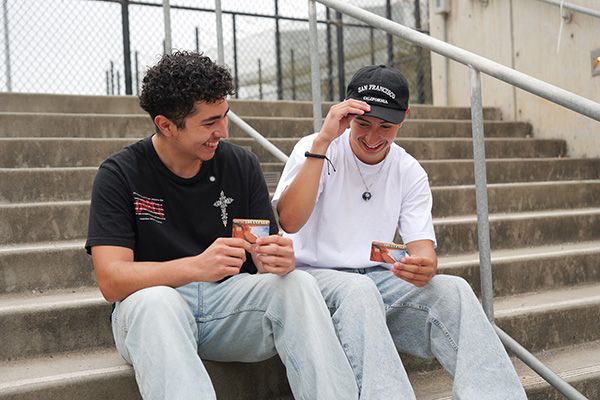
Keeping the fridge stocked with healthy, nutritious food just got easier for SFSU students. A new rule implemented by the California Department of Social Services allows all undergraduate students enrolled in a degree program at a California State University, community college or University of California campus to meet the initial application requirements for CalFresh.
CalFresh is the federally funded Supplemental Nutrition Assistance Program for California residents. It provides up to $306 or more for larger households for food and groceries each month. Visit the CalFresh website to apply and for more information.
“Knowing that I have my groceries covered, it’s a huge weight off my chest,” SFSU student Emma Galvez said just after registering successfully for CalFresh in September. “Balancing all my responsibilities as a student can be very difficult, especially having to manage my money and ensure that I can pay my bills on time and also go out to get groceries.”
SFSU’s Basic Needs Center offers additional free resources to help you remain nourished in a healthful, affordable fashion, including a CalFresh Help Clinic and vouchers for emergency meals. The Associated Students Food Pantry and Gator Groceries program, in partnership with the San Francisco-Marin Food Bank, provides free produce, protein, specialty items and more to our students every week.
“Access to affordable, nutritious food [can be] a challenge for many, including SFSU students,” said Mariven Rendon, the CalFresh outreach coordinator in SFSU’s Basic Needs Center. “SFSU students deserve access to healthy food options that truly support their individual needs and lifestyles, and CalFresh is another tool that they can use to help get through the SFSU experience a little easier and cheaper.”
Removing barriers
The new rule, in effect since June 1, removes barriers that kept financially eligible students from applying for CalFresh. Now, financially eligible undergraduate students enrolled at least half-time in an associate or bachelor’s degree program can begin qualifying — simply by being enrolled in any degree program at a CSU, UC or community college campus. Previously, student eligibility was dependent on working 20 hours a week, verification of Cal Grant status, securing a work-study job or enrolling in certain programs.
California officials expect the new rule will result in an additional 200,000 college students enrolling in CalFresh, helping them access over $250 million in additional food assistance. Rendon notes that SFSU’s CalFresh Help Clinic has assisted over 400 students living on campus this fall to apply for CalFresh benefits and reduce their meal plan.
“Because more students are able to qualify for CalFresh, more students are also able to change their meal plan to a 10-swipe plan, reducing their overall cost of attendance at SFSU,” Rendon said.
California Gov. Gavin Newsom and First Partner Jennifer Siebel Newsom announced the new rule at an Oct. 9 event at the San Francisco-Marin Food Bank also attended by SFSU students and SFSU President Lynn Mahoney.
“We can’t expect students to learn if they’re hungry, and in California, there is no reason for them to be, whether they’re in kindergarten, high school or college,” Newsom said in a news release. “You shouldn’t have to jump through hoops to get the food benefits you’re entitled to, and now you don’t have to. Go apply now — you might be leaving money on the table.”
Learn more about getting support at SFSU for basic needs, including help signing up for CalFresh.
Photo by Kacey Bruce Media
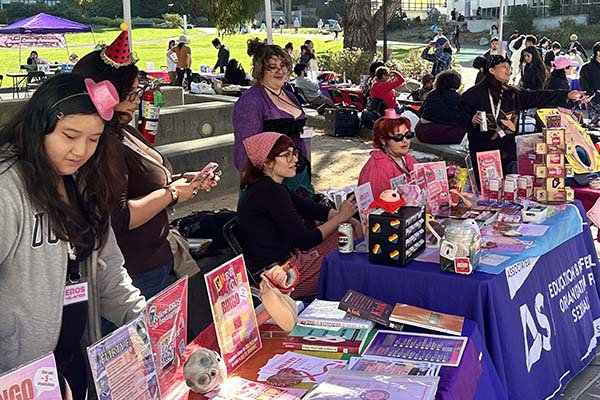
SFSU welcomed nearly 400 high school seniors from the San Francisco Unified School District’s AVID program to campus Oct. 27. Hosted by the Office of Undergraduate Admissions and Recruitment, the annual event brought students from Galileo, Washington, Lowell, Lincoln, Mission and Wallenberg high schools to explore academic programs and career opportunities at SFSU.
Students took part in hands-on activities led by SFSU faculty and staff, including demonstrations in Biology, Cinema, Apparel Design, Nutrition, Entrepreneurship and other disciplines. The visit also included an outdoor fair that gave students a firsthand look at college life, introduced them to potential career paths and helped them envision their futures at SFSU.
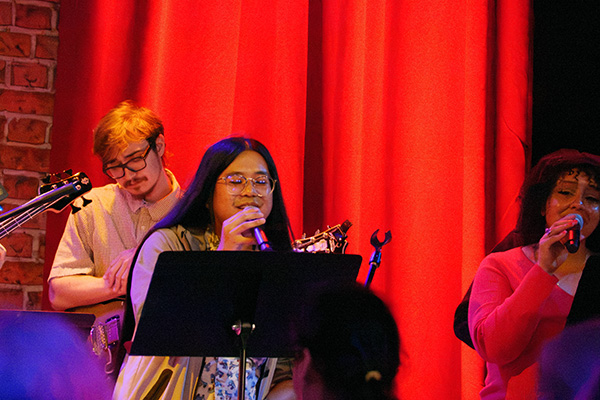
Once a month midday, SFSU’s Studio One becomes a nightclub called Jazz and Tacos. Here, our students get a feel for performing in front of an intimate audience in the type of music venues found all over the world. And, yes, free tacos are provided to all attendees.
Keeping jazz music’s time-honored tradition of improvisation, students receive the setlist only 90 minutes before showtime, including those in the “Music 388: Jazz Combos” class. Some get a surprise call on the spot to hop on stage.
Students say that the Jazz and Tacos event empowers them to live their dreams: the possibility of playing to standing ovations or working full time as a musician or music teacher.
“This was my first jam session ever,” said vocalist Anthony Joerel Garcia, a Music Education major who discovered a passion for jazz at Westmoor High School in Daly City and Skyline College in San Bruno. “It was so scary. But once we got into the groove and could feel the music, it was wonderful.”
Sarah Star, a Music major in Vocal Performance, says singing at Jazz and Tacos is thrilling and amazing.
“Events like this show us what we need to make it to the next level,” said Star, a new transfer student from Laney College in Oakland. “It immediately brings us into the professional world. Instead of being in a classroom, we are facing something in real life.”
Led by Assistant Professor of Music Kev Choice, the series brings acclaimed guest artists to perform alongside the students. On Oct. 6, special guest Martin Luther McCoy sat in on vocals and acoustic guitar while students rotated in and out of the ensemble. Choice played the drums for most of the show — a change from his usual seat at the piano.
“We vibrate. We listen. We learn to play together,” said Choice, a ubiquitous musician seen everywhere from the Oakland Symphony to National Public Radio’s “Tiny Desk” while also serving as president of the Recording Academy’s San Francisco chapter.
Garcia and Star were impressed with how McCoy communicated with all of the musicians on the stage without saying a word.
“It’s very impactful from a singer’s standpoint,” Star said, “observing his phrasing and how he is dealing with people in the audience and collaborating with everybody. He made eye contact with all of us.”
The SFSU students impressed McCoy with their talent. “The students are awesome,” he said. “I’m sitting up checking out people whose ears are already well outside of the box. I heard some people playing music that was way outside. And at a young age that’s pretty encouraging.”
Jazz music and SFSU have a long, storied history. Numerous jazz elders are SFSU alumni, starting in the 1950s with Cal Tjader and Vince Guaraldi and through the 1970s with the likes of George Duke and Wesla Whitfield. Millennial graduates such as Gabrielle Cavassa and Grammy winner Nate Mercereau have continued the tradition, with both having released acclaimed recordings for the landmark Blue Note Records label.
Jazz and Tacos is part of the LCA Live performing arts and lecture series in SFSU’s College of Liberal & Creative Arts. Its events also provide students with experience in lighting, sound, marketing and more. The concerts are held the first Tuesday of the month during the school year. The next show is Nov. 3 at 12:30 p.m.
“It reminds me of my original goal: having fun playing music. I get to be with my classmates just having fun,” said Michael Acuña, a Bachelor of Music student studying electric guitar. “There are good vibes from start to end.”
Learn more about SFSU’s School of Music.
Photo by Kayla Amarillas
With the launch of the new SFSU website in early November, the process for submitting items to CampusMemo will change. Instead of submitting news through Qualtrics, as in the past, assigned department, college and organization editors will be able to post stories to their department news feeds and mark them for inclusion in CampusMemo.
News
If you have news to share:
- Contact your department, college or organization’s assigned editor.
- Ask the editor to create the story using the News content type.
- The editor should select CampusMemo as the News Type and publish the story.
- The story will then be considered for inclusion in CampusMemo.
Events
To have an event considered for CampusMemo:
- Sign in to 25Live using your SFSU credentials.
- Create an event and select Yes when asked whether you would like it posted to a primary university calendar.
- In the Comments section, say that the event should be considered for CampusMemo.
- Include an event topic and event type, if possible.
- Save and submit the event request.
Events will be reviewed and approved before they appear on the website and in CampusMemo.
For questions and support, please email the Office of Strategic Marketing and Communications at marcomm@sfsu.edu.
The annual Civic and Community Engagement Awards honor individuals and groups for their outstanding leadership, service, and collaboration in our communities. This year, we also celebrate the 20th anniversary of the Institute for Civic and Community Engagement.
Nominations for Faculty, Student, Community Partnership and Staff awards are all open until Friday, Dec. 18. Awardees will be celebrated on Tuesday, March 16, 2027.
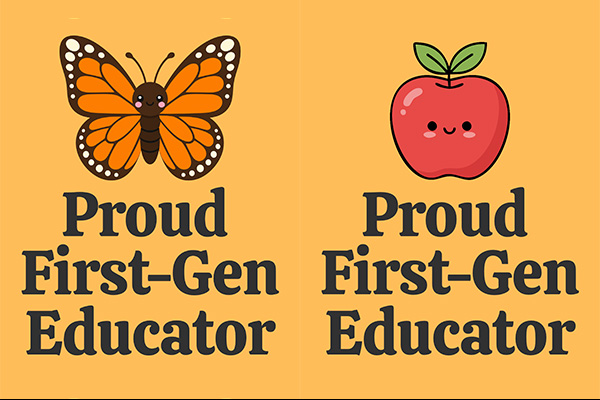
In honor of the First-Generation College Celebration commemorated annually on Nov. 8, SFSU joins other colleges, universities, nonprofits and K – 12 schools across the country to celebrate the success of first-generation college students, faculty, staff and alumni. This year we have made laminated “Proud First-Gen Educator” placards for staff and faculty to place in their office spaces.
Pick up your complimentary placard beginning Wednesday, Nov. 4, from the Student Support Services-TRIO Office in Student Services 203.
Join a CSU-sponsored Adobe grant-funded community of practice to design “futures assignments” that help students revise, remix and reimagine their writing for audiences beyond the classroom — in their future majors, careers and communities. Together, we’ll explore ways to use digital design tools to amplify students’ voices, showcase their writing accomplishments and help them imagine what their writing can do in the world.
This opportunity is open to faculty teaching First-Year Writing or Graduate Writing Assessment Requirement courses as well as any other writing intensive course including capstone/culminating experience courses.
Please review the scope of work and stipend details via Box.
The Ramanathan Million Climate Champions is a yearlong fellowship for SFSU students to work on community-engaged climate action projects on campus and/or with larger communities. Students awarded the fellowship will receive a $1,000 stipend for project-related expenses including time and effort, mentoring, leadership training and a supportive community. Course units are possible.
Any graduate or undergraduate SFSU student who will be available for the yearlong fellowship is eligible to apply. The deadline to apply is 5 p.m. Sunday, Nov. 15.
For questions, please email Professor Jennifer Daubenmier at jdauben@sfsu.edu.
Alternate Atlas is a collaborative, interdisciplinary project led by Ann Chamberlain Artist-in-Residence Paola de la Calle. The project explores how maps shape our understanding of place, belonging, history and power and how they might instead become tools for resistance, repair and collective imagination.
Alternate Atlas explores cartography, colonialism, erasure and memory and brings together archival research, art making, storytelling and participatory mapping to consider whose histories are recorded, whose are overlooked, and how unofficial forms of knowledge can challenge the silences in official archives and maps.
If you’re interested in collaborating with Alternative Atlas next semester, in class or outside of class, de la Calle would love to hear from you. Please email de la Calle at paoladelacalle@sfsu.edu to learn more or explore ways to get involved.
The SFSU Academic Senate met on Tuesday, Oct. 27, via Zoom.
The Senate:
- Adopted by general consent the following items:
- Graduate Paired Course Policy, No. F25-126, correction
- Passed the following item in second reading:
- Course Syllabus Policy, No. S25-257
- Department Chairs and Equivalent Unit Directors, No. S26-145
- Minor in Comparative World Literature
- Athletic Advisory Board, No. S92-175
- Heard in first reading:
- Resolution on Research, Scholarly and Creative Activities Accountability for Tenure Faculty
- Faculty Graduation Marshals, No. S98-202 motion to rescind
- Student Health Advisory Committee, No. S18-281
- Bachelor of Arts in Criminal Justice Studies
- Bachelor of Arts in Criminal Justice Studies (College of Professional and Global Education)
- Certificate in Human Language, Machine Models and AI Application
- Doctor of Philosophy in Education: Concentration in Special Education
- Certificate in Data Science and Artificial Intelligence for Biotechnology
Check out Chicano artist and muralist Fabian Debora’s latest series “Cara de Vago” in the Student Center Art Gallery through Friday, Nov. 13. The exhibition title is a take on Italian baroque painter Caravaggio’s name, for a series that explores Chicano culture, gang-life iconography and the connections between cultures.
Gallery hours:
- Mondays: 9 a.m. – noon, 3:30 – 6 p.m.
- Tuesdays: 9 a.m. – 6 p.m.
- Wednesdays: 9 a.m. – 5 p.m.
- Thursdays: 9 a.m. – 6 p.m.
- Fridays: 10 a.m. – 1 p.m.
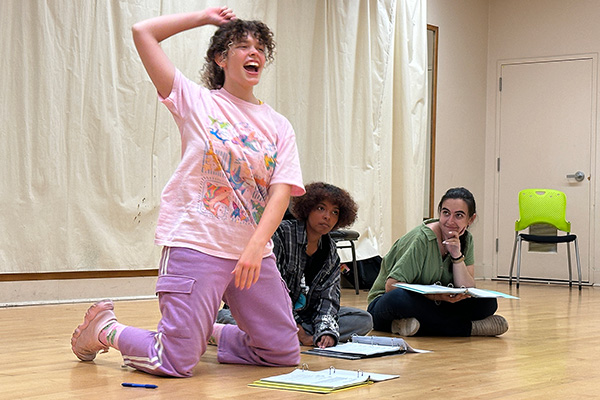
The School of Theatre and Dance presents “h*llo k*tty syndrome,” an original play by brian dang. It will be presented Monday, Nov. 2, and Wednesday, Nov. 4, at 3 p.m. in The Lab (Creative Arts 104).
What happens when the world becomes more interested in identifying you than knowing you? SF State REP breaks the boundaries of theatre and challenges audiences’ expectations with this partially devised production that highlights trans-centric voices. Directed by students Quinn Gilchrist and Grim, “h*llo k*tty syndrome” asks the audience to examine its own expectations and assumptions about visibility and performance.
Photo by Michael Schweikardt
The “AI Literacy Essentials: Prompting for Practical Applications” course offers a focused exploration of prompting and iteration strategies for generative artificial intelligence (AI) chatbots like Microsoft Copilot. It will take place Tuesday, Nov. 3, 1:30 – 2:30 p.m., via Zoom.
Through collaborative, hands-on activities and interactive exercises, participants will learn to write clear, effective prompts and apply refinement techniques such as prompt chaining. You will also assess AI-generated outputs for accuracy and relevance to achieve more reliable and useful results in a variety of academic and non-academic contexts.
This course is required to receive a digital badge for the AI Literacy Education Program.
Strategic Learning and Organizational Excellence (SLOE), part of the San Francisco Bay Region Network, supports employees, teams and leaders across Cal State East Bay, SFSU and Sonoma State. Through learning and professional development, leadership development and organizational development, SLOE helps build individual and organizational capabilities, strengthen effectiveness and support our universities as they evolve and pursue their strategic priorities.
Schedule:
- Multiple dates and times: “Weekly Dose of Mindfulness”
- Multiple dates and times: “Breath and Health”
- Wednesday, Nov. 4, 10 a.m. – 2 p.m.: “Crafted by Colleagues” presented by SFSU Staff Council, Burk Hall 168 and 170
- Wednesday, Nov. 4, 11 a.m. – noon: “Coordinating Student Success Efforts”
Wednesday, Nov. 4, 2 – 3:15 p.m., and Thursday, Nov. 19, 1 – 2:15 p.m.: “Supervising Hybrid and Teleworking Teams” (available only to Management Personnel Plan employees) - Thursday, Nov. 5, 9 – 10:30 a.m.: “Exposing Hidden Bias”
Thursday, Nov. 5, 2:30 – 3:30 p.m.: “Strategic Goal Setting: Crafting Your Path to Success” - Friday, Nov. 6, 11 a.m. – noon: “Beyond Hearing: Becoming a Better Listener”
- Friday, Nov. 6, 2 – 3 p.m.: “Leveraging Artificial Intelligence as a Learning Partner”
- Monday, Nov. 9, 10 – 11:30 a.m.: “Design Studio: Visual Design and PowerPoint for Non-Designers”
- Friday, Nov. 13, 11 a.m. – noon: “Co-Worker Communication”
- Monday, Nov. 16, 10 a.m. – noon: “De-escalation Strategies for Difficult Situations”
- Wednesday, Nov. 18, 10 – 11 a.m.: “Navigating Change by Leading Transition: Applying Bridges’ Model at CSU”
The Digital Media Studio and MakerSpace will host an open house event on Thursday, Nov. 5, 2 – 6 p.m., in Library 260. It is open to all SFSU students, faculty and staff.
Learn about 3D printing, virtual reality, podcasting, audio mixing, internet-of-things/micro-controllers/robotics and video/audio equipment checkout. The open house will also feature special presentations of student projects with edge computing, artificial intelligence and more.
The Pluralities Project presents a special closing-night screening of “The Negro Artist,” a collaborative work by filmmaker Nik Heftman and poet Caleb Rainey, on Thursday, Nov. 5 at 5:30 p.m. in McKenna Theatre, Creative Arts building.
Hosted by SFSU’s Documentary Film Institute, the sixth iteration of the Pluralities Project explores mapping, archives, cartography and the stories that shape our understanding of ourselves and our creative work.
The evening will feature the presentation of the Accomplice Award, recognizing artists, activists and cultural figures who take risks to bring important issues to light. This year, the award will posthumously honor Belva Davis (1932 – 2025), a pioneering African American journalist and the first Black woman hired as a journalist and news anchor on the West Coast, and her longtime producer and collaborator, George Osterkamp (1943 – 2026). Their work helped bring underrepresented stories to the forefront of journalism.
The program will also honor Gregory Tate (1957 – 2021), an influential cultural critic, musician and artist celebrated for his fearless commentary on the experiences and evolution of the African American diaspora.
Bringing together film, poetry, journalism, activism and cultural history, this event celebrates the people whose work challenges conventions and inspires meaningful conversations. The screening and awards ceremony is part of the sixth Pluralities Seminar, taking place Tuesday, Nov. 3 – Thursday, Nov. 5, at SFSU.
The event is supported by LCA Live: GatorFlix, the Department of Anthropology and additional partners.
A presentation on planning your CalPERS retirement will be held Friday, Nov. 6, 1 – 3:30 p.m., via Zoom. CalPERS-eligible faculty and staff are invited to this virtual CalPERS education class to help understand retirement details and steps needed.
Offered directly by CalPERS employees, this webinar will explain details such as retirement types, payment options, beneficiary and power of attorney, online resources and more.
Please RSVP via Qualtrics for the CalPERS retirement planning webinar.
The SFSU men’s and women’s basketball programs will host their annual “Purple-Out” games on Monday, Nov. 9, in the San Francisco Federal Credit Union Gymnasium. Nov. 9 is the first day of the basketball season.
The women’s program will play Point Loma at 4:45 p.m., while the men host Lincoln University at 7 p.m. The first 500 fans will receive headbands.
The campus community — including students, faculty, staff, alumni, veterans, active-duty service members, military spouses, dependents and other military-connected individuals — is invited to join the SFSU Veterans Services for a Veterans Day Recognition event on Tuesday, Nov. 10, at 11 a.m. at the Seven Hills Conference Center.
This event provides an opportunity for our University community to come together to honor the service, sacrifice and contributions of our military veterans. It also recognizes the role that veterans and military-connected individuals play in the SFSU community.
The event includes a catered luncheon. Registration is required. Registration is scheduled to close Monday, Nov. 2, at 5 p.m., unless capacity is reached before.
Faculty, staff and administrators are invited to participate in the Interstride “Careers Beyond Borders” Symposium on Tuesday, Nov. 10, at no cost through the SFSU Alumni Association’s partnership with GoinGlobal.
The virtual symposium brings together higher education professionals to explore international career development, global hiring, student mobility and strategies for supporting students pursuing career opportunities across borders.
Sessions will feature higher education leaders and career development professionals sharing practical approaches, institutional experiences and emerging strategies for preparing students for an increasingly global workforce.
To register for the Interstride Symposium, please complete the SFSU Alumni Association’s form. After submitting the form, you will receive instructions and a registration code to complete your symposium registration through Zoom.
Join the Center for Equity and Excellence in Teaching and Learning (CEETL) for a faculty and staff outing to San Francisco’s Aquarium of the Bay on Saturday, Nov. 14.
The aquarium has generously donated free tickets for educators. This is your chance to connect with colleagues, explore the aquarium, and visit the sea lions at Pier 39. Tickets are limited, so please register by Thursday, Nov. 4. Additional details such as meeting time and itinerary will be shared after you register.
Join the Center for Equity and Excellence in Teaching and Learning (CEETL) on Thursday, Nov. 19, at 10 a.m. via Zoom for a discussion on supporting neurodiverse students in engineering education and exploring the potential of generative artificial intelligence (AI) to enhance their college experience.
Faculty from SFSU’s Graduate College of Education and School of Engineering will share findings from student interviews and recent research on the strengths and challenges of neurodiverse learners, including the possibilities and limitations of generative AI. Participants will also collaborate on strength-based approaches to fostering more inclusive and supportive learning environments.
Register through CEETL’s single registration form under “JEDI Masters Programs.”
SFSU Spotlight
The Office of Research and Sponsored Programs (ORSP) congratulates these faculty members and others for their recent grant awards.
Erin Bray, associate professor, School of the Environment: $34,020 from the Delta Stewardship Council for “Peer Review of New Lines of Evidence for Effects on Fish from the Long-Term Operations of the CVP and SWP.” Billions of gallons of water per day are channeled from Northern California to drier Central and Southern California through the network of dams, canals, and other features that comprise the federal Central Valley Project (CVP) operated by the U.S. Bureau of Reclamation and the State Water Project (SWP) operated by the California Department of Water Resources. New lines of evidence evaluating fish and aquatic effects of the long-term operations of the CVP and SWP will be evaluated and analyzed. These will include literature reviews, particle tracking modeling, life-cycle analyses and entrainment analyses to better understand hydrodynamics and population responses associated with entrainment risk of listed fishes due to CVP and SWP water operations. In particular, the new lines of evidence refine understanding about the spatial and temporal extent of export-altered hydrodynamic conditions (i.e. zone of influence of water pumping and export operations). A robust peer review of suggested new lines of evidence will inform utilization of best available science to guide future actions and operations for long-term operations of the CVP and associated interested parties involved in CVP and SWP management.
Matthew Ferner, director San Francisco Bay National Estuarine Research Reserve (NERR): $931,000 from National Oceanic and Atmospheric Administration for “San Francisco Bay NERR.” Funds support operations, research and monitoring, education, training and stewardship activities of the San Francisco Bay NERR. SFSU will continue to monitor short-term variability and long-term changes in estuarine conditions at and around NERR sites, coordinate production of applied estuarine science at local and regional scales, and lead professional training, education and workforce development with the goals of strengthening coastal economies and increasing resilience of the nation’s open-water borders.
Megumi Fuse, professor emerita of Biology, and co-principal investigator Derrick Groom, associate professor of Biology: $32,000 subaward from Sacramento State/CSU Chancellor’s office for “CSU STEM Pathways & Research Alliance (CSU-SPaRA).” CSU-SPaRA’s objectives are to:
- support students at critical transition points in their science, technology, engineering and mathematics (STEM) education
- provide opportunities in research, internships, international activities, conferences, leadership roles, professional development and graduate school preparation activities with the goal of increasing the number of students entering graduate programs and professional careers in STEM
- support experiences that are important for socialization into STEM culture and careers with activities that build a sense of identity, belonging and community within STEM disciplines.
Jennifer Gasang, executive director, Institute for Civic and Community Engagement, and co-principal investigator Noah Price, associate dean of Graduate Studies and Career Development: $3,000,000 from U.S. Department of Education for “Strengthening Institutions Program.” SFSU will implement an integrated Student Success and Career Pathways Ecosystem that strengthens institutional infrastructure while expanding access to career-connected learning and workforce preparation opportunities. Major activities include:
- implementation of a campus-wide engagement and outcomes platform
- expansion of internships and other work-based learning opportunities
- faculty professional development in career-connected learning and artificial intelligence literacy
- a College Partnership Fund to support workforce-focused academic innovations
- expanded employer and community partner engagement.
Eileen Gonzales, assistant professor of Physics and Astronomy: $150,000 supplement from NASA for “A Symphony of Silicates: Quantifying Silicate Feature Diversity Across Age, Metallicity, and Composition.” The silicate cloud absorption feature observed in the atmospheres of brown dwarfs and giant exoplanets is one of the most diverse spectral features. In their study, Gonzales and team will examine silicate feature morphology in terms of observed fundamental properties to develop a compositional classification schema. They will address the following key questions:
- How does silicate grain composition/structure drive differences in observed silicate features?
- Which silicates best reproduce the morphologies we observe?
- Does silicate morphology correlate with physical properties such as age and metallicity?
Rama Ali Kased, associate professor of Race and Resistance Studies: $901,036 from the Regents of the University of California for “SF BRIDGE: Building Research Insiders to Dissipate Gaps in Equity.” The SF BRIDGE (Building up Research Insiders to Dissipate Gaps in Equity) Program builds on the longstanding partnership of SFSU and University of California, San Francisco, to advance equity and diversity in biomedical research training. The program will create a cross-institutional structure designed to expand research access and mentorship for students who represent priority populations with disproportionately high rates of tobacco use. This collaboration allows SF BRIDGE to integrate community-centered frameworks and culturally grounded pedagogy with high-impact biomedical research experiences.
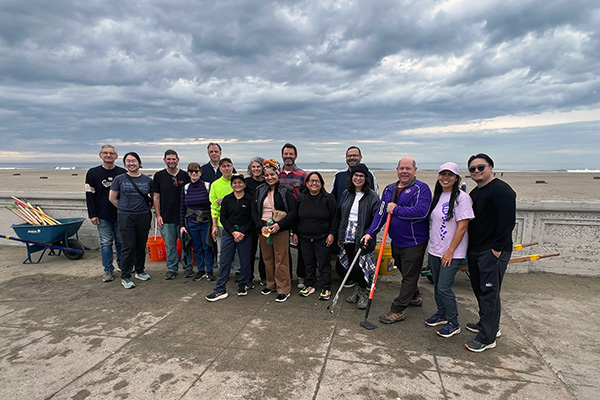
On Oct. 21, SFSU employees from University Advancement teamed up to volunteer for the Golden Gate National Parks Volunteer Program at Ocean Beach in San Francisco. They cleared litter, sand and other debris from the pedestrian promenade along the Great Highway between Fulton Street and Lincoln Way.
Participants in this event included: Anjali Billa, Mary Campbell, Christopher Clark, Marciana Flores, Matt Itelson, Dafna Kapshud, Yasmine Khan, Katie Lau, Paolo Maralit, Paul McNamara, Jim Muyo, Spring Nguyen, Rick Paradis, Chloe Pearson, Alex Sánchez and Joel Streicker.
Professor of Marketing Minu Kumar wrote “Rethinking Design Thinking: From Empathy to Responsibility” for MIT Sloan Management Review with Pietro Micheli, Jatinder Singh and Neil Goldberg. It was published on Sept. 23.
Kumar, Micheli, Singh and Goldberg also wrote “Responsible Design Thinking,” accepted and forthcoming in the Journal of Marketing.
In an Oct. 22 article in ASAP/Journal, Associate Professor of English Language and Literature Will Clark reviews the Los Angeles Museum of Contemporary Art’s retrospective on confederate monuments. He discusses why revisiting monuments is important — especially since some that have been removed are being reinstalled. He also recovers the organizing that went behind their removal.