News and Announcements
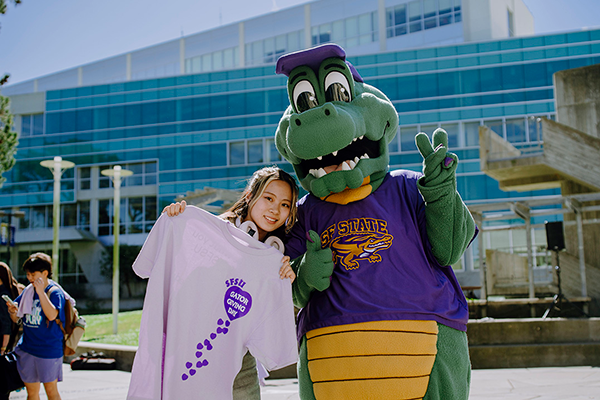
SFSU’s second annual Gator Giving Day delivered a strong showing, nearly doubling last year’s total and far surpassing its fundraising goal.
During the 24-hour campaign on March 18, more than 920 supporters contributed $196,735 — exceeding the $110,000 goal by 78%. Funds will support student clubs, academic departments, programs and scholarships across the University.
Alumni accounted for the largest share of donors (26%), followed by faculty and staff (22%), supporters of the University (20%), students (15%) and parents at (6%).
Throughout the day, matching gifts and challenges encouraged participation and helped donors maximize their impact. Perfect Pair, a student organization that connects students with older adults in assisted living facilities, won a social media challenge that secured an additional $500.
Graciela Bejarano, a third-year Cell and Molecular Biology student who is involved with Perfect Pair, said the event made fundraising for the organization easier. Fundraising can be challenging, she says, but the support and guidance behind Gator Giving Day turned it into a fun and rewarding experience. Bejarano said the additional funding will help the organization expand its mission.
“We’ve been able to grow our club and build meaningful connections with older adults at Alma Via of San Francisco,” she said. “The Perfect Pair team thanks SFSU and all of the donors from the bottom of our hearts.”
Attracting new donors remained a key priority. This year, 16% of contributors were first-time participants in Gator Giving Day, reflecting growing engagement throughout the SFSU community.
“It’s exciting to watch this community-based culture of philanthropy grow,” said Jeff Jackanicz, vice president for University Advancement. “Last year, we laid the foundation for this event and ended the day with 647 donors. That number grew by 42% this year — a clear indication that the seed we planted is taking root.”
A total of 132 groups participated, including 40 representing academic colleges, departments and programs. The remaining groups raised funds for student clubs and University Athletics.
The Lam Family College of Business raised $48,176 — more than triple its $15,000 goal. The funds will expand the college’s alumni-student mentorship program and support academic initiatives.
Dean Eugene Sivadas credited the college’s success to a collective effort among faculty, staff and alumni.
“Gator Giving Day captures the spirit of the Lam Family College of Business — our strong sense of community and shared purpose,” Sivadas said. “We thank our department chairs, faculty and staff for their energy and enthusiasm in amplifying the campaign. Above all, we celebrate our alumni, whose continued engagement and generosity support our students and shape our college’s future.”
If you missed Gator Giving Day and still want to help, there’s always time to make a difference. Your support ensures that SFSU will continue to deliver excellence and access to transformative education rooted in innovation and equity. Learn more about giving to SFSU. And you can look forward to next year’s Gator Giving Day, when we’ll achieve even greater success for our campus community.
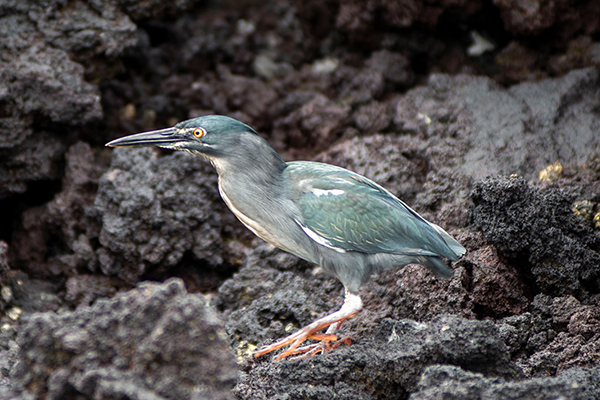
The Galapagos Islands are famous for the discoveries that shaped Charles Darwin’s theory of evolution. Now an SFSU graduate has added one more: Ezra Mendales (M.S., ’23) describes a new species as part of his master’s thesis.
“I feel super lucky with this project. I think we fell into this beautiful story that is really rare,” Mendales said of his work with SFSU Associate Professor Jaime Chaves and California Academy of Sciences Ornithology Curator Jack Dumbacher.
They found that the common Galapagos lava heron (Butorides sundevalli) is a distinct species, upending a decades-long assumption that it is a subspecies of the South American straited heron.
“I’d say the vast majority of ornithologists alive today have never been part of a new species description,” said Dumbacher, who shares a lab with Chaves and was on Mendales’ thesis committee.
A mystery in plain sight
The Galapagos lava heron is one of 72 new species recently described by Cal Academy researchers and collaborators. Unlike many discoveries of uncovering hidden species, the lava heron is a common sight in the Galapagos.
“There was always this bird that shows a lot of variation in its plumage, and for a long time there was questions of whether this was a separate species or a subspecies of a bird that lives on the mainland,” Chaves explained. Scientists have been studying these birds for decades and have tried to provide explanations based on their morphology and plumage, but no one provided a definite answer.
When Mendales joined Chaves’ lab, he took on the challenge. In 2022, the trio went to the Galapagos to collect samples. To understand the evolution of these birds, they needed more data — particularly from different locations and over time, and to capture the entire plumage variation — so they added specimens from the Cal Academy, American Museum of Natural History and the Field Museum to their dataset.
At the Academy’s Center for Comparative Genomics, Mendales used advanced genetic analyses to study the bird’s DNA. The results showed the Galapagos lava heron is a distinct species more closely related to the North American green heron than to the South American species, challenging earlier assumptions based on morphology.
“For any biologist, it’s a dream to be able to go to the Galapagos,” Mendales explained. “We are still learning things about some of the most investigated systems. There’s always going to be mysteries to solve.”
Convergence of stories
As an Ecuadorian, Chaves first visited the Galapagos Island with his family when he was 6 years old. The Galapagos Islands’ people, culture and wildlife became constants in his life. Chaves’ continuing fascination with the islands drives his research and work in the Galapagos community, which includes training tour guides.
“You have to have this collaboration with the locals. Somebody who really knows the birds on the ground,” Chaves said.
In this case, the local expertise came from Jason Castañeda, a Galapagos National Park ranger who helped the team catch the herons so theycould collect blood samples.
“He’s a co-author on our paper because it’s a substantial collaboration,” Chaves said.
While Chaves says the Galapagos draws students to the lab, Mendales, now a Ph.D. student at the University of Montana, is quick to credit his SFSU mentor instead. He first met Chaves in 2015 during an undergrad trip to the Galapagos and revered his expertise before coming to SFSU for his master’s work.
“Getting access to not only the faculty at San Francisco State but the resources and employees at the California Academy of Sciences — it’s a match made in heaven,” Mendales said.
Dumbacher, who has been at the Academy since 2003, was also familiar with Chaves’ expertise before Chaves became an SFSU professor. Establishing a joint lab to study the Galapagos was a natural extension of their interests and partnership. The Cal Academy alone has the world’s largest collection of scientific specimens from the Galapagos, dating back to 1905.
“Working with Jaime has been one of the most fun things I’ve gotten to do in my career. It’s really rare that somebody like me at a museum will have a collaborator that is so aligned,” Dumbacher explained.
The root of your goal
“Our students have access to things a lot of students in other labs don’t have,” Dumbacher said about the strength of the SFSU-Cal Academy partnership. Students get to benefit from the Academy’s connection to biotech, local research institutions and companies creating new technologies. “Seeing somebody like Ezra, who was interested in but didn’t have the [molecular biology] background in the lab, go from zero to 80 so quickly was really fun.”
But Mendales says this experience has given him far more than just access to resources and expertise. His SFSU mentors recognized that students bring a wide range of backgrounds and interests to their work and helped him channel those experiences into a clearer sense of purpose. They encouraged him to think deeply about why he does the work he does. “What they [helped] me with was finding the root of my goal. Not what is my goal, but what do I want out of life,” he said.
It’s an experience that echoes his mentor’s journey. Although Chaves became an SFSU professor in 2020, he first came to SFSU in 2002 as a master’s student. He studied hummingbirds with SFSU Professor Gretchen LeBuhn.
“I came in to do my master’s with a different perspective. I walked out of the lab the first day after I worked with DNA helping Professor Ravinder Sehgal, a postdoc at SFSU at that time. It changed my idea of research by 180 degrees,” Chaves said. He’s been using genetics to study bird evolution ever since.
“The Biology Department at SFSU has an amazing record of placing their master’s students in Ph.D. programs,” Dumbacher said. “At SFSU you have a really high caliber of master’s students and also professors teaching them. … It takes a special kind of professor that is good at research but is also a good teacher who is committed to teaching.”
Learn more about SFSU’s Department of Biology.
Photo copyright Jack Dumbacher and California Academy of Sciences
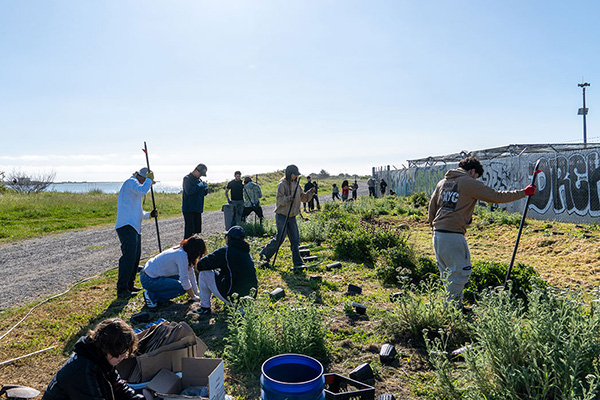
At Candlestick Point Native Plant Nursery in Bayview-Hunters Point, the view tells two very different stories. On one side is the Bay and its beauty; on the other, a decommissioned shipyard — a Superfund site with radioactive, metal and industrial contamination that continues to affect the neighborhood’s health. Hidden behind a building is the nursery, part of a lush and lively community garden and a nature-based response to these environmental challenges. On March 14, SFSU students added their energy to the space as volunteers.
SFSU Climate HQ and the Rotary Club of San Francisco rallied 35 SFSU students, faculty and staff, community college students and community members for a day of native plant restoration at the Bayview-Hunters Point nursery. The students were from across campus, representing a variety of programs like Biology, Child and Adolescent Development, Cinema, the School of the Environment and more.
“It was really nice to see a ton of people from all corners of campus coming together to do something good for the planet,” said first-year Marine Biology student Sandra Chavez. Hoping for a career in conservation, she is an avid community volunteer and was excited to pitch in.
Participants spent their Saturday split into three groups to prep soil or plant and transplant local native flowers that are hardy and resistant to weather, drought and fire.
The event was spearheaded by Climate HQ Co-Director Kai Burrus, a Biology professor and Rotary Climate Action team chair. Like many in Climate HQ, Burrus uses her community connections to expand opportunities for SFSU students.
“We have people who are well-positioned in San Francisco city government and the Department of the Environment, so we can make those connections. We had students that helped us link to the Pacifica government. We’ve had people who know people in business, people at grassroots organizations,” Burrus said. “They carry those connections with them to Climate HQ, and it becomes a fabric of our community.”
Climate HQ wants to make these types of events accessible whenever possible. The goal is to help students from all majors and colleges and from any background get involved.
“We want all students to be able to participate. Because the Rotary has been so supportive of these activities — which has been amazing — we had a bit of money to rent a van,” Burrus said, adding that they drove approximately 10 students to the event. “Many of the students had never been to Bayview-Hunters Point or Candlestick Park. Many of them don’t even have cars. This is to get people out of their headspaces and with others that have some common interests. It’s really great.”
Community and hope are common themes for Climate HQ, SFSU’s campus hub that aims to centralize and support climate change and climate justice activities at the University. It offers something for everyone (students, faculty, staff and community) via classes, certificates, initiatives and events.
“There are studies that show that collective action, whether it be about climate change or other things, help reduce grief and anxiety we’re feeling. I think that is true,” Burrus said.
Learn about how to become a part of Climate HQ.
Photo by Kai Burrus and Alcides Fuentes
Instructors: This is the last call for Affordable Instructional Materials (AIM) proposals for the current funding period. If you’ve taken steps to reduce the costs of instructional materials for students in your courses and would like to be considered for an AIM grant, please submit your application by Wednesday, April 15.
AIM awards funding to individual faculty members and full departments to support the adoption of no- or low-cost instructional materials to make quality education accessible for all students. Grants typically range from $250 to $750 for individual faculty and increase for departmental initiatives, depending on the projected impact and savings for students.
Please visit the Academic Technology website to learn more about the program and apply for a grant.
To discuss potential cost-reduction projects, please email Academic Technology at at@sfsu.edu.
Applications are invited from faculty members (lecturer and tenure/tenure-track faculty) for the 2026 Center for Equity and Excellence in Teaching and Learning (CEETL) Teaching Award. The awards honor faculty members who have made a difference in the lives of SFSU undergraduate or graduate students through exemplary teaching practices.
CEETL is interested in learning how faculty connect students to their communities, make their courses relevant for students and prepare them for the real world. How do you foster communities of care in the classroom and beyond? How do you partner with students to create social connections, community and belonging in the classroom?
Teaching practice should reflect CEETL’s values and mission. Please email your application by Wednesday, April 1, to ceetl@sfsu.edu with “Application for 2026 Exemplary Teaching Award” in the subject line.
Please visit the 2026 CEETL Teaching Awards web page for more information on submission procedures.
The University Budget Committee (UBC) is accepting nominations for staff and faculty members. No experience is needed; this is a unique opportunity to learn about University financial operations.
Time commitment: UBC meets monthly during the academic year. Time is needed to attend meetings, review materials and potentially serve on a workgroup. To learn about the UBC, attend a meeting or review the list of current members to inquire about their experience.
The nomination deadline is Monday, April 6. Please email UBC at ubc@sfsu.edu for your nomination form.
“Explore SFSU: Admitted Student Day” is the University’s signature spring event for admitted students and their families — a day for them to visit campus, make connections and learn about life as a Gator. It will take place Saturday, April 11, 9 a.m. – 2:30 p.m.
Please consider serving as a general ambassador for wayfinding, greeting, setup, etc., to assist in making this a great experience for our guests and a great success for our University.
Ambassador shifts are 7 a.m. – 2:30 p.m. Lunch will be provided for all who help for the day.
Please sign up via Qualtrics to be an “Explore SFSU” ambassador.
CSU International Programs is launching its inaugural faculty-led summer programs for summer 2027. Faculty are invited to submit their proposals by Wednesday, April 15, to design and lead a faculty-led summer program in one of three locations: Accra, Ghana; Florence, Italy; or Granada, Spain.
Programs will run in either June or July for three weeks. Courses should integrate classroom instruction with site visits, field learning, guest speakers and cultural engagement opportunities that deepen the academic experience.
For questions, please email Jaishankar Raman, director for CSU International Programs, at csuip@calstate.edu.
What is “vibe coding,” and why is everyone talking about it? Join an interactive workshop introducing you to vibe coding — a new way of building software by describing what you want to artificial intelligence (AI) and refining the results together. It will be held Monday, March 30, 1 – 2 p.m., via Zoom.
Instead of writing every line of code yourself, for vibe coding you work at the intent level and use AI to generate, test and improve your ideas in real time.
This session is designed for beginners, non-Computer Science majors, creatives, staff, faculty and early developers. No prior coding experience is needed to participate.
An RSVP is required. Please RSVP for “Vibe Coding” via Zoom.
Invest in your development this April with a range of training opportunities designed to strengthen communication, leadership and productivity skills.
- Wednesday, April 1, 11 – 11:30 a.m.: “Learning Lab: Emotional Intelligence in Action Part On”
- Friday, April 3, 11 a.m. – noon: “Dealing with Triggers”
- Tuesday, April 7, 9 – 10:30 a.m.: “Basics of Customer Service”
- Wednesday, April 8, 11 – 11:30 a.m.: “Learning Lab: Emotional Intelligence in Action Part Two”
- Thursday, April 9, 10 – 11:30 a.m.: “AI Playtime: Exploring AI for Work, Wellness and Creativity”
- Sunday, April 12, 9 – 10 a.m.: “Adobe Captioning with Premiere Pro”
- Tuesday, April 14, 10 – 11:30 a.m.: “Excel Tips and Tricks”
- Wednesday, April 15, 11 – 11:30 a.m.: “Learning Lab: Emotional Intelligence in Action Part Three”
- Friday, April 17, 11 a.m. – noon: “Dealing with Difficult Personalities”
- Wednesday, April 22, 2 – 3 p.m.: “Stepping Beyond: Customer Service”
- Thursday, April 23, 10 – 11 a.m. “Impact of Learning Styles in the Workplace”
- Wednesday, April 29, 10 – 11 a.m.: “Navigating Change by Leading Transition: Applying Bridges’ Model at CSU”
- Wednesday, April 29, 11 a.m. – noon: “Gender Identity and Pronoun Use”
- Thursday, April 30, 10 – 11 a.m.: “CSU’s Got Talent: Promoted into Incompetence Part One – Why Good Workers Become Poor Leaders”
- Thursday, April 30, 11 a.m. – noon: “Developmentally Focused Evaluations”
- Thursday, April 30, noon – 1 p.m.: “Success as First-Gen Professional”
Please visit the Human Resources website for more information and to register.
The “AI Literacy Essentials: Prompting for Practical Applications” course offers a focused exploration of prompting and iteration strategies for generative AI chatbots. It will be held Thursday, April 2, 11 a.m. – noon, via Zoom. RSVP is required.
Through collaborative, hands-on activities and interactive exercises, participants will learn to write clear, effective prompts, apply refinement techniques, and assess AI-generated outputs for accuracy and relevance to achieve more reliable and useful results in a variety of practical contexts.
This course is an elective that counts toward receiving a digital badge for the AI Literacy Education Program.
Curated by School of Art faculty member Lorena Molina, the “slow burn” exhibition centers how Black, Indigenous and People of Color (BIPOC) artists use slowness as a form of refusal and a way to highlight the systems of oppression that structure their lives. Rather than treating time as neutral, the exhibition frames it as a political structure forged by histories of displacement, control and erasure. In doing so, slow burn opens space to listen, to grieve, to be intimate and to advocate for opacity and temporal self-determination.
Participating artists are Mara Duvra, Tesora Garcia, Maria Gaspar, Tianzong Jiang, Ana Mendieta, Joshua Moreno and Elaine T. Nguyen.
This exhibit runs through Saturday, April 4. Regular hours are Tuesdays – Thursdays, noon – 4 p.m., and Saturday, April 4, 1 – 3 p.m., for receptions. Admission is free.
For more information, please email the Fine Arts Gallery at fineartsgallery@sfsu.edu or call (415) 338-6942.
Faculty and staff often support students through stress, hardships and uncertainty, but may not pause to extend the same care to themselves. Over time, this imbalance can lead to burnout, compassion fatigue or a struggle on how to balance student needs with one’s own needs. The Center for Equity and Excellence in Teaching and Learning’s (CEETL) “Circle on Self-Compassion” workshop introduces the concept of self-compassion as an evidence-based practice that supports instructor and staff well-being and promotes effective teaching.
Faculty, graduate teaching assistants and staff are invited to join this CEETL circle on Monday, April 6, noon – 1 p.m., via Zoom, to come together in community, learn and share a few practices that can help embrace and embody self-compassion in this chaotic world.
CEETL will explore practical ways to cultivate self-compassion in our own lives, from self-kindness to boundary-setting practices, with the goal of supporting our students in more compassionately sustainable ways.
Please register for the CEETL “Circle on Self-Compassion” via Qualtrics.
“Jazz and Tacos,” part of the LCA Live concert series and presented by the Shenson Foundation, is a high-energy live music series led by School of Music faculty member Kev Choice. The series takes place the first Tuesday of every month 12:15 – 1:15 p.m. in Studio 1 in the Creative Arts building. The former television studio has been transformed into one of SFSU’s newest live performance venues.
Tickets are free for SFSU students, faculty and staff. Every ticket includes free tacos.
Celebrate SFSU Night at Oracle Park as the San Francisco Giants take on the Philadelphia Phillies on Tuesday, April 7, starting at 6:45 p.m. Additional lower-box outfield seats have recently been added. Enjoy a night of Gator pride and Bay Area energy while repping an exclusive co-branded roped hat included with the purchase of a ticket.
This special event will include SFSU alumni highlights:
- Founder and CEO of EMPIRE Ghazi Shami (B.A., ’99) will throw the first pitch.
- Kimiko, daughter of Señor Sisig founder and CEO Evan Kidera (B.A., ‘04; MBA, ’14) will yell, “Play ball!”
Partial proceeds from each special event ticket will benefit the SFSU community.
Join the Lam Family College of Business for the “Boost Your Budget” community tabling event to explore campus resources that support your financial wellbeing. It will take place Wednesday, April 8, noon – 1:30 p.m., in the Business building.
Campus resources include:
- CalFresh: Access food assistance
- SFSU Basic Needs: Learn about campus support services
- SFSU Volunteer Income Tax Assistance: Receive free tax assistance
The Morrison Chamber Music Center present the vocal ensemble Volti on Thursday, April 9, at 7 p.m. in Knuth Hall, Creative Arts building.
Volti’s professional singers, under the direction of founder and Artistic Director Robert Geary, are dedicated to the discovery, creation and performance of new vocal music. The ensemble’s mission is to foster and showcase contemporary American music and composers and to introduce contemporary vocal music from around the world to local audiences. The group has commissioned more than 120 new works, by emerging as well as established composers.
Please visit University Tickets to reserve your free tickets.
The CSU Employee Tuition/Fee Waiver program provides eligible employees to attain a certificate, undergraduate or graduate degree or take classes at any CSU to enhance career development. Human Resources hosts a virtual information session on Friday, April 10, 11 a.m. – noon, for employees or their dependents to take advantage of this program.
Please RSVP for “Using Your Employee Tuition/Fee Waiver to Earn Degrees” via Qualtrics.
The campus community is invited to join the third annual reentry simulation on Tuesday, April 14, 11:30 a.m. – 2 p.m., in Jack Adams Hall.
Experience the challenges people face when returning to society after incarceration. In this interactive reentry simulation, participants take on the role of someone recently released from prison/jail and need to navigate real-life barriers such as managing living expenses, securing employment, and meeting supervision requirements. Watch a YouTube video about reentry simulations.
This event is hosted by Associated Students Project Rebound and the students of the Prison Reentry Studies minor PR 500: “Capstone Internship.”
Please register via Google Forms for the Reentry Simulation event.
Prospective students are invited to join an information session on Wednesday, April 15, 6 – 7 p.m., or Thursday, April 16, noon – 1 p.m., via Zoom to learn about the Department of Child and Adolescent Development’s undergraduate programs.
Please RSVP via Qualtrics for the Child and Adolescent Development information sessions.
Join the Alumni Association for a night out on Saturday, April 18, 6 – 8 p.m., at Legacy North Beach Bar at 1326 Grant Ave. in San Francisco. Karim Salgado (B.A., ’00) will share her journey from the classroom to co-owning one of San Francisco’s top bars, followed by a live cocktail-making demonstration led by co-owner Josh Fernandez.
After the demo, participants will be served a handcrafted tequila-based cocktail to pair with delicious bites from Marco Ballesteros of SFSU’s Taqueria Girasol. This promises to be an unforgettable evening filled with fun, flavor and Gator pride.
Please RSVP by Monday, April 6, via the Alumni Association website.
The College of Liberal & Creative Arts’ 10th annual Undergraduate Research Showcase will be held on Wednesday, April 29, 11 a.m. – 2:30 p.m., at Seven Hills Conference Center. The college will celebrate the research and creative works of undergraduates across all of its disciplines and academic levels. The event includes lunch and refreshments, resource tables and raffles.
Student presenters must register through the College Undergraduate Research Experience (CURE) website by Friday, April 17. All are welcome to attend.
For more information, please e-mail See-Won Byun at sbyun@sfsu.edu.
SFSU Spotlight
The Office of Research and Sponsored Programs (ORSP) congratulates faculty members and others for their recent grant awards.
Bradley Fogo, associate professor and chair of Secondary Education: $100,000 from Library of Congress for “Collaborative Local History and Action Civics with Library of Congress Documents.” This program connects classrooms of middle and high school students from different regions of the country through the study and sharing of local history, issues and events to inform possible collaborative civic action.
Yeon-Shim Lee, professor and chair of Social Work: $312,500 from Department of Health Care Access and Information/CSU for “Certified Wellness Coach Program.” This grant will help develop the Bachelor of Arts in Social Work curriculum content to train students to be certified wellness coaches.
Julie Paulson, professor of English Language and Literature; co-principal investigator: Mayumi Hagiwara, associate professor of Special Education: $950,000 from U.S. Department of Education/CSU Northridge for “Inclusive Post Secondary Education Pilot Program.” In a partnership with Cal State Northridge, this project builds on and expands existing inclusion initiatives for students with intellectual disabilities at each institution.
Kwok-Siong Teh, professor and director of Engineering: $80,000 from the University of California Office of the President for “Mathematics Engineering Science Achievements University Program (MUP) at San Francisco State University 2025 – 2026.” MUP is a student success program to support first-generation STEM students with academic/peer mentoring, career counseling and leadership development opportunities to enable future career success.
On March 19, Professor of Kinesiology Nicole Bolter spoke on a panel at San José State University titled “The Evolving Landscape in Collegiate Sports: A Conversation with Faculty Athletics Representatives from Bay Area Universities.” Bolter serves as SFSU’s faculty athletics representative.
“‘I Just Wasn’t Made For These Times’: U.S. Labor in the Age of Authoritarianism,” by John Logan, professor and director of Labor and Employment Studies, was selected for the “best papers” panel at the Labor and Employment Relations Association annual conference. It will be held Thursday, May 28 – Sunday, May 31, in Minneapolis.
Angie Lipschuetz, associate dean of the College of Professional & Global Education, will convene an online summit for the Learning Resources Network on Thursday, April 30.
The Commonwealth Club of California will host “Mix, Mingle and Be Moved: An Evening with San Francisco Poet Laureate Genny Lim, Musicians Chris Trinidad and Pianist Unpil Baek” on Monday, April 6, at 6 p.m. at the Taube Family Auditorium in San Francisco.
Alumna Genny Lim, San Francisco’s poet laureate, is an acclaimed poet, playwright and performer whose work reflects the rhythms, struggles and resilience of the city. Appointed in 2024 by Mayor London Breed, Lim is the city’s first Chinese American poet laureate. Drawing inspiration from her upbringing in Chinatown and North Beach, her poetry invites us to listen more deeply — to one another and to San Francisco itself.