News and Announcements
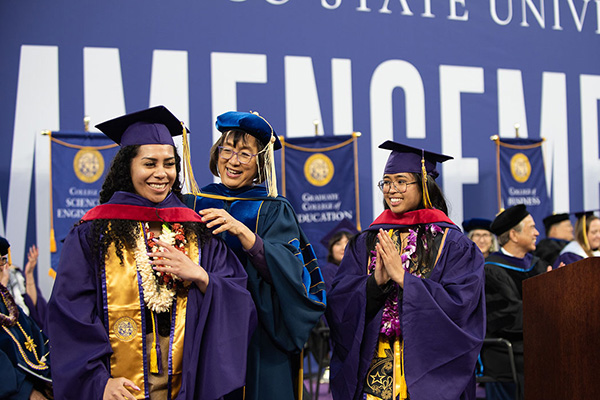
In the midst of an increasingly challenging landscape for new entrants into the workforce, SFSU is stepping up its efforts to help students successfully achieve their post-graduation career goals.
As SFSU held its annual Fall Career and Internship Fair, University President Lynn Mahoney announced the establishment of a new Future-Ready Workforce Initiative, a fully integrated campus-wide effort to ensure every SFSU graduate is equipped to succeed in the rapidly changing workforce of tomorrow. The initiative brings together representatives from all areas of the SFSU community, including faculty, students, alumni, administration, technology, government relations and the newly established position of workforce partnerships.
“We’re committed to providing every student with the opportunity to achieve economic mobility,” SFSU President Lynn Mahoney said. “This campus-wide initiative pulls every area of our university into a collaborative effort to ensure we deliver on our commitment.”
“San Francisco is on the rise, and we want our graduates to build their futures here,” said San Francisco Mayor Daniel Lurie. “When we invest in our students, we invest in San Francisco’s future. We’re glad to see San Francisco State’s new Future-Ready Workforce Initiative connecting students to the growing opportunities here in San Francisco, helping graduates launch careers and put down roots in the city we all love.”
Community of partners
As part of SFSU’s Future-Ready Workforce Initiative, the University created a new senior leadership position focused exclusively on building stronger connections with San Francisco and Bay Area companies to increase the volume and breadth of applied learning opportunities for students. Inés C. Barbosa joined SFSU this fall as its first assistant vice president for workforce partnerships, charged with expanding employer relationships, internships and other opportunities that give students a foothold in their careers before they graduate.
The University is already developing more of those connections. A new partnership with San Francisco Federal Credit Union, for example, created paid internships specifically for SFSU students. Students work alongside professionals across the organization, gaining experience and making contacts while still in school.
For SFSU, these workforce partnership programs not only create more internship opportunities but also provide the University with employer feedback about what they’re looking for from new graduates.
Academics
As part of the Future-Ready Workforce Initiative, the University is reshaping how its curriculum, majors and degree programs can better align with career pathways while preserving the benefits of a well-rounded education that remains at the heart of an SFSU degree.
“Now more than ever students are expecting their college degrees to launch them into careers,” SFSU Provost and Vice President of Academic Affairs Amy Sueyoshi said. “As an institution serving working Californians, SFSU must continue to do its best to fulfill students’ dreams for financial stability and meaningful work. Our alumni networks have been particularly helpful in creating pathways for our graduates, and I am grateful. Yet anyone who believes in the promise of public education should join the movement to mitigate growing income inequality by giving Gators opportunities for professional growth.”
Programs are also being developed to meet emerging career pathways. SFSU launched an undergraduate certificate in generative artificial intelligence that gives students experience with AI technology and its applications while also examining its ethical implications. Other professional programs have been developed in areas including AI automation, data analysis and business analytics.
Alumni
The new initiative also taps into SFSU’s more than 300,000 alumni to provide students with professional connections, mentorships and internships aligned with their fields of study and career goals.
Thousands of SFSU graduates are employed throughout the Bay Area, including in many of the companies, nonprofits, government agencies, schools and other organizations where today’s students hope to build careers. The University wants to make it easier for students to tap into that network.
Efforts include alumni mentoring and career programs that connect students with professionals who can offer advice, introduce them to industries and help them understand what employers expect.
Mahoney sees that work as central to the University’s mission.
“A university education should open doors,” she said. “Our responsibility is to not only make sure our students are ready when those doors open but also help them establish a path to those doorways.”
The announcement of SFSU’s Future-Ready Workforce Initiative comes on the heels of the University’s first year-over-year increase in enrollment in the past decade. Overall, SFSU’s fall 2026 incoming student enrollment is up over 18% compared to last year’s fall enrollment, including a 20% lift in incoming undergraduate enrollment.
Recent employment data points to encouraging signs for the San Francisco Bay Area job market. According to LinkedIn’s June 2026 Workforce Report, hiring in the Bay Area increased 7% from April to May and was virtually unchanged from a year earlier. The Bay Area was one of only two of the 20 major metropolitan areas tracked by LinkedIn to post year-over-year hiring growth, outperforming a national labor market where hiring declined 4.8% over the same period.
Explore career resources and opportunities for students at SFSU.
Photo by Juan Montes
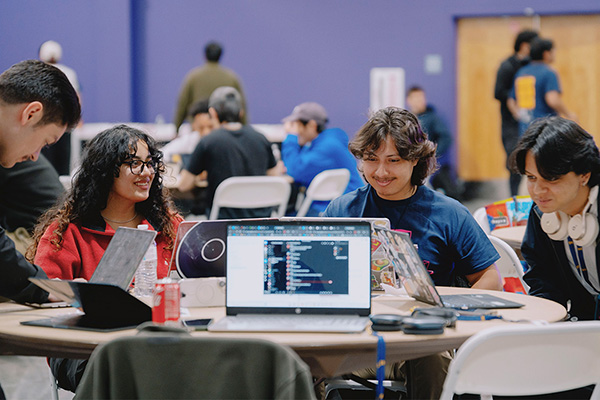
On Friday, Oct. 3, students filled SFSU’s Annex 1 for SF Hacks x GDG AI Hackathon, the University’s first hackathon dedicated to artificial intelligence.
The event was organized by two student organizations: SF Hacks and the University’s chapter of the Google Developer Group (GDG) which is supported by Google. The SFSU AI Student Commons sponsored the event as a way to show University support for students putting skills into practice. Together, the groups set out to give their peers — particularly beginners — a supportive environment to learn, network and create innovative solutions using AI. Participation was open to students from any university.
During the opening ceremony, SFSU President Lynn Mahoney celebrated the collaboration behind the event, which brought together student organizers with support from the University, regional industry and community partners.
“This is a student-driven event,” Mahoney said, thanking SF Hacks and Google Developer Groups for their work. “Supported by the University, supported by regional industry, the Bay Area Council and Google. This is it. This is how we change the world.”
Kelly Cure, vice president of public policy at the Bay Area Council, joined Mahoney as a speaker during the opening ceremony, emphasizing the value of pairing technical skills with curiosity to explore AI. The council is working with SFSU through AI For All, a future initiative aimed at expanding AI literacy in the Bay Area.
“[We’re] super excited to have the Gators, SFSU, as anchor partners in this program,” Cure said.
For the student organizers, building community was as important as building with AI.
“I really hope they take away that SFSU is a community. It’s somewhere you can thrive with other people and brainstorm and take your ideas and put them into real-life applications,” said David Ghukasyan, a Business Analytics and Statistics double major and lead ambassador of the SFSU AI Student Commons. “If [students come to the hackathon and] actually talk to other people about it and get a different perspective, then in my eyes, that’s a success.”
Participants worked as individuals or groups to create AI-related projects that fit into four tracks, including an SFSU track encouraging projects that would make life easier for SFSU students or anyone in the University community. Judges award more than $2,000 in prizes.
Students created projects that helped peers with wayfinding, scheduling, delegating for group projects and finding free food on campus. Other hackers created tools to support teachers specializing in dyslexia and help older adults interpret medicine labels and manage post-hospital visit instructions.
At noon, organizers invited the wider campus community into the conversation with “Live from the Hackathon: SFSU Students on AI,” a Zoom discussion where a panel of four students from Business, Statistics, Computer Science and Public Health spoke with the SFSU community about AI.
“It’s super important to have these conversations because when we don’t, silence kicks in and we have a lot of assumptions,” Ghukasyan said. He, along with his fellow panelists, honestly discussed their AI usage, the pros and cons in their view and how they’d like to see faculty and staff use and regulate AI on campus. Some students admitted their distrust of the technology.
“At SFSU, [AI is] something we are very open about. [We] have people who talk negative on the matter and we have people who talk positive on the matter. We can get that common ground and learn as a community,” Ghukasyan said.
Community partners were also in attendance to help kick off the event, mentor during the program and judge final projects. Alumnus Taso Grigoriou, now a Google software engineer, and Monica Kelly, Google corporate counsel and legal AI enthusiast, joined the opening ceremony. In addition to sharing his journey, Grigoriou discussed his job and shared his perspective on students’ burning questions, including “What’s the quality that people look for when hiring software engineers?”
“I started at City College, dropped out to pursue music, came back two years later, started as a math major initially and pivoted quickly to computer science when I fell in love with making iOS apps,” Grigoriou (B.S., ’19) said about his own path. “From there, I leveraged some of those side projects, iOS apps, to an Ancestry internship in the city and then I joined Google right out of college in 2019. I’ve been there since.”
Photo by Juan Montes
Kesia Williams and Jessie Peterson met 16 years ago through SFSU’s Guardian Scholars Program. They were participating in Fostering Art, a photography program for former foster youth, when they were paired for an exercise meant to help them get to know one another.
The conversation was fairly routine until Peterson asked Williams when her birthday was.
“Dec. 12,” Williams answered.
“No, it’s not,” Peterson said.
Williams remembers giving her a look. Peterson insisted. Her birthday was Dec. 12, too. They pulled out their IDs to settle the matter and discovered they were, in fact, born on the same day.
They have called each other “Twin” ever since.
In the years that followed, Williams and Peterson studied together, celebrated birthdays and traveled together. After Williams returned to San Diego, they stayed close, regularly visiting one another in San Diego and San Francisco.
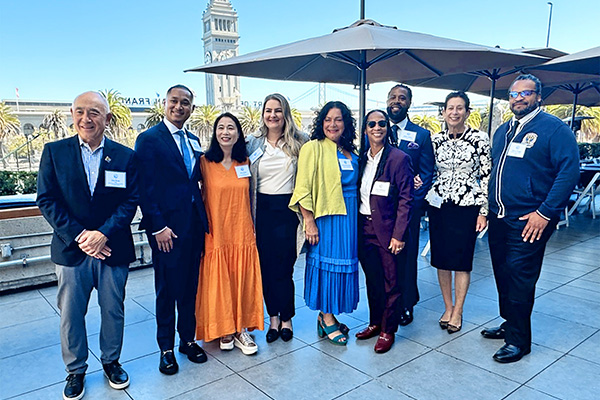
Their friendship was one of many stories shared Thursday, Oct. 1, when they returned to SFSU for the Guardian Scholars Donor Appreciation Luncheon. Hosted by longtime supporters and San Francisco State Foundation directors Dana Corvin and Amy Chan, the event brought together alumni, University leaders, friends and family to recognize a program that has served more than 400 students since it was founded in 2005.
Williams came to SFSU after spending six years in San Diego County’s foster care system and left shortly before she graduated from high school. She earned an associate degree at a community college before transferring to SFSU, where she joined Guardian Scholars and earned her bachelor’s degree in 2011. She later received a master’s degree from the University of Arizona.
After graduation, she stayed in touch with Guardian Scholars co-founder Xochitl Violetta Sanchez. At one point, Williams was between jobs and trying to figure out what she wanted to do next. Sanchez listened, offered advice, connected her with a mentor and even offered her a job.
Then Sanchez called and asked Williams to speak at a Guardian Scholars gala.
Williams agreed before she had given much thought to what she might say. Preparing for the event forced her to take stock of where she had been and what she had accomplished.
“Xochitl wasn’t just asking me to speak; she was helping me see what she already saw in me,” Williams said. “My resilience. My dedication to learning. My ability to inspire. And my strength to keep going even when I didn’t yet know exactly where I was headed.”
Williams went on to build a career supporting students, including young people who had experienced foster care. She began her career in the nonprofit sector before moving into higher education in 2016 and has since led Guardian Scholars programs at San Diego State University and UC San Diego. Today, she is a student conduct officer at SDSU.
She also created the Future Leaders Career Program, a weeklong summer program that introduces former foster youth attending California universities to career opportunities. Participants have visited companies including Google, Meta, Apple, LinkedIn and Salesforce, where they take part in workshops and meet people working in a range of professions.
When Williams was developing the program, she called Sanchez for advice.
After graduating from SFSU in 2014, Peterson worked as a paralegal at a corporate immigration law firm in San Francisco while serving on the San Francisco Juvenile Justice Commission, eventually becoming its chair. She went on to earn her law degree from the University of San Francisco. Today, she is an associate deputy state public defender with the California Office of the State Public Defender, representing clients in appeals before the California Courts of Appeal and California Supreme Court.
Peterson still lives in San Francisco, which she calls her “forever home.” She is also the mother of a young son.
“I would not be the person or professional I am today without the Guardian Scholars Program,” Peterson said. “GSP is my family. It provided me, as a student at SFSU, with financial, academic and housing support. Most importantly, it gave me community, unconditional love and long-lasting relationships.”
One of the stories she shared at the luncheon took place during her freshman year, when Guardian Scholars helped her land her first job, an internship with the San Francisco Mayor’s Office of Neighborhood Services.
Peterson was sitting in the front office at City Hall on her first day when the first constituent she was expected to help walked through the door.
It was Sanchez.
Peterson remembers turning bright red, worried that her new colleagues would figure out that her mother figure had come to check on her. Sanchez played along, pretending she had a problem involving plumbing or a housing permit. When no one was looking, she snapped a picture of Peterson and left.
“At that moment, I was so embarrassed,” Peterson recalled. “But I also felt so much love.”
Years later, Peterson returned to City Hall after being selected to administer the oath of office to San Francisco Mayor Daniel Lurie. She had first met Lurie 14 years earlier when he was CEO of Tipping Point Community, which supported Guardian Scholars.
When Peterson was invited to bring family members to the January 2025 ceremony, everyone she chose had a connection to the program: Sanchez and Guardian Scholars co-founder Sonja Lenz-Rashid, Williams, fellow Guardian Scholars alumnus Bonta Hill and mentors Jason and Abby Porth, whom Peterson had met through Guardian Scholars.
“When I think about that moment, I can’t help but think back to that nervous freshman sitting in the front office of City Hall on my first day,” Peterson said. “Years later, I was at City Hall again. This time, to administer the oath of office to the mayor of San Francisco. And, again, I was not alone. My GSP family was standing beside me.”
That kind of lasting connection has been part of Guardian Scholars since its beginning.
The program, which is part of SFSU’s Educational Opportunity and Pathway Programs and works in collaboration with the School of Social Work, serves undergraduate and graduate students who are current or former foster youth. Its support is tailored to individual students and can include priority access to campus housing, scholarships, priority registration, financial aid assistance, academic and personal support, peer mentorship and connections to internships and jobs.
Guardian Scholars also uses a clinical model, with licensed clinical social workers providing case management and dedicated mental health therapists working with students. Staff help scholars navigate University services and maintain connections with community organizations and social service agencies.
“Access has always been central to SFSU’s mission, but opening the door to a university education is not enough,” said Anjali Billa, interim vice president for University Advancement and president of the San Francisco State University Foundation. “We have a responsibility to make sure students have the support, resources and sense of belonging they need to earn their degrees and build meaningful lives and careers.”
Donors have contributed nearly $20 million to Guardian Scholars over the past two decades. The money has not come from a single transformational gift. It has been built over time through contributions large and small, in-kind gifts, alumni support, foundation grants and donors who have stayed involved with the program over the years.
“Guardian Scholars shows what is possible when a community continues to show up for students,” said Don Endo, chair of the San Francisco State University Foundation. “We are deeply grateful to the donors whose generosity gives students the support and opportunities they need to earn their degrees and build successful futures.”
The program is still growing. Fall 2026 brought its largest incoming class to date, while SFSU recently established a guaranteed-admission pathway for eligible current and former foster youth attending San Francisco Unified School District and City College of San Francisco.
About 70% of SFSU Guardian Scholars graduate, according to Sanchez. More than 400 students have participated in the program since it was founded.
“When we started Guardian Scholars more than 20 years ago, we knew getting young people into college wasn’t enough — they needed a community that believed in them and stood beside them,” Sanchez said. “I am incredibly proud of our students and alumni, and deeply grateful to everyone who has helped build and sustain this community.”
Lenz-Rashid puts it more simply.
“We could not change what happened to them, but we could change what happens next,” she said.
Williams and Peterson graduated years ago, but both remain closely connected to Guardian Scholars and the people they met through the program.
Guardian Scholars have a phrase for it.
“Once a GSPer, always a GSPer,” Williams said. “That’s because we are a family, forever.”
Additional links
- Learn more about the Guardian Scholars Program and how to support its students.
- Watch Guardian Scholars alumnus Bonta Hill share how the program helped him earn his SFSU degree and launch his career in sports broadcasting.
- Read more about Guardian Scholars alumna Jessie Peterson and her journey from SFSU to a career in public service.
Photo by David Knutson
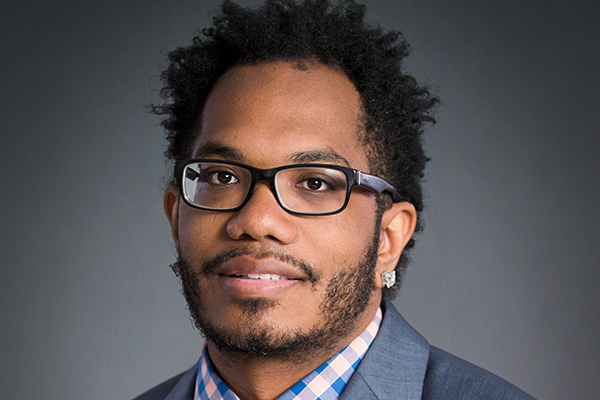
Provost Amy Sueyoshi has announced the appointment of Robert L. Bonner as interim dean of the Lam Family College of Business, effective Saturday, Jan. 2, 2027.
Bonner joined SFSU in 2018 and is serving his second term as chair of the Management Department. A recipient of the Lam-Larsen Distinguished Teaching Award, he brings 14 years of teaching experience across three universities and has authored or coauthored 15 publications on organizations, management and business education. He also serves as associate editor for two management education journals. His extensive university service includes membership on the Academic Senate Executive Committee and committees focused on enrollment management, the first-year experience and the Academic Affairs budget.
Provost Sueyoshi extends her gratitude to the faculty, staff and campus partners who provided feedback throughout the selection process, with special appreciation to advisory committee members Theresa Roeder, Jeffrey Chun and Andreana Clay.
Two Gators from the SFSU wrestling team competed at the U23 World Championships on Oct. 16 – 17 at the Thomas and Mack Center in Las Vegas. Hayden Ancheta represented the Philippines at 61 kilograms in the freestyle, and Kydyn Lima represented Brazil at 79 kilograms in the freestyle.
This week’s Cybersecurity Awareness Month tip from Information Technology Services: Scammers are experts at manipulating emotions, and one of the biggest red flags in an email, text or even a phone call is when it makes you feel sudden urgency, whether it’s excitement, fear or pressure to act fast.
Messages that state “You’ve won a prize,” “You owe back taxes” or “Your boss needs your bank account info right now” are common scam tactics. These communications try to trigger strong emotions to get you to click before you think. Always pause and ask yourself is the message unexpected, emotional, or asking for payment or sensitive information. Instead report the message as phishing, delete the message, and blocking the sender.
The CSU CourseMatch program has released its call for proposals for spring 2027. Qualifying courses must be fully online and asynchronous undergraduate general education (upper or lower division) and have less than 15% repeatable grades (D, F, W, NC) from previous semesters.
Proposals must be submitted by Friday, Nov. 6.
Please visit the SFSU CourseMatch page for more information and to make a campus submission.
The J. Paul Leonard Library provides free access to NYTimes.com articles, infographics, podcasts and videos through its subscription to The New York Times Digital Edition. This University-wide subscription allows you to view digital content on NYTimes.com and with The New York Times app. It does not include NYT Cooking, Games, Wirecutter or The Athletic.
To get started, follow the instructions or how-to video via the SFSU website.
Many SFSU employees who signed up when the Library launched this subscription in fall 2022 are due to renew their accounts this fall. Faculty and staff have four years of full account access and then need to reauthenticate for four more years. Students have access until Dec. 31 of the graduation year they enter when they create their account. Please login to renew or check your account’s expiration date.
For questions, please email a librarian at ask@sfsu.libanswers.com.
The SFSU Academic Senate met on Tuesday, Oct. 13, via Zoom.
The Senate:
- Adopted by general consent the following items:
- Revision to University Research, Scholarship and Creative Activities Council, No. S21-231
- Graduate Certificate in Inclusive Early Learning and Intervention
- Passed the following item in second reading:
- Minor in Forensic Investigations
- Minor in Operations and Supply Chain Management
- Bachelor of Arts in Child Adolescent Development, concentration in Elementary Education Integrated Teacher Education Program
- Bachelor of Arts in Applied World Languages
- Certificate in Exercise Physiology
- Minor in German Studies
- Minor in Italian Studies
- Heard in first reading:
- Course Syllabus Policy, No. S25-257
- Minor in Comparative World Literature
- Department Chair and Equivalent Unit Directors, No. S26-145
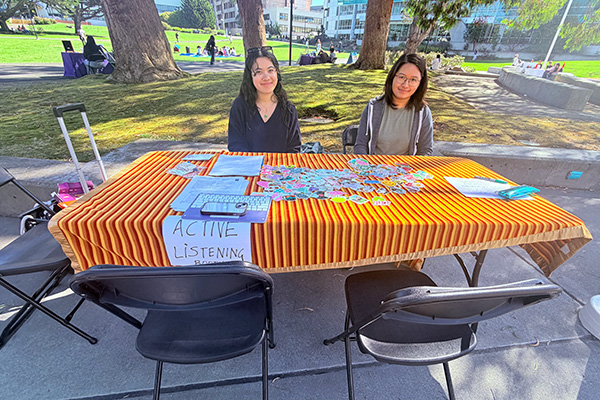
Worried about exam?s Tired working multiple full-time jobs? Uncertain about your career? Have a dilemma you would like to talk about? Walk in and campus peer mediators will listen to you without judgment and offering advice. Students from Communication Studies 430: “Peer Mediation” along with Professor Ashmi Desai will have their active listening booth set up on Wednesdays, 1 – 4 p.m., through Dec 2 outside the Student Center
Communication Studies 430 counts toward the Conflict Transformation Certificate.
For questions about the table, class or certificate, please email Desai at ashmidesai@sfsu.edu.
Photo courtesy of Ashmi Desai
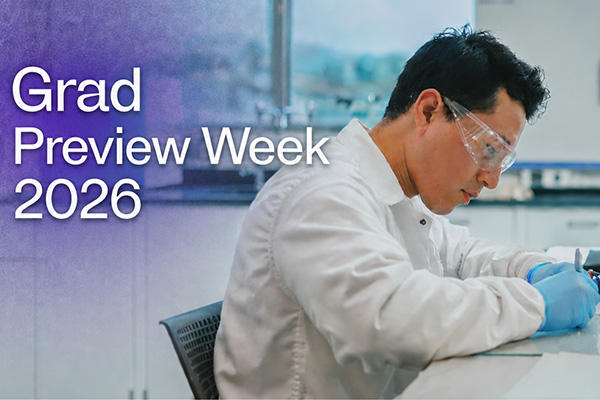
The Division of Graduate Studies and Career Development will host our annual Grad Preview Week Monday, Oct. 19 – Friday, Oct. 23. The division asks the campus community to encourage undergraduate students to join the many virtual and in-person events and explore SFSU graduate education. Staff are also encouraged to explore opportunities to pursue an advanced degree or graduate certificate at SFSU.
The Center for Equity and Excellence in Teaching and Learning (CEETL) invites all SFSU faculty to help reimagine and relaunch the Faculty Commons. Visit the open-house event on Tuesday, Oct. 20, noon – 2 p.m., in Library 286. Enjoy refreshments, explore the space, reconnect with colleagues, share your ideas for how you’d like to use it and help envision what Faculty Commons can become.
Over the years, this space has served many purposes — from faculty gatherings to campus events. CEETL is excited to bring it back to its original spirit: a welcoming space for faculty to connect, collaborate, recharge and simply be.
CEETL hopes the Faculty Commons will become a place you can make your own, whether you’re looking for a quiet corner to read or grade, a comfortable place to enjoy lunch, a space to meet with colleagues or an opportunity to unwind through crafting, mindfulness or conversation. CEETL wants this to be a space for faculty, shaped by faculty — a place to foster community, creativity, connection and belonging across campus.
The “AI Literacy Essentials: Critical Analysis of Generative AI” course explores the critical analysis of generative artificial intelligence (AI) to support responsible use of this technology. It will be held Thursday, Oct. 21, 10:30 – 11:30 a.m., via Zoom.
Learn how AI models are trained and why misinformation and biases may occur in AI-generated content. Develop strategies to analyze AI outputs and assess AI tools for quality and ethical considerations. Participants will be expected to engage in the evaluation process through collaborative, hands-on activities and reflective discussions.
This course is an elective that counts toward receiving a digital badge for the AI Literacy Education Program.
Human Resources invites staff to attend its next Staff Forum on Wednesday, Oct. 21, 11 a.m.– noon, via Zoom. All SFSU staff, except management personnel plan employees and faculty, are encouraged to attend. These forums are held monthly during the academic year and are intended to share information across campus.
This month welcomes an update on the campus website project from the Office of Strategic Marketing and Communications, new Alumni Relations efforts and how to support students in tutoring and advising with the Undergraduate Advising Center and Tutoring and Academic Support Center.
The College of Ethnic Studies will host a block party on Wednesday, Oct. 21, noon – 2 p.m., on Malcolm X Plaza. Explore and learn about our majors: American Indian Studies, Africana Studies, Asian American Studies, Latina/o Studies, Race and Resistance Studies and Race Ethnicity and Health as well as our master’s programs in Ethnic Studies and Asian American Studies.
Renowned science-fiction author Ted Chiang will present a talk about speculative fiction as viewed through the lenses of naturalism and expressionism on Wednesday, Oct. 21, at 12:30 p.m., in Humanities 587. Creative Writing Professor Andrew Joron hosts the event.
Chiang is known for his philosophically rich and meticulously crafted short stories. His novelette “Story of Your Life” was adapted into the Academy Award-winning film “Arrival.” Chiang also writes essays and op-eds on artificial intelligence (AI) and technology for publications like The New Yorker. He was inducted into the Science Fiction and Fantasy Hall of Fame in 2020 and named one of Time magazine’s 100 Most Influential People in AI in 2023. He has won top honors in the science-fiction field, including four Hugo Awards and four Nebula Awards.
The Digital Media Studio and MakerSpace hosts events for the SFSU community.
This week:
- “Crochet Hours,” Wednesday, Oct. 21, 3 – 6 p.m., Library 260: Relax, create and crochet with others. Tools and materials will be provided, and the hosts will be happy to help if you need assistance. All experience levels are welcome, including beginners.
- “Laser Cutting 101” workshop, Thursday, Oct. 22, 3 – 5 p.m., Library 260: Learn the basics of laser cutting and create your own wooden keychain! Design and engrave your name, image or custom design onto wood. You will be guided through the process, and all materials will be provided.
The Lam-Larsen Initiatives and Centers host the webinar “The Agentic Future: Designing and Scaling Multi-Agent AI Systems” on Monday, Oct. 26, 4 – 5 p.m.
In this webinar, Babak Hodjat, Ph.D., will explore the emerging world of multi-agent AI systems and demonstrate how intelligent networks of AI agents can be designed and scaled, including a look at Neuro SAN, an open-source framework for prototyping and scaling systems of agent networks.
Hodjat is the chief artificial intelligence (AI) officer at Cognizant Technologies. He is a longtime entrepreneur and the co-counder and former CEO of Sentient, where he was responsible for the core technology behind what became one of the world’s largest distributed AI systems. Babak was also the founder of Sentient Investment Management, one of the world’s first AI-driven hedge funds. Hodjat is a serial entrepreneur who has started Silicon Valley companies as a principal inventor and technologist and has 25 granted or pending patents to his name. He is also the primary inventor of Dejima’s patented agent-oriented technology, which was applied to intelligent interfaces for mobile and enterprise computing and contributed to the technology behind Apple’s Siri.
A memorial service for Leona M. Bridges (B.A., ’79) will be held Wednesday, Oct. 28, at 11 a.m. at Third Baptist Church, 1399 McAllister St., in San Francisco. A longtime member of the SFSU Foundation Board of Directors and a generous supporter of the University, Bridges passed away in late September.
Bridges spent more than two decades as a managing director at Barclays Global Investors and held numerous public service positions, including commissioner of the San Francisco Employees’ Retirement System and member of the CSU System Investment Advisory Committee. She was also active in Delta Sigma Theta Sorority. She established the Leona M. Bridges Endowed Scholarship in Business to support students in need and was inducted into the SFSU Alumni Hall of Fame in 2012.
A free workshop for beginner gardeners is offered on Wednesday, Oct. 28, at 12:30 p.m. in Library 121 and is open to all at SFSU. The purpose is to educate participants about sustainable food systems and encourage budget-friendly gardening by highlighting free resources available through the J. Paul Leonard Library, public libraries and community organizations.
Participants will have the opportunity for hands-on practice starting potted plants they’ll be able to take home. The event also provides social engagement and community building with others who share an interest in starting to garden.
This workshop is part of an Office of Research and Sponsored Programs grant project. For questions, please email Zubaida Qamar at qz@sfsu.edu or Supriya Misra at supriya@sfsu.edu.
MELA (Movimiento Estudiantil Para la Liberación de las Americas), the Ltnx Queer Club, Lambda Theta Nu and the Latina/Latino Studies Department sponsor a Día de los Muertos/Day of the Dead event on Wednesday, Oct. 28, 4 – 7 p.m., in the University Club, Student Center.
During this event, attendees will be able to create and decorate their own amaranth sugar skull and contribute to a community altar. Guest speakers Tere Almaguer and Nancy Pili will lead a discussion on how we are connected to amaranth and the role ofrendas play during Day of the Dead. Snacks will be provided.
The Lam-Larsen Initiatives and Centers will host a talk on “Human Intelligence in the Age of AI: ‘AI, Art and Us’” featuring Maya Ackerman, Ph.D., on Monday, Nov. 30, at 5 p.m. at the Downtown Campus.
Ackerman is a leading expert in generative artificial intelligence (AI). She is the CEO and co-founder of WaveAI, one of the first generative AI startups, which has served millions across the globe. A professor of Computer Science at Santa Clara University, she has authored more than 50 peer-reviewed publications and is an internationally sought-after speaker, having given talks at Oxford, Google, the United Nations, Stanford and Microsoft. Her work has been featured in Forbes, National Public Radio, Fortune, NBC News and other major outlets. She is the author of “Creative Machines: AI, Art and Us,” an exploration of how AI is reshaping creativity and what that means for the future of humanity. She has been named among 100 Women in AI, a Billboard Executive Honoree and the Silicon Valley Business Journal’s Woman of Influence.
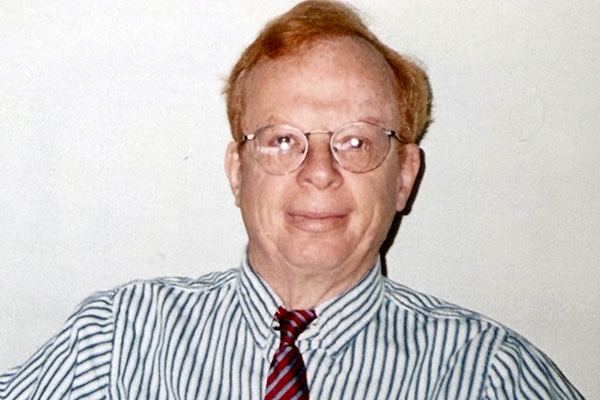
Arthur Asa Berger, a professor emeritus whose almost 100 books helped shape how generations of students learned about media and popular culture, died Sept. 19, at 93.
Born in Boston in 1933, he earned a bachelor’s degree in Literature and Philosophy from the University of Massachusetts Amherst in 1954, a master’s in journalism from the University of Iowa in 1956 and a doctorate in American Studies from the University of Minnesota in 1965, writing his dissertation on the comic strip Li’l Abner as a satire on American life.
In 1965 he joined the Broadcast and Electronic Communication Arts department at San Francisco State, where he taught writing and media criticism for 38 years until his retirement in 2003. He published more than 130 articles and almost 100 books on media, popular culture, humor, semiotics and culture, among them “Media Analysis Techniques,” “Media and Communication Research Methods,” “Seeing Is Believing,” “An Anatomy of Humor” and “Ads, Fads and Consumer Culture.” His work was translated into eight languages, including 13 books rendered into Chinese and five into Persian.
He was a Fulbright scholar at the University of Milan in 1963 – 1964 and later a Fulbright senior specialist, lecturing on semiotics and media in Argentina, Germany and elsewhere. He held visiting appointments at the Annenberg School for Communication at the University of Southern California, Hong Kong Polytechnic University and Jinan and Tsinghua universities in China. He lectured in more than a dozen countries. In 2009 he was inducted into the University of Iowa School of Journalism and Mass Communication Hall of Fame.
In addition to his scholarly books, he wrote a series of academic murder mysteries, including “Postmortem for a Postmodernist” and “Durkheim Is Dead: Sherlock Holmes Is Introduced to Sociological Theory.” In the latter book, by his own description, he cheerfully bumped off what he termed “loathsome academics” while teaching readers something about theory. He drew cartoons, illustrated his own books and those of other writers, and described himself as a popularizer of obscure theories “with questionable results.” He kept writing his entire life.
Berger was, by any measure, hard to miss. The bright red hair he had for most of his life was matched by a sartorial style entirely his own. He and Phyllis, his wife of 65 years, loved to travel, and in his later life he particularly loved cruises.
He is survived by his wife Phyllis, his daughter Nina Savelle-Rocklin, his son Gabriel Berger and four grandchildren: Ariel Beesley, Kavanna Rocklin, Seth Berger and Noah Berger.
Photo courtesy of Nina Savelle-Rocklin
SFSU Spotlight
Women and Gender Studies Professor Martha Kenney and Associate Professor of Anthropology and Public Health Martha Lincoln presented their collaborative research on artificial intelligence (AI) adoption in higher education at Memorial University Newfoundland (MUN) earlier this month. They discussed their work at an Oct. 2 fireside chat titled “Marthas Against AI: Inside the Fight for Higher Education” with MUN Professors Christina Doonan (Political Science) and Carol Lynn D’Arcangelis (Gender Studies).
The same week, both SFSU faculty members joined programs on Radio New Zealand and Canada’s CBC to discuss trends in AI adoption by universities globally.
Supported by an SFSU Climate HQ Climate Justice Mini-Grant in 2024, Economics Lecturer Faculty Camille Antinori facilitates the Berkeley Fishing Oral History Project with Professor of Economics Venoo Kakar and Professor of Recreation, Parks and Tourism Pavlina Latkova. It documents the intergenerational stories of people who grew up fishing along the Berkeley waterfront and highlights fishing as a source of community, food, well-being and connection to nature.
The project’s stories recently reached a broader audience through an episode of the East Bay Yesterday podcast, “Fishing Kept Us Out of Trouble,” illuminating how equitable access to the Bay shoreline has shaped generations of East Bay residents. The first four photos shown in this episode were collected during this investigation.
An Oct. 6 article in Travel and Leisure magazine features Professor of Kinesiology Jimmy Bagley discussing the growing popularity of “runcations,” or vacations planned around running events.
Bagley, a muscle physiologist and amateur ultramarathon runner, shares advice on preparing for destination races, including the challenges of travel, jet lag, altitude and unfamiliar environments.
“Usually the most stressful challenge will be the one that is most different from your norm,” Bagley said. He also discusses how jet lag affects muscle performance, the benefits of light exercise after traveling, and the importance of post-race recovery.
As artificial intelligence (AI) becomes increasingly embedded in children's everyday lives, a new publication co-written by Associate Professor of Child and Adolescent Development Rachel Flynn argues that developmental science should guide how children learn to understand and use AI.
While public discussions often focus on the risks of children’s AI use, the authors emphasize the importance of understanding children’s developmental capabilities and providing age-appropriate guidance. “Children’s AI Use: Developmental Risks and Opportunities in Early and Middle Childhood” is published in the Journal of Children and Media.
Drawing on research in cognitive development, the article examines how children’s understanding of AI changes from preschool through elementary school. Young children, for example, may attribute human-like thoughts and feelings to AI systems, potentially increasing their trust in inaccurate information. Older children develop stronger critical thinking and reasoning skills but still need guidance evaluating AI-generated information and recognizing when to rely on their own problem-solving abilities.
The authors offer recommendations for AI education and technology design that support children's developing cognitive abilities, including helping children understand AI’s limitations, recognize misinformation and think critically about AI-generated content.
Flynn’s research focuses on how media and technology shape children's physical, social and cognitive development. Her recent work emphasizes the importance of developmentally appropriate AI literacy.
California Assembly Speaker Robert Rivas has appointed Professor of Public Health Emma Sanchez-Vaznaugh to the California Precision Medicine Advisory Council.
The council advises and makes recommendations to the California Health and Human Services Agency on matters related to the California Initiative to Advance Precision Medicine. Members of this council represent diverse stakeholders, including patient advocacy and community groups, private industry, health policy, clinical providers, venture capitalists and philanthropy and academia.
“Queens of the Court (As Donas da Quadra)” (Editora Mulheres à Cesta), a new book by Professor of Kinesiology Claudia Guedes, brings back the story of Maria Helena Cardoso and Maria Helena Campos, who helped reshape Brazilian women’s basketball.
It will be released in Campinas, São Paulo, Brazil, at the same time as a documentary. The book launch took place on Oct. 15 at Clube de Regatas in Campinas.