News and Annoucments
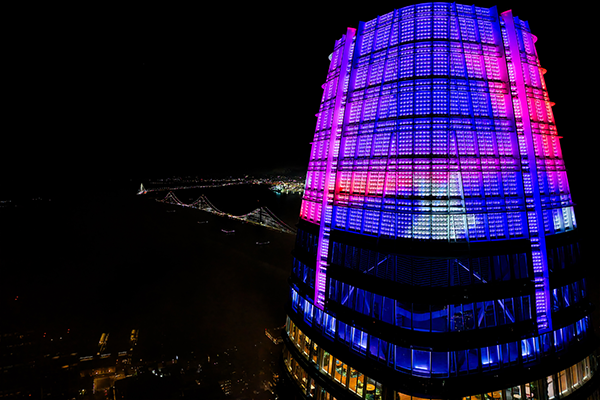
Digital artwork created by SFSU students received a high level of visibility — 1,070 feet high to be exact — at the top of the Salesforce Tower. Tens of thousands of people looked up to the San Francisco skyscraper between May 21 and 23 to view their installation celebrating the Class of 2026.
“We have this amazing opportunity to make something for the second tallest tower this side of the Mississippi that’s going up during our graduation week,” said Gabe Janssen, one of 16 Broadcast and Electronic Communication Arts (BECA) students to volunteer for this project. “We’re going to show the world what we do.”
The six-minute video loop alternates moving images of graduates in caps and gowns with dancing alligators and more, all in colorful, high-contrast LED lights. Its debut coincided with SFSU’s Commencement, beginning after dark and the end of the ceremony.
Assistant Professor Graham Carpenter, the project coordinator, says that he has been excited to see it bring out the artistic talent in students that they didn’t know they had. As a Sports Emmy Award-winning cameraperson, he can relate.
“I teach directing. We do sports. We do drones. But how do we become a visual artist?” said Carpenter, filing through a storage bin filled with his media credentials from major American sporting events, including Super Bowl LX in February. “Tapping into this other visual artist side has been super awesome and really, really fulfilling.”
Student Carla Appleberry’s contributions include shooting and editing footage of dancers at Creations Berkeley Media and Performing Arts, her nonprofit organization for schoolchildren.
“Imagine being a kid and seeing yourself on top of the Salesforce Tower and how that may open up a world for you,” Appleberry said. “Being a woman in business, being able to be a business owner and further your education at the same time and have these opportunities as a minority, I think it’s paramount.”
The SFSU student art is a collaboration with the Salesforce Tower Top art project led by Jim Campbell and Emma Strebel. They frequently team up with universities and high schools to make art for display at the tip of the tower. Jillian Sobol (B.S., ’16) made the connection to get SFSU selected.
“I love the SFSU Commencement at Oracle Park, both when I was a graduate and an employee,” said Sobol, a former events manager in the SFSU Alumni Relations office. “Celebrating with City Hall and SFO in purple and gold Gator pride, when Salesforce [Tower] opened in 2018, I knew it should be part of the celebration.”
Amylah Charles, a graduating senior, says her fellow classmates aimed to present a thoughtful message, especially given the magnitude of the medium. It is the highest public art installation in the world and can be visible from 20 miles away.
“What story do you want to tell when you have the eyes of the city on you?” said Charles, also the award-winning business owner of Curly Crownz Hair Care and host of the “Under the Sun Podcastz.” “It was a heavy pit in my chest. I’m so excited to do this, but whoa, representation truly matters.”
Maya Alford-Hill showcased her skills and creative passions that also include television writing and a podcast, “The Hybrina Series.” She is excited not only by the boost it gives her portfolio, but also how others will react.
“This is a way to show what I was doing [on a California State University campus]. People underestimate what a CSU is,” said Alford-Hill, a junior from New Jersey. “Also, once I bring my grandma there, I think her face will light up.”
It is an extra tassel on the graduation cap for members of SFSU’s Class of 2026 like Charles and Appleberry.
“Every time I come across the Bay Bridge for school and I see the tower, I’m like, ‘I’m going to be up there flying, and everybody’s going to see it,’” Appleberry said. “And I’m going to be able to prove to everybody I made it. It’s my way of showing the world: Don’t count me out.”
Learn more about the Broadcast and Electronic Communication Arts Department.
Photo by Graham Carpenter
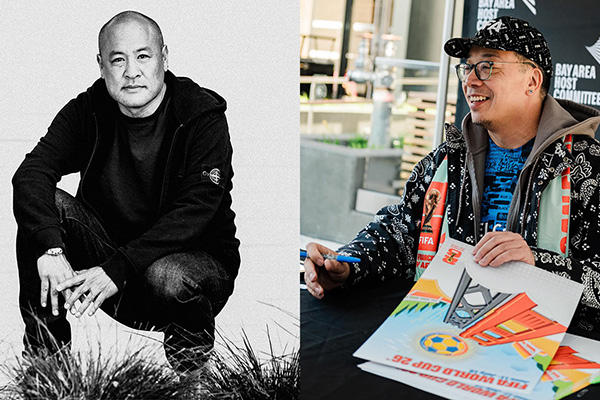
As millions of soccer fans around the globe turn their eyes toward the Bay Area this month for the FIFA World Cup 26, two alumni of SFSU’s School of Design are playing roles on the creative side. Dan “The Automator” Nakamura and LeRoid David exemplify how an education at SFSU prepares you for career success in ways you never would imagine.
The Bay Area Host Committee, the civic organization responsible for bringing major sporting events to the Bay Area, commissioned Nakamura (B.A., ’90) to remix the Official FIFA World Cup 26 Theme. David (B.A., ’02) won a contest for his poster design promoting the FIFA World Cup 26 in the Bay Area, which takes place Thursday, June 11, to Sunday, July 19, in Santa Clara.
LeRoid David
David’s poster is part of FIFA’s Host City series created through a contest, judged by FIFA and the Bay Area Host Committee. His expertise in storytelling through visual art made his submission stand out. On his full-color poster, towers from the Golden Gate and Bay bridges leap out from the fog, vaulting a soccer ball into the sky. His design is now featured on shirts and other merchandise.
“This is more than a poster — it represents a lasting moment in time,” said Zaileen Janmohamed, Bay Area Host Committee president and CEO. “As the FIFA World Cup 26 is played across 16 cities in three countries for the first time, LeRoid’s design will be etched in history as the Bay Area’s artistic contribution to this unprecedented global celebration of the game.”
David is a San Francisco native and proud second-generation Filipino American. The FIFA World Cup 26 poster has opened up many new opportunities for him. He is part of the San Francisco Giants 2026 Artist Series and has designed the jersey they will give away to fans at this year’s Filipino Heritage Night. He is also featured on the ESPN documentary “Last Train to North America.” His portfolio also includes work for NBC Sports Bay Area and almost every major Northern California professional sports team.
“The SFSU School of Design was more than learning new technology and producing art, but building self-confidence, communication and collaboration — skills that helped me work my way through complex work environments,” David said.
Dan ‘The Automator’ Nakamura
Nakamura’s remix of the Official FIFA World Cup 26 Theme infuses the distinct rhythm, vibe and cultural essence of the Bay. He is among 16 producers from each of the respective World Cup host cities across Canada, Mexico and the U.S. to be chosen to create a piece of music that blends global appeal with local sounds.
Nakamura is a music producer, DJ, composer and audio engineer. His lauded, innovative musical groups include Gorillaz, Deltron 3030, Dr. Octagon and Handsome Boy Modeling School.
For over two decades, the Grammy Award nominee has created progressive, genre-warping music on his terms. Whether collaborating with like-minded artists such as Del the Funky Homosapien and Damon Albarn or scoring films such as “Booksmart,” he has disregarded accepted convention and fleeting trends. Nakamura remains in constant motion, performing on stages around the world and lending his singular artistic vision to one endeavor after another.
Learn more about the SFSU School of Design.
Photos: Dan “The Automator” Nakamura by Josh Rose, LeRoid David by Jeffrey Tanhueco
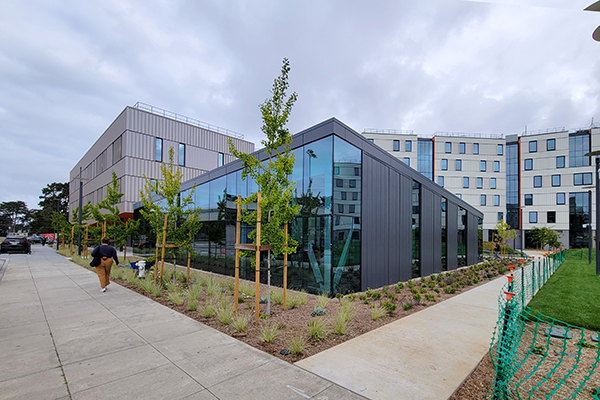
Two of SFSU’s newest buildings, West Grove Commons and the Gator Student Health Center, have been certified LEED Gold by the United States Green Building Council. This certification recognizes how the buildings were designed and constructed to maximize energy efficiency and other sustainability improvements.
Some of the features that contributed to this award include supporting sustainable transportation, reduced water consumption, optimized energy performance, improved indoor environmental quality and building life-cycle impact reductions. The project joins Manzanita Square, Mashouf Wellness Center, Marcus Hall and the Science and Engineering Innovation Center in SFSU’s collection of LEED-certified buildings.
Photo courtesy of Rutherford and Chekene
The Office of the Provost is pleased to announce the appointment of Christy Stevens as dean of the J. Paul Leonard Library following a comprehensive review process. Her appointment was effective June 1.
After serving as interim dean for the past year and a half, Stevens earned strong support from faculty, staff, administrators and campus partners who praised her transparent, inclusive and collaborative leadership style. A strategic academic library leader with more than 23 years of experience in academic libraries and more than a decade of administrative leadership in the CSU system, she has strengthened communication, shared governance and organizational effectiveness while fostering a more welcoming library culture. Under Stevens’ leadership, the library has become more “sticky,” an encouraging space for students to study and linger and produced its first ever impact report.
Stevens holds an M.A. in Library and Information Science from the University of Iowa, as well as graduate degrees from the University of California, Irvine, and San Diego State University.
The Office of the Provost would also like thank the search committee for its service, collaboration and commitment during this process.
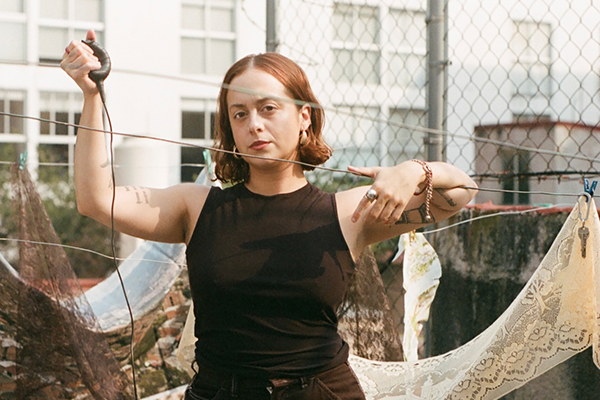
Paola de la Calle is the recipient of the Ann Chamberlain Artist in Residency for 2026 – 2027. This yearlong residency, sponsored by the Harker Fund of the San Francisco Foundation, honors the late Ann Chamberlain through its support of women and non-binary artists working in the nine Bay Area counties.
Over the course of the 2026 – 2027 academic year, de la Calle will collaborate with SFSU students, faculty, staff and the general public in her development of “Alternate Atlas,” the theme of her residency.
The residency will culminate in an exhibition in SFSU’s Fine Arts Gallery in August 2027.
The School of Art at SFSU offers B.A. degrees in Studio Art and Art History, and an MFA in Art. The school has 10 full-time faculty and over 450 majors. The Ann Chamberlain Artist in Residency will have a studio space and access to the School of Art’s production facilities that include printmaking, photography, textiles, painting and drawing, ceramics and sculpture/expanded practice.
‘Alternate Atlas’
At its core “Alternate Atlas” is an exploration of how maps have shaped how we see and understand the world, our place in it and our relationship to others. It uses art and the process of making to interrogate the past and speculate on the future — to imagine new worlds collectively. Developed through collaborative projects with student participants and the larger SFSU community, “Alternate Atlas” asks how maps might be reclaimed as spaces of imagination, resistance and collective memory.
Why is renaming the Gulf of Mexico the Gulf of America significant? What histories are made visible — and which are rendered invisible — through cartographic practices? How do maps serve as tools of colonial control or dispossession? And how might maps function as sites of resistance?
“Alternate Atlas” asks what shifting maps can reveal about power, memory and collective history. Using archival maps and cartographic methods as a point of departure, the project explores how dominant narratives and borders are constructed, preserved, and enforced and asks us to critically examine maps as political and cultural documents. Through this exploration, “Alternate Atlas” proposes that unofficial forms of knowledge and record-keeping — personal memory, oral histories and embodied practices — can serve as an intervention to silences in formal archives and existing maps.
The project draws from historical and contemporary examples of people and communities that have collaborated, resisted erasure and preserved memory outside of official systems. Guided by a series of workshops and interventions, project participants will be encouraged to draw from their own histories, community knowledge and materials in their environment to create speculative maps of the future, reinterpret first person accounts of colonization and westward expansion, and plot sites of resistance.
Through the process of cutting, transforming and mending, this project explores mapping as both a physical and conceptual act of repair. By stitching together fragmented histories of the past and present, “Alternate Atlas” imagines new ways of seeing the world — one that honors memory and opens space for more complex, collective understandings of place and belonging.
Paola de la Calle
de la Calle is a Colombian American multidisciplinary artist whose work examines home, identity, borders and nostalgia through the use of textiles, printmaking and sculpture. In her practice, de la Calle combines photographs sourced from family albums and found images which she prints on textiles, as well as poetic texts, paintings made with coffee instead of paint and found objects, to mine the aesthetics of nostalgia and examine the sociopolitical relationship between the United States and Colombia.
Ann Chamberlain Artist in Residency
The residency honors the legacy of artist Ann Chamberlain, who died from breast cancer in 2008 at age 56. “Ann was a woman of great courage and commitment,” writes her friend Whitney Chadwick, emerita Art History professor at SFSU, where Chamberlain received two graduate degrees and also taught. “All of her work — from monumental public installations to printed books and hand-drawn maps — evolved from her belief that collaborative, community-based, culturally specific artwork has the power to redefine public spaces and alter private lives.”
The Harker Fund of the San Francisco Foundation is supporting two Ann Chamberlain Artists in Residency during the current cycle. Along with de la Calle’s residency at SFSU, Ashwini Bhat will be in residence at the Oakland Museum of California.
Photo courtesy of the SFSU Fine Arts Gallery
Calling all Gators: For a limited time, you can leave a legacy at SFSU with a personalized, engraved brick displayed on campus for years to come. A limited number of bricks are available for purchase through Friday, July 31 — a perfect way to show your Gator pride or honor a special Gator in your life.
Amit Ghanghas, a graduate student in Kinesiology, is conducting an anonymous master’s thesis survey on yoga participation, awareness of SFSU yoga offerings and what may make yoga easier or harder to access at SFSU.
SFSU undergraduate students, graduate students, faculty and staff who are 18 years of age or older are invited to participate. You do not need to have practiced yoga before. Your perspective is valuable whether you currently practice yoga, used to practice or have never practiced.
The survey takes about 12 – 15 minutes. Participation is voluntary, and survey responses are anonymous.
At the end of the survey, participants may choose to enter a separate, unlinked optional drawing for a chance to receive a $20 Amazon electronic gift card.
Celebrate the legacy of groundbreaking filmmaker and SFSU alumna Barbara Hammer at a special screening of “Barbara Forever” during Frameline50, the San Francisco International LGBTQ+ Film Festival. The event is Thursday, June 25, 7 – 11 p.m., at the Castro Theatre in San Francisco. Tickets are $15 each.
“Barbara Forever” highlights Hammer’s (M.A., ’75) pioneering impact through archival footage, personal reflections and intimate storytelling.
Join fellow Gators for a reception and an opportunity to connect with the film’s director, Hammer’s partner and other community members ahead of this powerful tribute to one of queer cinema’s most influential voices. The reception will be held within walking distance of the Castro Theatre.
Please note: This film contains sexually explicit content.
CalPERS-eligible faculty and staff are invited to attend a virtual CalPERS education class to help plan for retirement. It will be held via Zoom on Friday, July 17, 9 – 11:30 a.m.; Friday, Sept. 11, 1 – 3:30 p.m.; and Friday, Nov. 6, 1 – 3:30 p.m.
Offered by CalPERS, this webinar is their most comprehensive class to provide a deeper understanding of your benefits as you begin to prepare for retirement. Learn how your pension is calculated, ways to increase it and payment options for your beneficiary. You will also learn about the CalPERS special power of attorney and employer-contracted CalPERS health benefits.
Please RSVP via Qualtrics for the CalPERS retirement webinar.
SFSU Spotlight
The Office of Research and Sponsored Programs (ORSP) congratulates these faculty members and others for their recent grant awards.
Niny Arcila-Maya, assistant professor of Mathematics: $7,300 from the Center for Undergraduate Research in Mathematics (CURM)/National Science Foundation for “CURM Mini-Grant.”
The grant supports undergraduate research at the intersection of topological data analysis and economics.
Tendai Chitewere, professor of Environment: $48,000 from the Crankstart Foundation for “San Francisco Math Circle.” The grant gives about 20 scholarships to low-income San Francisco Math Circle summer participants.
Jeff Duncan-Andrade, professor of Latina/Latino Studies and Race and Resistance Studies: $100,000 from the Stuart Foundation for “Repurposing Public Schools: Toward a Model of Community Responsiveness and Wellness.” The project studies what it will take (collectively, financially, socially, politically and emotionally) to transform whole school institutions into truly community-responsive spaces.
Matt Ferner, National Estuarine Research Reserve (NERR) director: $40,899 from the Environmental Protection Agency/San Francisco Estuary Institute for “Beneficial Baylands: Innovation and Tools for Nature-Based Adaptation Project.” NERR staff and students will collect surface elevation data from regional wetlands to support development of a new vegetation-corrected digital elevation model for the San Francisco Bay.
Recent SFSU Journalism graduates Paula Sibulo and Olivia Mendez are being recognized for their reporting on the innovative Wilderness Arts and Literacy Collaborative, a long-running program that integrates ethnic studies and environmental education for high school students in San Francisco. Their story, “Combining ethnic studies with outdoor ed to foster connection, inside and out,” aired on KALW-FM’s “Crosscurrents.” It explores how students develop a stronger sense of belonging, environmental stewardship and community engagement through outdoor learning experiences.
The reporting emerged from the Climate Justice and Curriculum research project, supported by mini-grants from the College of Liberal & Creative Arts and the Climate HQ program. The larger project brings together educators, researchers, journalists and students to explore the intersections of climate justice, ethnic studies, media literacy and storytelling.
The story builds on a growing body of scholarship by SFSU Associate Professor of Journalism Laura Moorhead and State University of New York, Cortland, Assistant Professor Jeremy Jiménez that examines how environmental education can be rooted in social justice and community advocacy. A recent peer-reviewed publication from the project, “‘Do Not Go Through the System Passively’: Integrating Environmental Studies and Ethnic Studies Through a Social Justice Outdoor Education Program for High School Learners,” highlights how students can become climate justice advocates by connecting environmental stewardship with the histories and experiences of their own communities.
Calcium is essential for growth and bone development during adolescence, yet many adolescents worldwide do not meet recommended calcium intake levels. Because dairy foods are a major source of calcium, a new global scoping review examines actionable factors that contribute to adolescent dairy consumption patterns as a proxy for calcium adequacy. “Multilevel, Actionable Factors Related to Adolescent Dairy Intake: A Scoping Review Guided by the Social Ecological Model” is authored by Emily Sklar, Marcela D. Radtke, Brittany Loofbourrow, Family, Interiors Nutrition and Apparel (FINA) Professor Gretchen L. George, graduate student Rebecca Crosby, Sheri Zidenberg-Cherr and FINA Lecturer Faculty Rachel E. Scherr. It is published in Current Developments in Nutrition.
The review finds that dairy intake is influenced by multiple levels of the Social Ecological Model, including individual factors (nutrition knowledge and food literacy), interpersonal factors (family and peer influences), institutional factors (school environments), community factors (availability and access to dairy foods) and policy factors (school nutrition policies and food assistance programs). These findings highlight the need for coordinated, multilevel interventions to improve calcium intake and support healthy dietary behaviors among adolescents.
Computer Science Professor E. Wes Bethel was recently appointed as inaugural editor of the Quantum Visual Computing department in the Institute of Electrical and Electronics Engineers’ Computer Graphics and Applications.
Under the backdrop of the United States’ 250th anniversary, Asian American Studies Professor Jonathan Lee was featured recently on “Our Seven Neighbors,” the podcast from the Institute for Religion, Immigration and International Studies at Chicago Theological Seminary. The sixth episode of season five features host Reza Aslan in conversation with Lee, exploring the long, contested history of religious diversity in the United States.
Rather than a feel-good celebration of pluralism, the episode emphasizes that religious diversity in America has been a hard-won achievement shaped by conflict, exclusion, resistance and moral struggle.
Through this episode, Lee also situates current debates over Christian nationalism within a broader historical framework, emphasizing how struggles over religious freedom have always been intertwined with questions of power, citizenship and democratic inclusion in the United States.
John Logan, professor and director of Labor and Employment Studies, published the article “The (Sectoral) Bargain Hunt: Why Looking to Europe Won’t Save U.S. Labour” in the International Union Rights Journal.
He also participated in two panels at the Labor and Employment Relations Association’s (LERA) annual conference, held May 28 – 31 in Minneapolis. On the Best Papers (Research-Centered) panel, he presented “Why ‘Sectoral Bargaining’ Won’t Save the Labor Movement.” He moderated the panel discussion titled “With the NLRB in Crisis, What’s Next for Workers’ Right to Organize?”
Professor of Recreation, Parks and Tourism Erik Peper recently published two articles in Townsend Letter: