News and Announcements
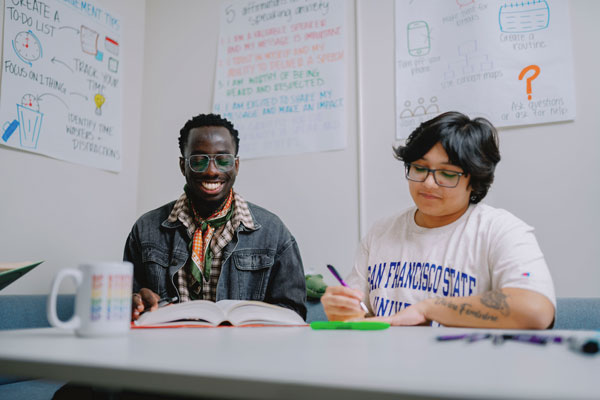
The Tutoring and Academic Support Center (TASC) offers tutoring for most subjects with flexible options that meet students where they are, whether they need occasional help or ongoing support, in person or online, scheduled in advance or drop-in. Please encourage students to take advantage of our free, high-impact academic support services, as faculty and staff referrals are a key component to student engagement.
This semester, TASC expands offerings with academic success coaching. Peer coaches work with students on time management, planning, studying for exams, note taking, goal setting and effective use of tools like Canvas and Navigate. TASC help students build long-term habits that promote persistence and confidence in school and beyond.
TASC also offers a new Learning Lab, which is a welcoming, structured space where students can drop in to study and get support from on-site writing and math tutors.
Career and Leadership Development (CLD) is excited to share several updates and opportunities to support our students’ career readiness this semester.
New career platform
CLD introduces Hiration, its AI-powered career development platform available to all SFSU students and alumni. Hiration offers:
- AI resume building
- Instant resume reviews
- Tips to tailor the resume to the job description
- Cover letter generation
- LinkedIn profile optimization
- Virtual mock interview practice with feedback
Career fairs
- Part-Time Job Fair: Thursday, Feb. 19, noon – 3 p.m., Cesar Chavez Student Center, plaza level
- Career and Internship Fair: Thursday, March 5, noon – 3 p.m., Mashouf Wellness Center, Mac Gym
Request classroom, department presentations
CLD accepts requests for classroom, department and staff presentations. Its team can provide customized sessions on career topics such as career exploration and decision-making, resume and cover letter development, internship and job search strategies and utilizing Hiration and other CLD resources.
To schedule a presentation for your students or department, please fill out the request form via Microsoft Forms or email the CLD office at career@sfsu.edu.
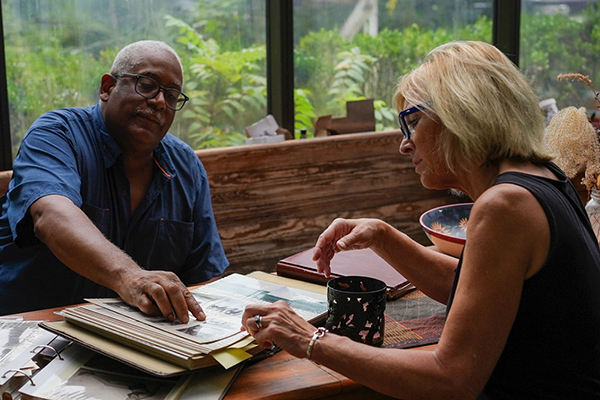
More than four decades after studying at SFSU, documentary filmmaker and producer Maggie Stogner (B.A., ’79) is still telling urgent environmental stories. This month, her documentary about water justice, “Upstream, Downriver,” will be screened at the Wild and Scenic Film Festival in Nevada City, a five-day festival (Feb. 19 – 23) that celebrates environmental activism and nature in film. For those who can’t make the trek to Nevada City, her film is available to stream through Kanopy.
Stogner’s film commemorates the 50th anniversary of the Clean Water Act. It documents the work of community activists across the country fighting for water justice. This is one of several films she created while serving as the executive director for the Center for Environmental Filmmaking at American University in Washington, D.C., where she also teaches.
Her interest in conservation dates to her childhood in Berkeley. Her parents were activists, especially for clean water. Her mom, whom Stogner calls a “water warrior,” would speak out at city council meetings. Her parents even pulled her and her sister out of school for a week so the family could help wildlife injured in the 1971 San Francisco Standard Oil spill. The cries of the injured birds are still ingrained in Stogner’s memory.
“This was the first time I realized how fragile nature was, and I don’t think I could articulate it at that age,” she said. “That’s why I make these films, because [nature is] fragile, and we as humans have a stewardship responsibility to take care of our beautiful planet.”
It was also around this time that she developed an interest in photography. After Stogner transferred to SFSU, that passion spilled over into film. “The courses that I took at SFSU helped me see film in a larger light,” she said. “That got me thinking in a different direction, beyond photojournalism, that documentary storytelling can really change minds and hearts.”
A few years after graduating, Stogner pursued documentary film more seriously, enrolling in Stanford University’s documentary film program. After earning her graduate degree, she worked as a freelance film editor and pursued independent projects, then was hired by Apple Computer to create videos in its communications group. Later she launched a multimedia company in Oregon.
In 1995, she received a call from a film school friend working at National Geographic TV & Film about an opportunity for the summer. She couldn’t say no to National Geographic. So, she moved to D.C. with her family. The summer contract turned into ten years on staff at National Geographic where she traveled around the world making films and supervising many of NatGeo’s expedition films.
Working for National Geographic was truly a dream job, she says. When she applied to the graduate program at Stanford University, she was asked where she saw herself in five years. Her reply at the time: “I want to work with Jane Goodall and Jacques Cousteau!” Her dream quickly came true: One of her first projects at National Geographic was with Goodall.
Stogner left National Geographic to start her own documentary film production company, Blue Bear Films. She worked on many large world-traveling museum exhibitions from King Tut with NatGeo to Roads of Arabia with the Smithsonian, to the Real World of Archaeology with LucasFilms, as well as other projects.
When COVID hit, she returned to her roots — environmental activism and filmmaking. She became the executive director for the Center for Environmental Filmmaking at American University, as well as a tenured professor of Film and Media Arts. She’s currently working on a spinoff of her film: short profiles for the upcoming “Upstream, Downriver YouTube Channel”. In a full-circle way, these will feature women water activists (or “Women Water Warriors”) to reach an expanded audience. Though documentary filmmaking has its uncertainties, she remains deeply committed to the field.
“Documentary, it’s not an easy path. The funding is always difficult,” she said. “But I really, really enjoy the people I meet. They’re passionate, and they’re trying to make a difference in the world. It inspires me every day.”
More information about the School of Cinema can be found online.
The Vista Room, the sit-down service training restaurant, is open Thursdays only for lunch at 11:45 a.m. To make your reservation, please email the Vista Room at vista@sfsu.edu.

SFSU departments and programs interested in participating in Giving Day still have time to sign up. Registration has been extended through Wednesday, Feb. 18. Once registered, teams will receive training and next steps to prepare for the event. Giving Day will be held on Wednesday, March 18.
Please register for Giving Day via Qualtrics. For questions, please email the Giving Day team at givingday@sfsu.edu.
Applications are open for the Climate Action Fellowship, a paid opportunity for undergraduate and graduate students from all majors to develop and lead climate- and climate justice-focused projects. Fellows receive $10,000. Projects can include creative work, research, education, outreach or community-based efforts.
For more information or questions, please email the fellowship team at climate.action.fellowship@sfsu.edu.
Associated Students (AS) accepts candidacy filings for the 2026 AS Board of Directors elections. The AS Board of Directors is composed of student leaders elected by their peers to advocate for student needs, shape campus priorities and oversee a multimillion-dollar nonprofit organization that serves the SFSU community.
This is an opportunity for students who already lead, organize and advocate for change, whether in student organizations, academic programs, cultural communities or campus initiatives, to deepen their impact. Serving on the AS board builds real-world experience in governance, budgeting, policy development and collaborative leadership, while centering student voices in institutional decision-making.
The filing period is through Thursday, Feb. 26.
Faculty and staff play a critical role in encouraging student leadership. If you work with students who demonstrate integrity, initiative and a commitment to improving campus life, please consider sharing the candidacy-filing link with them and encouraging them to run. Your encouragement can help ensure the board reflects the diversity, talent and values of our student body.
The SFSU Academic Senate met on Tuesday, Feb. 10, via Zoom.
The Senate:
- Presented the following informational item:
- Fall 2025 Academic Senate Official Actions
- Passed the following items:
- Senate Bylaws Update
- B.A. in Chinese, Integrated Teacher Education Preparation: name change, revision of suspended program
- Certificate in Multilingual and Psychology Competencies: new program
- Certificate in Multilingual and Public Health Competencies: new program
- Heard in first reading:
- Graduation Requirements for Baccalaureate Students, No. S25-309
- Certificate in Conflict Transformation
- Graduate Certificate in Cybersecurity
- Graduate Certificate in Digital Learning Design
- Master of Arts in Family and Consumer Sciences
- Faculty Initiate Tenure Line Transfer
- Administration and Processing of Student Course Feedback Forms, No. S22-213
- Heard in first reading motions to rescind existing policies:
- Oral/Written Comprehensive Examinations Policy, No. S85-127
- Policy on Administrative Placement of Interschool Programs, No. S85-129
- Policy on Intersegmental Cooperation between SFSU and Community College Programs, No. F91-172
- Held Executive Committee at-large member election:
- Senator Robert Bonner, associate professor, Management, Lam Family College of Business
- Heard presentations from:
- Rob Collins and Dipendra Sinha, Academic Senate of the CSU update
The “AI Literacy Essentials: Critical Analysis of Generative AI” course explores the critical analysis of generative artificial intelligence (AI) to support responsible use of this technology. It will be held Tuesday, Feb. 17, 2 – 3 p.m., via Zoom.
Learn how AI models are trained and why misinformation and biases may occur in AI-generated content. Develop strategies to analyze AI outputs and assess AI tools for quality and ethical considerations. Participants will be expected to engage in the evaluation process through collaborative, hands-on activities and reflective discussions.
This course is an elective that counts toward receiving a digital badge for the AI Literacy Education Program.
Acknowledging the uncertainty around what is happening in the campus community and the world around us, and the sense of loss due to the campus contraction, the Center for Equity and Excellence in Teaching and Learning (CEETL) invite you to come together in this space to share and connect with others. Join on Thursday, Feb. 19, 12:30 – 1:30 p.m., via Zoom.
What are some strategies that help you take care of yourself and find energy in this work? What are some ways in which CEETL and the campus can better support you?
Join SFSU alumni for “ThursDates” at the Oakland Museum of California on Thursday, Feb. 19, 5:30 – 8 p.m. This adults-only event includes live figure drawing sessions, a Black history-themed trivia competition and conversations with museum facilitators throughout the galleries, including in the “Black Spaces: Reclaim and Remain” special exhibit closing this month.
Please RSVP via the Alumni Association website for the “ThursDates” event. For questions, please email Nereida Moussa at nmoussa@sfsu.edu.
Human Resources offers a presentation on Friday, Feb. 20, 11 a.m. – noon, via Zoom on neurodiversity, describing differences in how people learn and process information.
People with autism, attention deficit/hyperactivity disorder, dyslexia, obsessive compulsive disorder and other learning differences are considered neurodiverse. This session will focus on supporting these employees and helping them thrive. Content includes the definition and importance of neurodiversity, benefits of a neurodiverse workplace and challenges to understand neurodiversity traits, communication strategies with neurodivergent employees.
This event is offered from LifeMatters, our employee assistance program.
Please RSVP for “Neurodiversity in the Workplace” via Qualtrics.
The Digital Media Studio and MakerSpace hosts a “3D Printing 101” event on Friday, Feb. 20, 1 – 2 p.m., in Library 260. It is open to all SFSU students, faculty and staff.
Learn the basics of 3D printing and 3D modeling, from design in TinkerCAD to operating the Ultimaker 3 and Ultimaker S5 printers.
An RSVP is required. Please RSVP for “3D Printing 101” via the Academic Technology website.
Curated by School of Art faculty member Lorena Molina, the “slow burn” exhibition centers how Black, Indigenous and People of Color (BIPOC) artists use slowness as a form of refusal and a way to highlight the systems of oppression that structure their lives. Rather than treating time as neutral, the exhibition frames it as a political structure forged by histories of displacement, control and erasure. In doing so, slow burn opens space to listen, to grieve, to be intimate, and to advocate for opacity and temporal self-determination.
Participating artists are Mara Duvra, Tesora Garcia, Maria Gaspar, Tianzong Jiang, Ana Mendieta, Joshua Moreno and Elaine T. Nguyen.
This exhibit will run through Saturday, April 4. Regular hours are Tuesdays – Thursdays, noon – 4 p.m., and Saturdays, Feb. 21 and April 4, 1 – 3 p.m., for receptions. Admission is free.
For more information, please email the Fine Arts Gallery at fineartsgallery@sfsu.edu or call (415) 338-6942.
Faculty and graduate teaching assistants are invited to the Center for Equity and Excellence in Teaching and Learning’s (CEETL) Q&A workshop, “Back to the Basics of Gen AI,” with computer scientist Dragutin Petkovic on Tuesday, Feb. 24, 1 – 2 p.m., via Zoom.
Ever wondered why chatbots give different answers to the same questions? Or why your custom GPT doesn’t always work the way you designed it? Curious whether artificial intelligence (AI) will keep improving or whether, as some scientists are now saying, it has reached its limits? Wondering what agentic AI is and how it differs from large-language model technology?
Please register for “Back to the Basics of Gen AI” via Qualtrics.
National TRIO Celebration Week at SF State will run Monday, Feb. 23 – Thursday, Feb. 26, to commemorate 40 years of TRIO Day’s inception by Congress, celebrated since 1986. This is a call for attention to the needs, aspirations and extraordinary potential of students from low-income, first-generation backgrounds and/or students with a disability seeking to improve their lives through education.
The campus community is invited to the National TRIO Day 40th Anniversary Celebration and Resource Fair with campus partners, community resources and TRIO programs on Feb. 23, noon – 2 p.m., in Library 121. Learn more about TRIO and its impact at SFSU, which has a legacy of advocacy, access and student success. Cake and other refreshments will be served.
TRIO comprises eight federal programs in middle schools through higher education and community service organizations nationally. Its goal is to increase access, retention and graduation of students who are first-generation, low-income and/or students with a disability. TRIO programs began in 1964 and provide opportunities for those with potential who lack resources to prepare for, and succeed in, higher education.
There are two TRIO programs on campus: Student Support Services TRIO in Educational Opportunity and Pathway Programs and SOAR TRIO in the College of Health & Social Sciences. Student Support Services-TRIO has supported students since 1997, providing holistic academic, personal and professional support throughout their college journey. Similarly, SOAR joined in 2015, expanding TRIO’s reach to support first-year and transfer students in health and social science majors in the college. Together and without duplicating services, both programs serve over 300 SFSU students each academic year.
Please RSVP via Qualtrics for National TRIO Celebration Week.
The campus community is invited to join the Africana Studies Department to welcome special guest author Dorsey Nunn on Wednesday, Feb. 25, 12:15 – 2 p.m., in the University Club, Cesar Chavez Student Center. Bring your own lunch. Africana Studies Lecturer Dave “Davey D” Cook will moderate the event.
Nunn is an advocate of restorative justice and the legal system. In his book “What Kind of Bird Can’t Fly,” he explores the realities of life after long-term incarceration, transformation and advocacy. He is leading a major push to remove involuntary servitude from the California Constitution.
This event is co-sponsored by Project Rebound.
Undergraduates exploring careers in medicine, dentistry, pharmacy, nursing, clinical laboratory science and other health professions now have a centralized resource for guidance on health careers, prerequisites, and applying. Pre-Health Advising offers workshops via Zoom, planning tools and support for the application process. Faculty and staff are encouraged to refer students to complete the online form to identify themselves as Pre-Health. Students can meet with any adviser at the Undergraduate Advising Center for one-on-one support in planning their Pre-Health pathway.
Upcoming workshops:
- Pre-Nursing Academic Planning Workshops: Thursday, Feb. 26, and Monday, March 2, 3:30 – 5 p.m.
- Pre-Health Career Exploration Workshop: Wednesday, March 11: 1 – 2 p.m.
- Pre-Health Application Readiness Workshop: Tuesday, March 17: 1 – 2 p.m., and 4 – 5 p.m.
- Pre-Health Academic Planning Workshop: Thursday, April 2: 9 – 10 a.m.
The Department of Philosophy is thrilled to host Professor John Sullins, a leading scholar in the philosophy of artificial intelligence (AI) and information technology, as part of the Department of Philosophy’s Chin-Plaisance Colloquia Series.
Sullins will discuss “Artificial Wisdom: What Role Does Philosophical Wisdom Play in a World of AI?” on Thursday, Feb. 26, 4 – 6 p.m., in Humanities 587.
Sullins is a widely recognized voice in AI ethics, responsible technology and the philosophical implications of emerging technologies. His work bridges philosophy, computer science and public policy, speaking directly to the urgent questions many of us are now facing across disciplines.
This is a public, cross-campus event, and the Department of Philosophy is delighted to welcome faculty, students, and staff from across the University. A light reception will follow the talk, offering time for conversation and connection.
Human Resources invites you to a live webinar to learn how and why to create your 401(k) or 457(b) with Savings Plus to complement your 2026 financial goals with payroll-deduction savings. It will be held Friday, Feb. 27, 2 – 3 p.m.
Working side-by-side with your CalPERS pension, you can contribute at least $25 a month from each paycheck to “set it and forget it” and save toward your goals. Which plan is best for you? How to enroll? What are qualified withdrawals? How does it affect taxes? Topics include differences between the 401k, 403b and 457b; contributing pre-tax versus Roth IRA; how to direct your investments; and more.
Please RSVP for “Nearing Retirement with Savings Plus” via Microsoft Teams.
SFSU Spotlight
The Office of Research and Sponsored Programs (ORSP) congratulates faculty members and others for their recent grant awards.
Nicole Bolter, professor of Kinesiology: $25,708 from Giants Community Fund for “Junior Giants Program Evaluation 2025 – 2026.” This project focuses on evaluating two sport-based youth development programs run by the Giants Community Fund. The work centers on data analysis and manuscript production of quantitative and qualitative data.
Eileen Gonzales, assistant professor of Physics and Astronomy: $150,000 from NASA for “A Symphony of Silicates: Quantifying Silicate Feature Diversity Across Age, Metallicity and Composition.” This is a detailed examination of exoplanet analogs to understand the impact of age, metallicity and composition.
JingJing Qiu, associate professor of Chemistry: $25,000 from The Camille and Henry Dreyfus Foundation for “Jean Dreyfus Lectureship for Undergraduate Institutions.” This lectureship will bring a chemical science leader to SFSU to engage with faculty and students on a two-day visit.
Ravinder Seghal, professor of Biology: $60,000 from Flora Family Foundation for “Impact of Deforestation on African Birds.” The purpose of the project is to conduct field research in Cameroon on how deforestation and palm-oil expansion impact bird diseases, mosquito vectors and biodiversity. Funds will also be used to train local students in conservation science.
Matthew Ferner, director of the San Francisco Bay National Estuarine Research Reserve: $48,076 from Association of Bay Area Governments/Environmental Protection Agency for “Wetlands Regional Monitoring Program Synthesis Consulting.” This project supports the San Francisco Estuary Partnership and Wetlands Regional Monitoring Program to synthesize data on estuarine stewardship, restoration and public engagement.
Elaine Musselman, professor of Nursing: $50,000 from Becton, Dickinson and Co. for “Bioscience Nursing Fellowships 2026.” This funding is designed to support nontuition costs incurred by students in the entry-level master’s Nursing program. Support will be through needs-based fellowship awards.
Professor Marc Dollinger, the Richard and Rhoda Goldman Chair in Jewish Studies and Social Responsibility, is interviewed in the new PBS documentary series “Black and Jewish America: An Interwoven History.”
During the first episode, Dollinger discusses the protections of religious freedom in the U.S. Constitution.
“There was a notion that on the first day of the United States, Jews would be able to be full and complete and active citizens of the new country in a way that, for more than 1,000 years in Europe, they never could,” he said.
Assistant Professor of Cinema Mihaela Mihailova appeared on the “Fantasy/Animation” podcast, discussing her research on the impact of generative artificial intelligence (AI) on the animation and visual effects industry. The episode was recorded during the annual Society for Animation Studies conference in London.
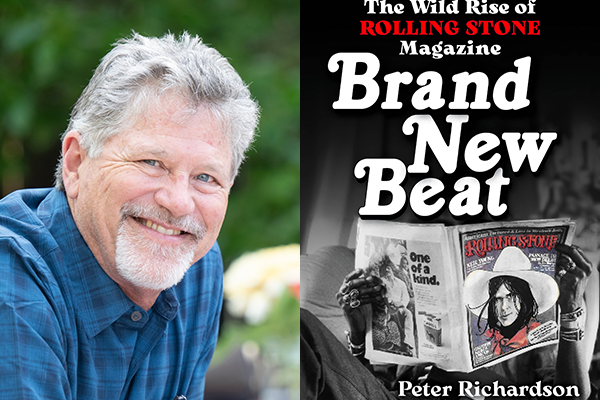
Peter Richardson, former lecturer faculty of Humanities, is the author of “Brand New Beat: The Wild Rise of Rolling Stone Magazine” (University of California Press). The book charts the origins and evolution of the iconic magazine through its formative early years in San Francisco.
Highlighting the magazine’s early and often overlooked reporting, its blockbuster stories, trailblazing writers and their seminal interviews with subjects ranging from John Lennon to Bob Dylan, Richardson reveals how Rolling Stone managed to reach beyond music to delve into the tempestuous culture and politics of its time.