News and Announcements
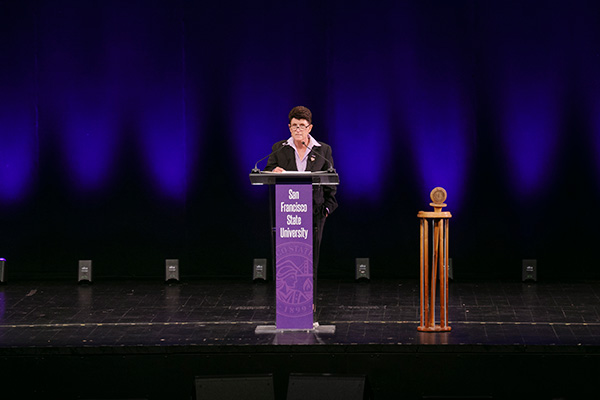
SFSU is heading into the 2026 – 2027 academic year with new momentum and a continued commitment to helping students turn their education into opportunity.
“We have wind in our sails,” President Lynn Mahoney told faculty and staff gathered Aug. 20 for SFSU’s annual Opening Convocation in McKenna Theatre. The traditional ceremony brings the University community together to mark the beginning of each academic year.
This fall, the University is anticipating 6,000 new students, with sizable increases among first-year, transfer and graduate students — about 700 more students, 10% more than last year.
Mahoney said the growth creates an opportunity to build on SFSU’s strengths as a destination for students seeking an accessible education in one of the world’s most dynamic cities.
“Our intensive strategic enrollment planning and the city’s growing reputation have combined to shift the tides and provide an opportunity to once again envision SFSU as a destination campus,” said Mahoney.
That momentum, Mahoney said, brings a renewed focus on not only bringing students to SFSU but also preparing them to thrive after graduation.
“Our commitment, here at SF State, to access and upward mobility is deep. As the world around us changes, we will continue to evolve our work to ensure that students have access to career and graduate school pipelines that lead to rewarding careers,” she said. “As part of our student success work, we will prioritize post-collegiate outcomes. This is about infusing what we do well with what will help students when they leave us.”
Other speakers included California Faculty Association chapter President Brad Erickson, CSU Employees Union SFSU Organizing Chair Matt Itelson, Staff Council Chair Mirna Vasquez and Provost and Vice President of Academic Affairs Amy Sueyoshi. Administrators welcomed the six new tenure-track faculty members joining SFSU this year.
Convocation also featured an awards ceremony honoring distinguished faculty and staff:
- Excellence in Service (Staff): Anarose Flores Schelstrate. For nearly 30 years, Schelstrate has been a cornerstone of the Department of Equity, Leadership Studies and Instructional Technologies, providing critical administrative leadership and continuity across multiple academic programs.
- Excellence in Teaching (Lecturer): Jonathon Whooley. Whooley has taught in SFSU’s Department of International Relations since 2014, offering courses across multiple modalities in international relations, foreign policy, security, cyber conflict, gender and criminal justice.
- Excellence in Teaching (Tenured): Laura Moorhead. An associate professor of Journalism, Moorhead bridges professional practice, scholarly inquiry and meaningful community engagement in her teaching. She pioneered a peer-led Supplemental Instruction program that has helped students succeed in a challenging gateway reporting course while fostering a supportive, collaborative culture.
- Excellence in Professional Achievement (Tenured): Zhaoshuo Jiang. A professor of Civil Engineering, Jiang focuses his research on structural vibration, smart infrastructure, artificial intelligence, human-health monitoring and data-driven building design. He has authored more than 100 peer-reviewed publications, holds two patents and has secured approximately $5.7 million in research funding.
- Excellence in Service (Tenured): Mai-Nhung Le, chair and professor of the Asian American Studies Department. Le’s leadership has spanned the department, college, university, CSU system and broader community. She has served in key roles, including chair of Asian American Studies, assistant dean, interim associate dean and executive director of AA CARES.
Jackson Wilson, chair of the Academic Senate, closed Convocation by encouraging the SFSU community to stay connected to the work of the Academic Senate so that we can all “continue to support the lives of our students, faculty, staff, administrators and community members as we continue to write our own story.”
Visit the Academic Senate website to learn more about this year’s Opening Convocation.
Photo by Juan Montes
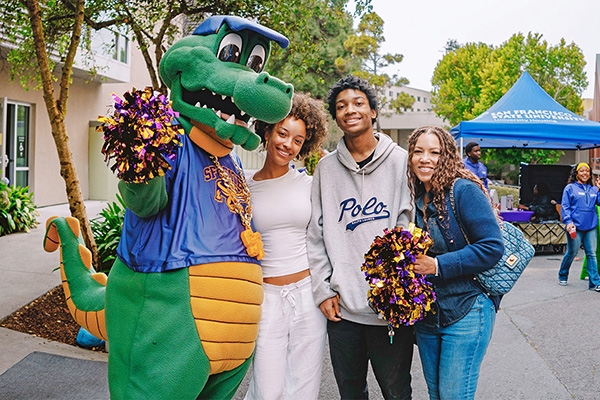
Few times of year bring as much energy to campus as August, when students return and move-in marks the start of a new academic year. On Aug. 18 and 19, approximately 4,200 students moved into SFSU’s seven residential communities.
In true San Francisco fashion, the city’s famed “Karl the Fog” brought overcast skies and cool temperatures as Alli Gator welcomed students to campus — a bonus as far as some students were concerned.
“I really like the city. I want to be closer to it,” said Public Health major Nicholas Kobe Cruz. “And in general, the weather does play a big factor for me. As much as I love sunny San Diego, I just wanted a more cooling and relaxing weather.”
This year, first-time freshmen and juniors each account for approximately 27% of residents, followed by sophomores, seniors and other students. Thirty-four percent of residents are from the Bay Area. Another 55% come from elsewhere in California, with students from other states and countries bringing the total from outside the Bay Area to 66%.
First-year Engineering student Gabriel Barrientos came up from Los Angeles — like Cruz, he wanted a change in weather — but added that he has a mix of emotions. “I’m more excited for my classes to begin,” he said. “But I’m also nervous about meeting new people. I want to meet new people but I feel like it’s not my specialty.”
But SFSU and the housing communities are here to help students navigate this life transition. Community is a large part of on-campus living, according to student surveys: 77% of students feel a strong sense of belonging, and 81% find peers who shared common interests.
“I really just want to branch out and find myself as a young adult,” said Brittany Lopez, a Nursing student from Hayward.
“Move-in is more than the start of the new semester. It’s the moment the campus community comes to life,” said Jeny Patiño, associate vice president of Housing, Dining and Conference Services. “From the moment students arrive, our goal is to create a welcoming community where they feel a sense of belonging, make meaningful connections and get excited about the experiences and opportunities ahead of them at SFSU.”
Next up? Classes begin this week, and the annual GatorFest campus welcome events are also gearing up to start. It includes several months of festivities across campus that help students connect with their peers, explore campus and San Francisco and have fun.
Learn more about housing at SFSU.
Photo by Juan Montes
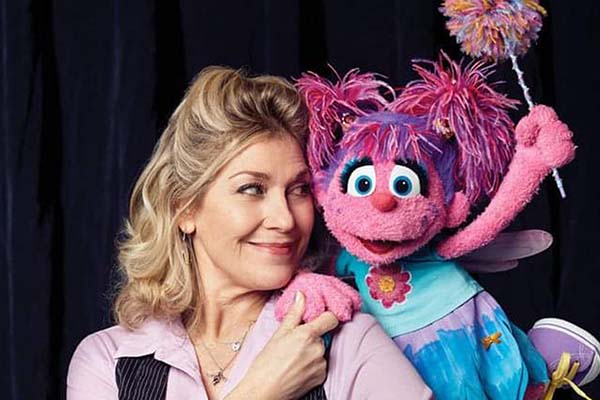
Twenty years ago, Leslie Carrara-Rudolph (B.A., ’87) auditioned for the role of the newest character on “Sesame Street,” Abby Cadabby, a pink, wish-granting fairy with dragonfly wings and a big, open heart. The moment Carrara-Rudolph tried on the puppet, she says, she felt a magnetic pull, as if she were destined to play Abby. She landed the role — and three Emmys — and, two decades later, has become one of the show’s most beloved characters.
But the road to “Sesame Street” was long and winding. There were stops at “Muppets Tonight,” Disney, “Beach Blanket Babylon” and her own theatrical productions. But her real origin story began at SFSU.
As a child, Carrara-Rudolph struggled in school, particularly with reading. She always knew she wanted to work with children but wasn’t quite sure in what capacity. Teaching in a school setting was out of the question because of her learning differences, she says. “It would take me a year to finish reading a book I assigned,” she said.
At the recommendation of an SFSU counselor, she cobbled together her own special major based on her interests. Her major, Child Development Through the Arts, combined courses in Psychology, Child and Adolescent Development, Parks and Recreation, Art, Theatre and Dance. At the time, she wrote her mother an uncannily prescient letter explaining her decision and the path she hoped to pursue.
“I foresee myself working in the community through the recreation departments and entertaining children on an individual basis — clowning. I love kids and I love performing,” she wrote. “Need I explain more? I hope to encourage kids to develop themselves in a creative way and bring a sparkle into their hearts.”
Carrara-Rudolph’s major combined everything that had brought her comfort as a child. The tragic death of her brother, who was killed in a motorcycle accident, cast a shadow over her family. She found peace and light through the Pleasant Hill Parks and Recreation Department programs and community theatre.
SFSU, classes such as “The Power of Play” and “Child Psychology” helped her better understand her target audience. In her courses, she designed programs for senior centers, children in hospitals and a preschool, and worked with at-risk children in foster care. “SFSU ensures you put your knowledge into practice,” she said.
After college, Carrara-Rudolph held several jobs — sometimes five at once. She was part of Kids on Camera, a San Francisco school that offered acting training for children; led parks and recreation programs; taught summer school; starred in the musical revue “Beach Blanket Babylon”; performed with Fantasy Forum Actors Ensemble; and waitressed.
Her first big break came when she was offered a job performing improv as different characters at Disney World. A few years later, she wrote a show called “Life in Other People’s Shoes,” which brought her to Los Angeles. Meanwhile, a friend suggested she audition for ABC’s “Muppets Tonight” because the show was looking for female comedians who could sing in character. It was a cattle-call audition, but she stood out and was hired as a puppeteer.
With no background in puppetry, she absorbed as much as she could from those around her and eventually fell in love with the art form. From 1996 to 1998, she played Spamela Hamderson and other characters. It was her biggest break yet, but when the show ended, she returned to catering.
There was a 10-year gap between “Muppets Tonight” and landing the role of Abby Cadabby on “Sesame Street.” In between, she developed pilots for Disney, had a role in “The Wubbulous World of Dr. Seuss” and worked on other programs. She also spent time creating her own puppets and shows.
When she auditioned for the new character Abby Cadabby in 2006, she riffed for 15 minutes with Fran Brill, who played the Muppet Zoe. “When I first saw the puppet and put her on, it was like something out of a comic book,” she said. “I was like, ‘You’re going to have to cut this off my arm.’” That’s all it took for executives to realize they had found their Abby. Fifteen minutes after leaving the studio, Carrara-Rudolph received a call telling her she got the role.
The past 20 years on “Sesame Street” have been quite a ride. She’s traveled to disaster zones after Hurricane Katrina, met Michelle Obama more than once, won a Sports Emmy for hosting during NBC Olympics in Paris and won two Children’s and Family Emmy Awards — in 2025 and 2026 — for Outstanding Puppetry Performance, among other honors.
And she gets to play a character she feels deeply connected to. “[Abby’s] an empath. ... She is having to learn to help people follow their hearts and find the magic in every day,” she said. “She’s always open, she’s always supportive, she’s always accepting.”
After all these years, she credits SFSU with leading her to her dream job. “They were willing to understand that everybody learns differently,” she said. Creating her own major gave her the confidence to try a path less traveled. “Had they not done that,” she said, “I probably wouldn’t have the permission slip [that] I give myself.” A permission slip that helped her find her way to “Sesame Street” (where the air is sweet).
The Academic Technology (AT) team provides information and resources to help students and instructors this fall, including new design tools for instructors in Canvas, artificial intelligence (AI) opportunities for students and creative tools in the Digital Media Studio and MakerSpace. AT continues to offer workshops, tutorials, and consultations to assist in working with technology and get help whenever you need it.
AT has resumed extended hours to support evening classes. Semester operating hours are Mondays – Thursdays, 8 a.m. – 8 p.m., and Fridays, 8 a.m. – 5 p.m. Visit AT in Library 80 or contact the team by phone at (415) 405-5555 or by email at at@sfsu.edu.
Would you be willing to let the study abroad team visit your class this semester for a 5 – 10-minute presentation about study abroad?
SF State Abroad wants students to know that studying abroad is possible if they are interested and the study abroad team is here to support them.
On SFSU Study Abroad Programs, students:
- Pay the same SFSU tuition while participating in our exchange programs.
- Use their financial aid.
- Enjoy a cost of living that is often less expensive than in San Francisco.
- Earn SFSU resident credit toward their degree.
The spring 2027 application deadline is Tuesday, Sept. 15. Students can learn more at the Study Abroad Fair on Tuesday, Sept. 8, and Wednesday, Sept. 9, 11 a.m. – 2 p.m., on the Quad.
The Center for Equity and Excellence in Teaching and Learning (CEETL)-organized faculty writing meetups provide opportunities for faculty to check in briefly about their writing and ample time to quietly work on individual writing projects. The meetups are scheduled for every first and third Tuesday (via Zoom and in Library 242) and every second and fourth Friday, 1 – 3 p.m. (via Zoom). The first meetup is Tuesday, Sept. 1, 1 – 3 p.m., in Library 242 and via Zoom. Snacks will be provided.
Participants who have attended in the past will receive a calendar invite. Please accept to indicate your continued interest. Let CEETL know if you’d like to be removed from the list.
To be added to the calendar invite, please sign up via Qualtrics for faculty writing meetups.
The Center for Equity and Excellence in Teaching and Learning (CEETL) invites faculty and tutors to participate in “What’s in a Name?”, a hands-on pronunciation workshop designed to help educators confidently and respectfully pronounce the names of their students and tutees. It will be held Wednesday, Sept. 2, noon – 1 p.m., in Library 242 (Zoom available on request). It is a Justice, Equity, Diversity and Inclusion (JEDI) workshop.
This interactive session will focus on names commonly found in Chinese, Hindi, Thai and Vietnamese languages. Participants are encouraged to bring their class rosters and practice name pronunciation with experienced language coaches Hana Arnold, Sudha Krishnamoorthy, Perry Udomwadhanaphorn and Trang Tran. Attendees will learn the sounds and pronunciation patterns of each language; gain familiarity with common male, female and non-binary given names; and develop confidence in pronouncing frequently used family names.
Led by Robert Kohls, associate professor of English Language and Literature, through the Pronunciation Awareness Project, this workshop offers a meaningful opportunity to foster a more inclusive, welcoming and equitable learning environment where every student's identity is acknowledged and respected.
Please register via Qualtrics using CEETL’s single registration link.
Professor Emeritus of History Abdiel Oñate passed away on July 30. Born and raised in Mexico, Oñate was a specialist in Latin American history, including the Caribbean.
At SFSU, where he began teaching in 1986, he became the first director of the Latin American Area Studies program and also served as a Social Sciences/History Teaching Credential adviser.
Oñate’s Ph.D. was from El Colegio de Mexico, Universidad Autonoma de Mexico, in 1985; he had received a diploma in history from the University of East Anglia (Great Britain) in 1975. His B.A. was in Economics, from the National University of Mexico in 1971. His teaching and publications reflected his broad and well-informed perspective on local, national and international history, politics and economy. His books, “Razones de estado: estudios sobre la formación del estado mexicano moderno” (Raison d’état: Studies on the Formation of the Modern Mexican State, Plaza y Valdés Editores, 2006) and “Banqueros y hacendados. La quimera de la modernización en Mexico (Bankers and Landowners: The Chimera of Modernization in Mexico)” (Universidad Autónoma Metropolitana Press, 1992), remain key texts in the field. His articles exploring the political, historical and economic ties and parallels between modern Latin America and Western countries, particularly Spain, France and Britain, appeared in journals and anthologies published in Mexico and the U.S. Until his passing, Oñate continued to be called upon to give guest lectures about his research.
As a member of the SFSU Academic Senate, Oñate was a strong defender of the principles of shared governance. He served on and often chaired all departmental committees and also took an active part in professional associations.
“Abdiel was a superb officemate,” History Professor Trevor Getz said. “I learned a great deal by listening to and witnessing the extraordinary patience with which he treated students who were facing difficulties, whether academic or in real life. He was an absolute gem of a human being.”
Professor Emerita of History Julyana Peard recalls: “Abdiel was really appreciated by his students. As a fellow Latin Americanist, I had many students who took Abdiel’s courses, and I was always hearing how much they learned in his classes. For me personally, he was an excellent colleague, who was very helpful and kind when I first joined the department. One of the things I most enjoyed about Abdiel was his hilarious sense of humor with a totally deadpan delivery.”
One of Oñate’s former students, Griselda Jarquin Wille, is now an assistant professor. “I credit my understanding of economics, Marxism and dependency theory to him,” she said. “I always mention him to my students whenever they ask how I came to be a Latin American historian.”
Oñate’s constant curiosity led to his having deep knowledge of many fields, from environmentalism to space exploration, and he remained a voracious reader and avant-garde thinker, with a keen wit, to his last day.
Professor Emerita of Art Whitney Chadwick, an accomplished academic and influential art historian who brought centuries of women artists full credit for what they had achieved, died on Aug. 6 in Berkeley. The cause of death was Alzheimer’s disease. Her husband of 38 years, the realist painter Robert Bechtle, preceded her in death in 2020.
Chadwick’s first major publication, “Women Artists and the Surrealist Movement,” published in 1985, explored the role of women, their partners and muses in the development of the surrealist movement, a cultural transformation that ultimately brought women artists into the limelight. Frida Kahlo, photographer Dora Marr, painters Leonora Carrington and Lee Miller were among the first to be accepted for their, then startling contributions to the art world.
After investigating the roles these and other women played in the arts, that world expanded with the publication of Whitney’s second major investigation, “Women, Art and Society.” Published in 1990, it quickly became the textbook of choice for many college-level courses in an area long ignored. Books, articles, catalogue essays, reviews and anthology chapters followed in profusion. A prolific researcher and writer, Chadwick teamed with numerous art historians and feminist scholars to investigate the contributions of women artists across the globe.
As a change of pace, Chadwick also wrote, in 1998, her only novel, “Framed,” a historical crime novel, published in London by Macmillan.
Having earned a Bachelor of Arts degree in Fine Art from Middlebury College in 1965, Chadwick went on to earn a Master of Art and a Ph.D. in Art History from the Pennsylvania State University in 1968 and 1975, respectively. Her doctoral dissertation, “Myth in Surrealistic Painting, 1929 – 1939: Dali, Ernst, Masson,” formed the basis for many of her subsequent explorations.
Her professional teaching career began at the Massachusetts Institute of Technology in 1972, as a lecturer, then assistant professor (1973 – 1977) and, finally, associate professor in 1978. A stint as visiting assistant professor of Art History at the University of California, Berkeley, in 1977, spurred a permanent relocation to California. In 1978 she joined the faculty at SFSU, with short periods at Stanford University, Williams College in Massachusetts and the University of Uppsala in Sweden, sparking a lifelong interest in and association with that country.
In 2003 she was awarded an honorary degree (Doctor Honoris Causa) by the University of Gothenburg in Sweden. Research grants and fellowships followed in abundance. She was a fellow at the Radcliffe Institute for Advanced Study at Harvard University (2011 – 2012); The Institute for Advanced Study in Arts, Literature and Theology at Uppsala University in 2006; The Sterling and Francine Clark Art Institute at Williams College (2002); and the Mary Ingraham Bunting Institute, Radcliffe College (1993). She received research grants from The Institute for Advanced Study in Arts, Literature and Theology at Uppsala University (Sweden); Ulster University in Belfast; the National Endowment for the Humanities; and the American Council of Learned Societies, among others. She also received a Lifetime Achievement Award from the National Women’s Caucus for Art in 2012. Other awards included an Award of Distinction from the National Council of Arts Administrators in 1999, and a Certificate of Honor for Outstanding Service to the People of the City and County of San Francisco in 1994.
Though born in the East, Chadwick came to love California’s Bay Area with all it had to offer. She and Bechtle enjoyed equally their summers in Westport Point, Massachusetts, where she wrote and Bechtle painted in a custom-built studio on the property, and they both sailed and entertained their Westport friends. Travel was important to both, and Chadwick especially covered swaths of Europe as part of her research gathering. She and Bechtle also spent time together in Greece, on the island of Paros.
She will be remembered for her intellect, her mentorship skills and her love of and ease at entertaining. A prolific researcher, writer and teacher, Chadwick death leaves the art world bereft of one of its most ground-breaking and prolific art historians.
Chadwick is survived by her sisters, Linda (and husband William Byrn) of Cambridge, Massachusetts, and Sara, of Middletown, Rhode Island, and her late husband’s children, Anne (and Kevin) Higgins of Sacramento and Max Bechtle and his wife Kara of Sonora. She also leaves four beloved grandchildren: Brendan, Aidan and Declan Higgins, and Allison Bechtle.
A celebration of Chadwick’s life will be held at a date and location to be announced.
SFSU Spotlight
The Office of Research and Sponsored Programs (ORSP) congratulates these faculty members and others for their recent grant awards.
Mojitaba Azadi, associate professor of Engineering: $200,000 from National Science Foundation for “ERI: Understanding the Fallopian Tube's Shape and Physical Environment to Improve Embryo Culture for Fertility Treatment.” This Engineering Research Initiation (ERI) project establishes a quantitative, model-ready foundation for studying human Fallopian tube (FT) biomechanics. Two integrated goals drive the work:
- processing of nine human FT micro-CT datasets to build the first finite-element–ready models and morphometry atlas of the FT and its lumen, including centerline tortuosity, cross-sectional area and perimeter, hydraulic diameter, minimum inscribed radius and fold statistics
- identification of critical time- and frequency-dependent mechanical properties of the FT mucosal surface using atomic force microscopy (AFM) with large spherical probes at cellular depths. The team will also train eight undergraduates in image analysis, computational morphometry, AFM experimentation and constitutive modeling.
The team will also train eight undergraduates in image analysis, computational morphometry, AFM experimentation, and constitutive modeling.
Kai Burrus, professor of Biology: $7,000 from San Francisco Rotary Foundation for “Planting Climate Resilience: SF Rotary and SFSU Climate HQ.” The goal of this work is to bring together SFSU students and Rotary Club members to do restoration work along the San Francisco Bay shoreline, including:
- a fall 2026 shoreline restoration service day at Baylands Nature Preserve in Menlo Park
- a spring 2027 shoreline restoration service day at Heron’s Head Park in Bayview-Hunters Point in San Francisco
- an indoor educational event at a San Francisco Rotary Club lunch meeting, coordinated with the Heron’s Head Park service day.
Stephanie Claussen, associate professor of Engineering: $8,000 from American Society for Engineering Education for “Equipping Columbian Engineering Students with Sociotechnical thinking for the UN Sustainable Development Goals.” In this engineering education project, Claussen works with Colombian collaborators to develop, disseminate and assess new sociotechnical teaching modules to integrate into introductory undergraduate electrical engineering courses. The instructional modules are focused on sociotechnical issues and contexts that are related to the United Nations sustainable development goals and relevant to Colombian students and professional engineers, including topics such as the circular economy for electronics and electrification in post‐conflict regions.
Maarten Golterman, professor of Physics and Astronomy: $49,820 subaward from Stanford/U.S. Department of Energy for “Dark Matter Science with the LDMX detector.” On this subaward with Stanford, a recent graduate from the Department of Physics and Astronomy, Layan Alsarayra, performs analysis and testing of a Trigger Scintillator subsystem for the Light Dark Matter eXperiment, in the group of Professor Lauren Tompkins at Stanford University. Using GEANT4-based simulations and data collected from the December 2025 test beam run at the SLAC National Accelerator Laboratory’s End Station A, she analyzes detector performance and compares measured and simulated results to demonstrate the detector’s ability to accurately reconstruct electrons.
Rama Kased, associate professor of Race and Resistance Studies: $10,000 from FirstGen Forward for “Metro Student Leadership.” Metro Student Leadership is an employment initiative that positions student employment as a high-impact practice for leadership development, identity affirmation, sense of belonging and long-term academic success. Alumni of the Metro College Success Program come back and serve as peer mentors and navigators to help first- and second-year students understand the college process, including registering, joining a club, picking courses and accessing other resources on campus.
Audrey Parangan-Smith, director of SF BUILD: $70,000 supplement from University of California, San Francisco (UCSF), for “SF BUILD Sustainability.” The SF BUILD partnership for workforce diversity between SFSU and UCSF was established through a 10-year National Institutes of Health grant that ended in 2024. SF BUILD aimed to eliminate structural barriers to success for historically excluded students while equipping these students with tools to combat toxic teaching and research environments. This work is ongoing and part of the SF BUILD Strategic Work Plan for Sustainability, which guides collective efforts to develop the cross-institutional infrastructure for systemically bridging SFSU and UCSF. The overall objective is to sustain, expand and evaluate SF BUILD programming with the goal of increasing opportunities for SFSU students and increasing workforce diversity at UCSF.
Kwok-Siong Teh, professor and chair of Engineering: $149,963 from CSU Northridge for “FUTURE STARS: Fostering Underrepresented Talent Using Real-World Experiences — STEAM Talent Academy for Resilient Success.” FUTURE STARS is a science, technology, engineering, art and math (STEAM) program to support first-generation students in achieving professional success through applied research, financial literacy and career and leadership development training.
Kwok-Siong Teh, professor and chair of Engineering: $80,000 supplement from the University of California Office of the President for “MESA Engineering Program FY 23 – 25.” The MESA University Program is a student success program aimed to support first-generation SFSU science, technology, engineering and mathematics (STEM) students with academic/peer mentoring, career counseling and leadership development opportunities to enable future career success.
SFSU VITA and the Beta Alpha Psi (BAP) chapter received the Internal Revenue Service (IRS) VITA Gold Destination Award at the 2026 BAP International Annual Meeting in Baltimore. The award recognizes VITA sites preparing 601 – 1,000 tax returns.
SFSU VITA completed its 19th year of service during the 2026 tax season. The recognition reflects the dedication of SFSU VITA student site coordinators, site managers and volunteers, as well as the continued support of faculty, staff, college leadership, alumni mentors, the IRS, United Way Bay Area and community partners.
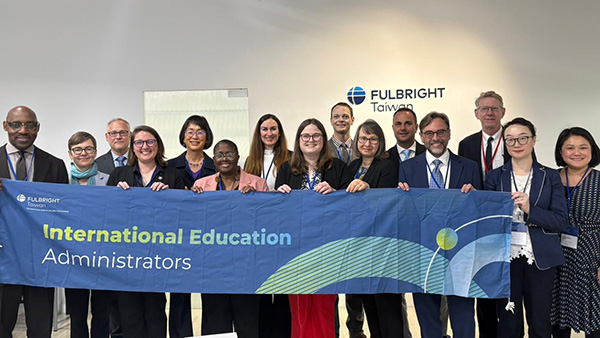
College of Ethnic Studies Dean Grace Yoo was selected for the Fulbright U.S.-Taiwan International Education Administrators (IEA) Seminar for 2026 – 2027.
The U.S.-Taiwan IEA Award is a competitive two-week grant program for U.S. higher education professionals and senior campus leaders. Administered by Fulbright Taiwan and the Foundation for Scholarly Exchange, it helps participants understand Taiwan’s higher education system to build institutional partnerships.
Fulbright IEA Awards are part of the Fulbright Scholar Program. These prestigious fellowships offer higher education administrators unique professional development opportunities to foster long-term connections that enrich their campuses, careers and communities.
Photo courtesy of Grace Yoo
Associate Professor of Journalism Kim Komenich won the 2026 Distinguished Teaching in Journalism Award from the Society of Professional Journalists.
“There is something so touching about seeing the passion a professor brings to the classroom every day, and that is something Kim has shown day in and day out. I do my best to emulate that exact fervor for photography and the world of news,” student Braelyn Furse said.
“Across every dimension of this award — teaching ability, contributions to journalism and journalism education, and dedication to professional excellence — Kim Komenich stands out as an extraordinary candidate. His career reflects not only individual achievement but a sustained and meaningful investment in the next generation of journalists,” Associate Professor of Journalism Laura Moorhead said.
Associate Professor of Creative Writing Michael David Lukas has written a new novel, “The Invisible Line.” It will be published by Penguin/Random House on April 6, 2027.
In this audacious historical novel, an American spy agrees to help the victors divide up the spoils of World War I by literally drawing the new borders of the Middle East — only to discover that the relic he holds has far greater power than he could have imagined.
Journalism Professor Cristina L. Azocar and Meta G. Carstarphen are the editors of “Indigenous Peoples and the Media” (University of Oklahoma Press). It was published on Aug. 4.
Azocar and Carstarphen build upon the 2012 book “American Indians and the Mass Media” with a brand-new volume to showcase the diversity and resilience of Indigenous storytelling in today’s media context. Together, their contributors — ranging from media scholars to Indigenous content creators —document experiences, analyze representations and provide a platform for a conversation about how mass media can lead consumers toward social justice.
International Relations Professor Amy Skonieczny has been selected to receive the Holsti Award of the International Studies Association (ISA). The Ole R. Holsti Distinguished Scholar Award is an annual honor given by the International Studies Association West region to recognize outstanding scholarship, teaching, mentorship and service in the field of international studies.
Skonieczny is also a 2026 recipient of the University’s Marcus Transformative Award.
A celebration of Skonieczny’s contributions to scholarship, service to supporting graduate and undergraduate students at SFSU, and recognition in the field of international relations will take place during the ISA-West Conference in Pasadena on Friday, Sept. 25.
On July 5, KQED-FM aired the fifth episode of “The Future of the Bay.” Students in Associate Professor Josh Davis’ spring 2026 course in Journalism/Broadcast and Electronic Communication Arts (BECA) 480: “Audio Journalism” produced this news magazine radio series.
This one-hour special reports on women-focused gyms, alternative therapies, prediction markets, nightlife and other stories that amplify diverse voices from all over the Bay Area.
SFSU students produced every second of this special report — from reporting to audio production and editing. The student journalists behind this work are: Bianca Sieraski, Lara Magdesian, Sasha Onadja, Derrick Wills, Giselle Garza Lerma, Gwen Murray, Grace Pastene, Cole Fowler, Gibran Beydoun, Lourence Alturino, Clarissa Delgado Barco, Alexa Luna, Angelique Persails, Alex Gomez, Steven Agrusa, Paul Singh, Jazlyn Wong, Gabe Janssen and Julian Olson.
In June, Professor and Co-Program Lead in Nutrition and Dietetics Gretchen George and Cal State San Marcos Professor Devan Romero served as guest lecturers at the Sant’Anna Institute in Sorrento, Italy, as part of its Human Nutrition course.
“It was a rewarding experience to engage with an international group of students and faculty, discussing interdisciplinary approaches to health education and exploring how nutrition, culture and public health intersect across different contexts,” George said. “This underscored the value of global perspectives in education and health promotion.”
The second edition of “Cambodian American Experiences: Histories, Communities, Cultures and Identities” by Asian American Studies Professor Jonathan H. X. Lee was recently published by Kendall Hunt Publishing Co.
First published in 2010, Lee’s book on Cambodian Americans remains the only comprehensive volume on the subject. The new edition features updated research, new material and revisions that better reflect the diversity of the Cambodian American experience.
Sandy Rosen, professor emerita of Special Education, won the Josephine L. Taylor Award from the Association for Education and Rehabilitation of the Blind and Visually Impaired. She joins the honorable list of SFSU faculty who have made tremendous contributions to the field of visual impairment and orientation and mobility. This is the highest award that exists in the field of visual impairment.